Global Temperature Anomalies from 1880 to 2025
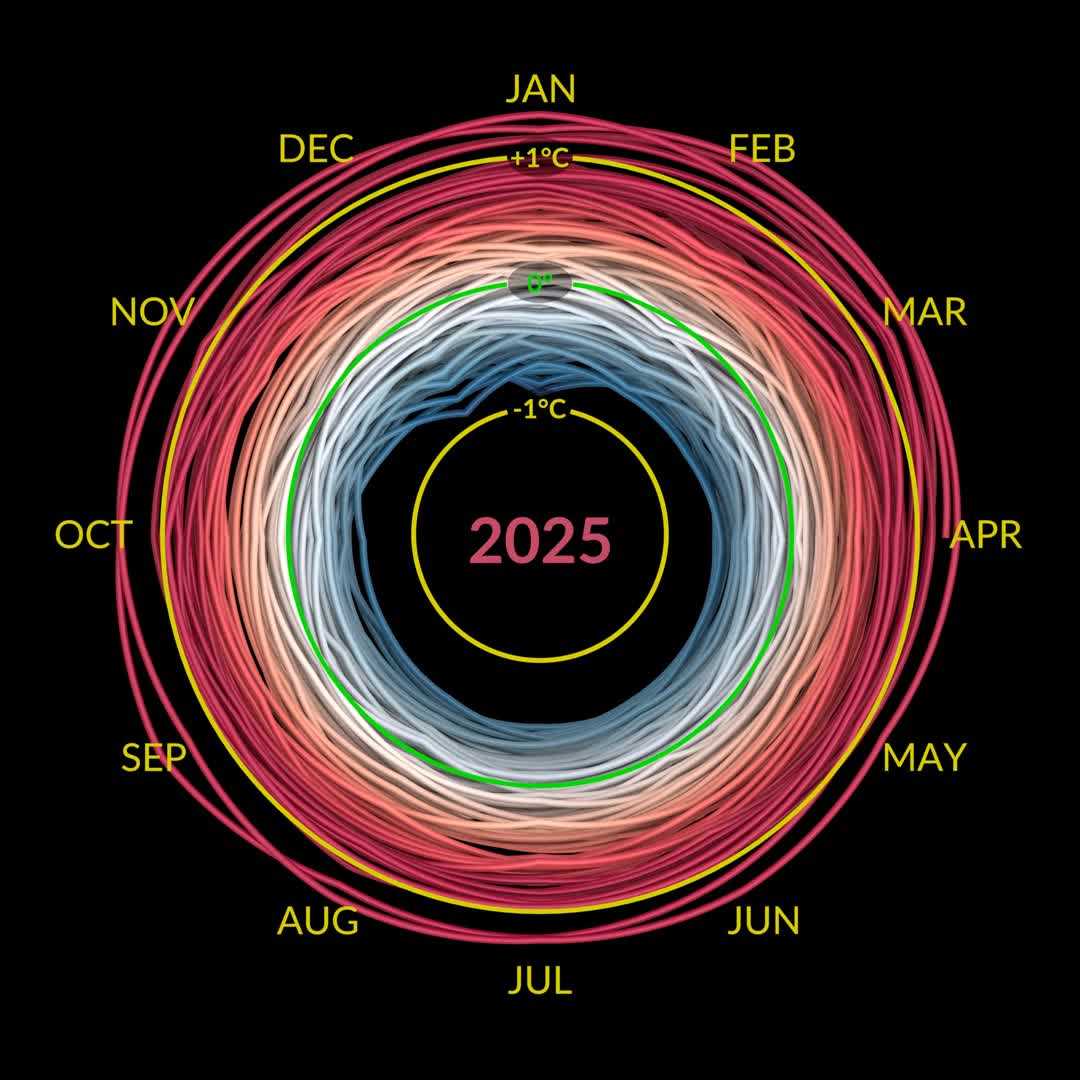
The GISS Surface Temperature Analysis version 4 (GISTEMP v4) is an estimate of global surface temperature change using current data from NOAA GHCN v4 (meteorological stations) and ERSST v5 (ocean areas).
NASA's full dataset of global surface temperatures as well as full details with code of how NASA scientists conducted the analysis, are publicly available from GISS. GISS is a NASA laboratory managed by the Earth Sciences Division of the agency's Goddard Space Flight Center in Greenbelt, Maryland. The laboratory is affiliated with Columbia University's Earth Institute and School of Engineering and Applied Science in New York.
Global Temperature Anomalies for 2025 (no smoothing)

2025 global surface air temperature anomalies. In this version, there is no spatial smoothing of the dataset. The map is in a Robinson projection. The colormap is "vik" from Crameri (2018).
Global air surface temperature anomalies for the year 2025 relative to a baseline period of 1951-1980.
2025 Global Temperature Anomalies (smoothed)
2025 global surface air temperature anomalies. In this version, the dataset is spatially smoothed. The map is in a Robinson projection. The colormap is "vik" from Crameri (2018).
2025 global surface air temperature anomalies relative to a baseline period of 1951 - 1980.
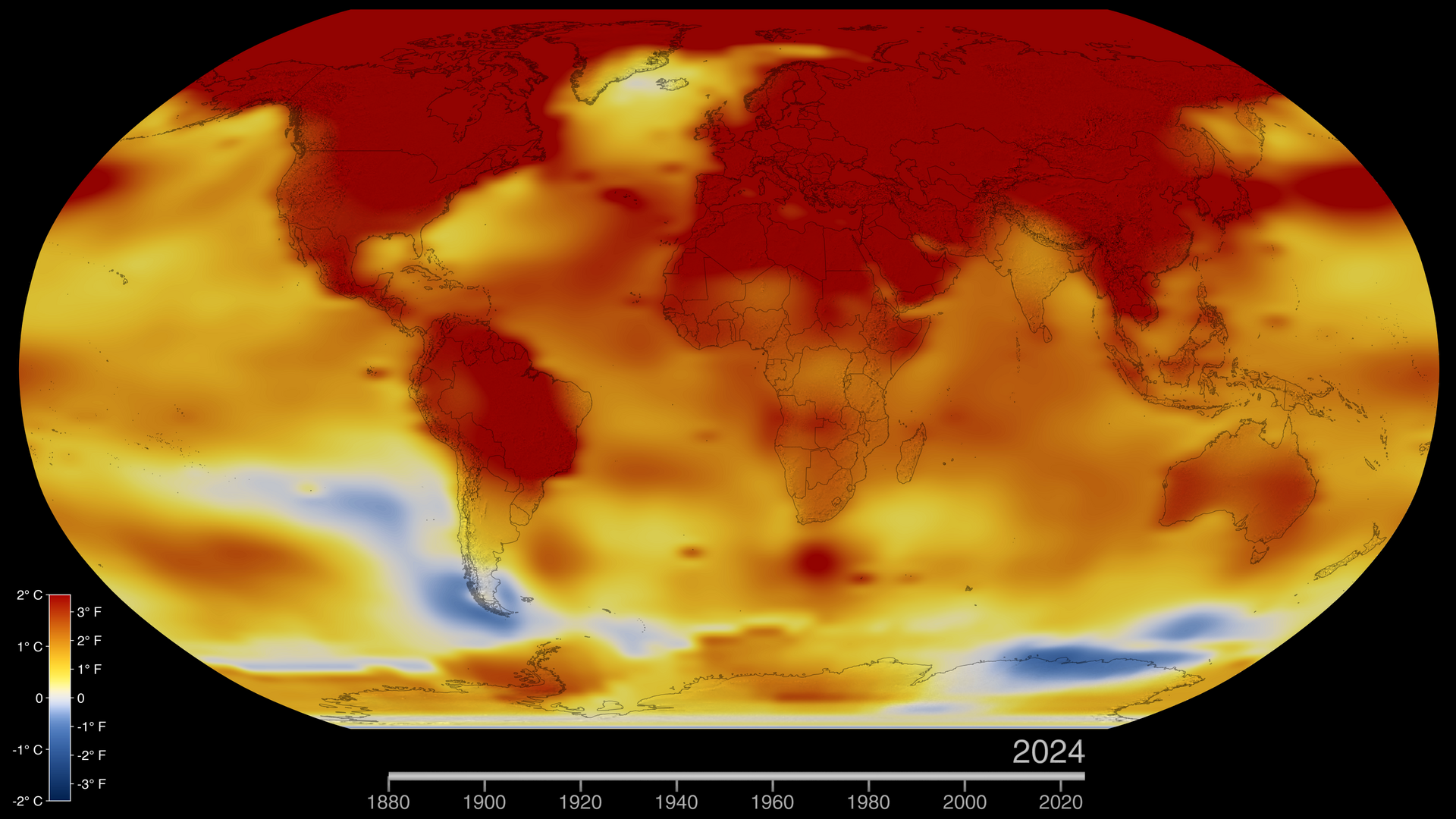
Global Temperature Anomalies from 1880 - 2025 (no smoothing)
2025 global surface air temperature anomalies. In this version, there is no spatial smoothing of the dataset. There is 12 months of temporal averaging. The time on the timeline coresponds to the midpoint of the smoothing window. The map is in a Robinson projection. The colormap is "vik" from Crameri (2018).
Global air surface temperature anomalies from 1880-2025 relative to a baseline period of 1951-1980.
Global Temperature Anomalies from 1880 - 2025 (smoothed)
2025 global surface air temperature anomalies. In this version, the dataset is spatially smoothed. There is 12 months of temporal averaging. The time on the timeline cooresponds to the midpoint of the smoothing window. The map is in a Robinson projection. The colormap is "vik" from Crameri (2018).
Global air surface temperature anomalies from 1880-2025 relative to a baseline period of 1951-1980.
Equirectangular and Science on a Sphere Content (unsmoothed)
2025 global surface air temperature anamalies. In this version, there is no spatial smoothing of the dataset. There is 12 months of temporal averaging. The time on the timeline corresponds to the midpoint of the smoothing window. The map is in a Robinson projection. The colormap is "vik" from Crameri (2018).
Global air surface temperature anomalies from 1880-2025 relative to a baseline period of 1951-1980. The downloads from this interactive sphere include the map in an equirectangular format for use in applications such at NOAA's Science On a Sphere and digital planetaria software.
Credits
Please give credit for this item to:
NASA's Scientific Visualization Studio
Data provided by Robert B. Schmunk (NASA/GSFC GISS)
-
Scientists
-
Gavin A. Schmidt
(NASA/GSFC GISS)

-
Robert B Schmunk
(SIGMA Space Partners, LLC.)
-
Reto A. Ruedy
(SIGMA Space Partners, LLC.)
-
Gavin A. Schmidt
(NASA/GSFC GISS)
-
Public affairs officer
-
Peter H. Jacobs
(NASA/GSFC)
-
Peter H. Jacobs
(NASA/GSFC)
-
Visualizer
-
Mark SubbaRao
(NASA/GSFC)
-
Mark SubbaRao
(NASA/GSFC)
Series
This page can be found in the following series:Datasets used
-
GISTEMP [GISS Surface Temperature Analysis (GISTEMP)]
ID: 585The GISS Surface Temperature Analysis version 4 (GISTEMP v4) is an estimate of global surface temperature change. Graphs and tables are updated around the middle of every month using current data files from NOAA GHCN v4 (meteorological stations) and ERSST v5 (ocean areas), combined as described in our publications Hansen et al. (2010), Lenssen et al. (2019), and Lenssen et al. (2024).
Credit: Lenssen, N., G.A. Schmidt, M. Hendrickson, P. Jacobs, M. Menne, and R. Ruedy, 2024: A GISTEMPv4 observational uncertainty ensemble. J. Geophys. Res. Atmos., 129, no. 17, e2023JD040179, doi:10.1029/2023JD040179.
This dataset can be found at: https://data.giss.nasa.gov/gistemp/
See all pages that use this dataset
Note: While we identify the data sets used on this page, we do not store any further details, nor the data sets themselves on our site.
Related
- ID: 5607
 Visualization
 - ID: 5613

- ID: 5376
 Visualization
 - ID: 5451
 Visualization
 - ID: 14743
 Produced Video
 - ID: 5383
 Visualization
 - ID: 5311
- ID: 5327

- ID: 5209
 Visualization
 - ID: 5211
- ID: 5191
 Visualization
 - ID: 5190
 Visualization
 - ID: 5161
 Visualization
 - ID: 5137
 Visualization
 - ID: 5065
- ID: 14327
- ID: 5057
 Visualization
 - ID: 5059
 Visualization
 - ID: 14273
 Produced Video
 - ID: 4978
 Visualization
 - ID: 4975
 Visualization
 - ID: 14069

- ID: 4961
 Visualization
 - ID: 4908
 Visualization
 - ID: 4891
- ID: 13791
 Produced Video
Older Versions
- ID: 5450
 Visualization
Release date
This page was originally published on Wednesday, January 14, 2026.
This page was last updated on Tuesday, January 20, 2026 at 3:50 PM EST.