A Pathway to Protocells on Titan – Animations
These animations illustrate how simple protocells could form in the lakes of Titan, Saturn’s largest moon. When rain falls from Titan’s methane clouds into its hydrocarbon lakes, it can transport organic molecules like acrylonitrile that are attracted to both water and oil. Such amphiphile molecules are likely to collect in a thin film on the surface of Titan’s lakes. As large raindrops pelt the lakes, they could stir up this floating “pond scum” to form spherical droplets of methane coated in a bilayer of amphiphiles – structures called vesicles that resemble cell membranes on Earth.
Although such vesicles have yet to be detected on Titan, a 2025 study by Christian Mayer and NASA scientist Conor Nixon lays out the process for their formation and evolution, and it proposes a mechanism for their discovery by a future mission to Titan. The paper also proposes that different mixtures of amphiphiles could stabilize vesicles and lead to the evolution of simple protocells on Titan.
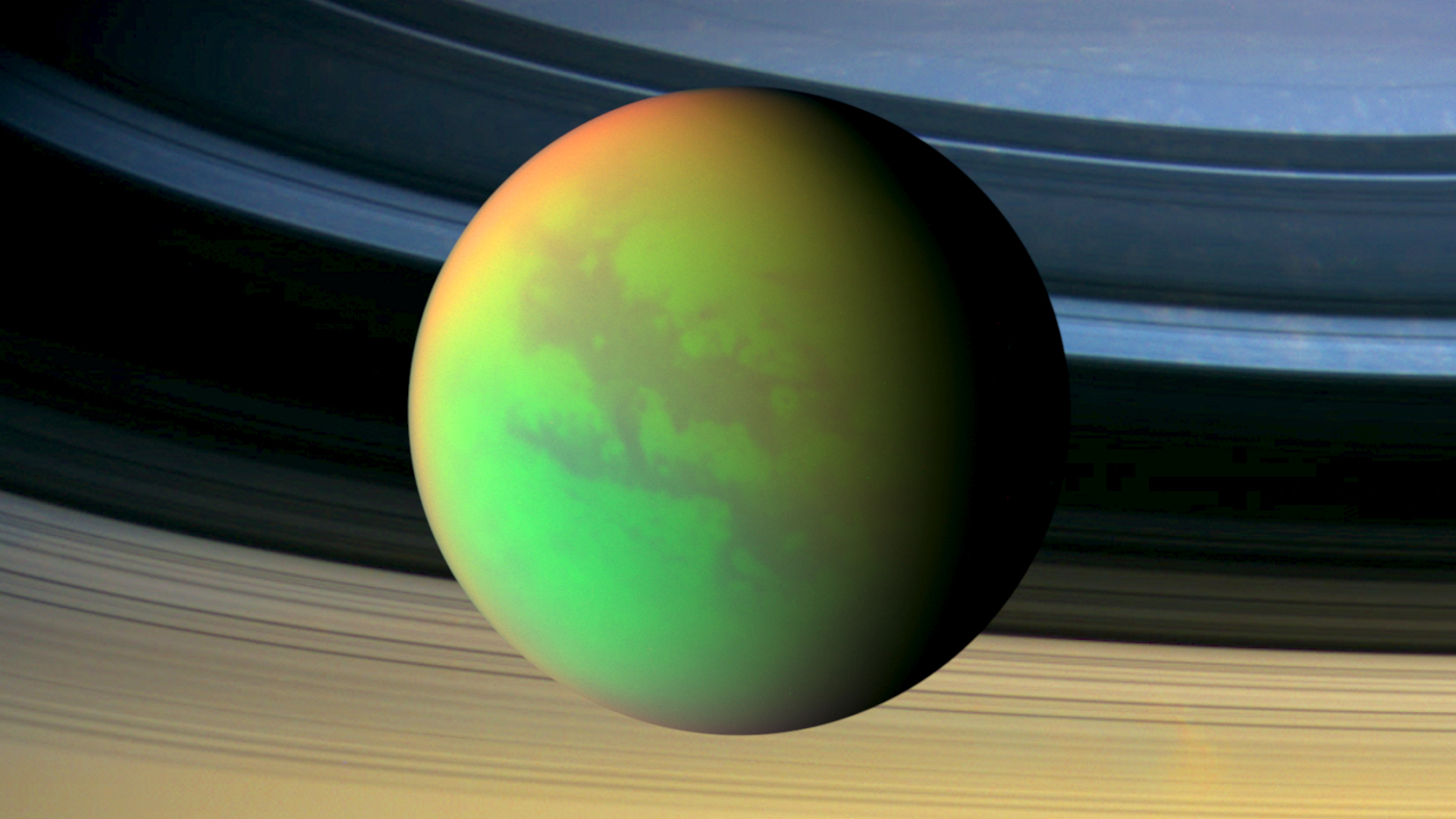
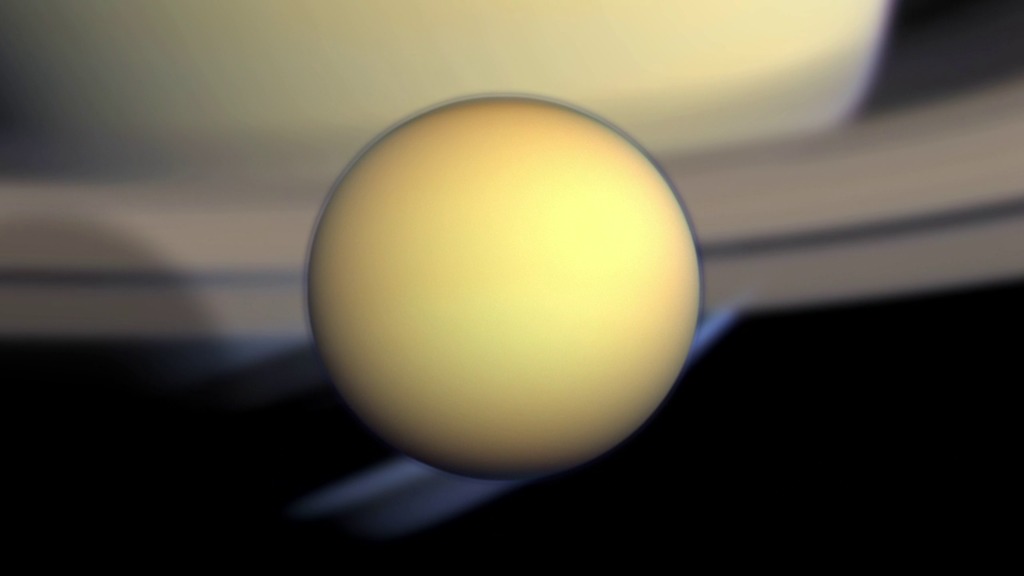
Zoom in on Saturn’s ring plane to reveal Titan, the only place in the solar system besides Earth that is known to have large lakes on its surface.
Credit: NASA Goddard/CI Lab
Titan’s clouds part to reveal an icy landscape stained by organic molecules. In the distance, a hydrocarbon lake is slicked with an iridescent sheen.
Credit: NASA Goddard/CI Lab
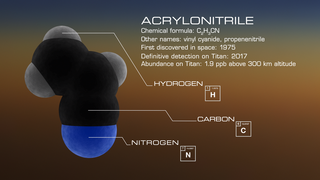
Acrylonitrile molecules drift through Titan’s atmosphere. These simple organics could form membrane-like bubbles called “vesicles” within Titan’s lakes.
Credit: NASA Goddard/CI Lab
Methane rain falls into a hydrocarbon lake, delivering the chemical ingredients and the kinetic energy needed to form membrane-like bubbles. The view tilts upward to a methane rain cloud.
Credit: NASA Goddard/CI Lab
Sunlight drives chemical reactions in Titan’s upper atmosphere. Methane and molecular nitrogen are broken apart and reassembled into the organic molecules needed to form protocell-like bubbles.
Credit: NASA Goddard/CI Lab
A large raindrop falls into a methane lake, which is covered by a layer of acrylonitrile molecules. The raindrop splashes up small droplets of methane coated in a single layer of acrylonitrile.
Credit: NASA Goddard/CI Lab
A methane droplet falls and sinks back into the lake. As it passes through the surface, it receives a second coating of acrylonitrile, creating a protocell-like bubble called a vesicle.
Credit: NASA Goddard/CI Lab
If vesicles in Titan’s lakes have more stable and less stable mixes of amphiphiles, the most stable would eventually become predominant – an evolutionary process that could lead to the formation of simple protocells.
Credit: NASA Goddard/CI Lab
Cross section of a cell membrane in a terrestrial organism. Cell membranes are composed of a lipid bilayer that separates the cell from its environment, along with membrane proteins that help to carry out vital functions.
Credit: NASA Goddard
For More Information
See NASA.gov
Credits
Please give credit for this item to:
NASA's Goddard Space Flight Center Conceptual Image Lab
-
Animators
- Kim Dongjae (eMITS)
- Wes D. Buchanan (eMITS)
- Jenny McElligott (eMITS)
- Dan Gallagher (eMITS)
-
Project manager
- Walt Feimer (eMITS)
-
Art director
- Michael Lentz (eMITS)
-
Producer
- Dan Gallagher (eMITS)
-
Scientists
- Christian Mayer (Universität Duisburg-Essen)
- Conor Nixon (NASA/GSFC)
Related
- ID: 20403

- ID: 14843
![NASA’s Webb Telescope has discovered a new molecule in Titan’s atmosphere – one that may have implications for the future of this surprisingly Earthlike world.Complete transcript available.Universal Production Music: “Barfuß Durch Die Stadt” by Edgar Möller [GEMA] and Lucia Wilke [GEMA]; “Into the Void” by Gage Boozan [ASCAP]; “Pulse of Progress” by Emma Zarobyan [SOCAN]; “Playing With The Narrative” by Cathleen Flynn [ASCAP] and Micah Barnes [BMI]; “Back From The Brink” by Daniel Gunnar Louis Trachtenberg [PRS]Watch this video on the James Webb Space Telescope YouTube channel.](/vis/a010000/a014800/a014843/Webb_Titan_Climate_Thumbnail.jpg) Produced Video
Produced Video - ID: 13693
 Produced Video
 - ID: 13562
 Produced Video
 - ID: 20311
 Animation
 - ID: 12709
 Produced Video
 - ID: 12467
 Produced Video
 - ID: 11339
 Produced Video
Used as a Source In
- ID: 14951
![Titan’s hydrocarbon lakes could contain structures called vesicles that strongly resemble cell membranes on Earth. A recent study coauthored by NASA shows that rainfall might provide the energy needed for these vesicles to form.Complete transcript available.Universal Production Music: “Perpetual Resonance” by Lee John Gretton [PRS]Watch this video on the NASA Goddard YouTube channel and Facebook.](/vis/a010000/a014900/a014951/Titan-Vesicles-Thumbnail-V3.jpg) Produced Video
Produced Video
Release date
This page was originally published on Wednesday, January 14, 2026.
This page was last updated on Friday, January 23, 2026 at 11:57 AM EST.