Flash Talk: Roman Spacecraft Overview
This presentation was orginally given by Josh Schlieder at special day-of-launch event. It was designed specifically to be followed by the Science Overview presentation.
His script notes for a five-minute presentation are available with each individual graphic and also collected here .

Title slide. Includes Josh's original and a blank template.

Slide 2) - NASA’s Nancy Grace Roman Space Telescope is on the launch pad right now. It waits for its ride to space where it will unleash its capabilities to revolutionize astrophysics and inspire the world
Slide 2) ALTERNATE with launch footage- NASA’s Nancy Grace Roman Space Telescope launched on August 30th. It is on its way to where it will unleash its capabilities to revolutionize astrophysics and inspire the world
Slide 3) - In the hours and days after launch, the observatory will deploy its solar panels to generate 4500W of electricity, unfold its large antenna to transmit data back to Earth, open its aperture cover to allow the telescope to see the universe for the first time, and fire its thrusters to continue toward its final orbit
Slide 4) - Over the next three months, Roman’s computers, cameras, and other systems will be powered on and calibrated and its telescope will be brought into focus, ensuring the observatory is prepared for its ultimate purpose, next generation science, enabling what was previously impossible.
Slide 5) - During this commissioning phase, Roman will travel to a gravitationally stable point 1 million miles away, where it will be isolated from Earth and lunar light and have unobstructed views of the cosmos.
Slide 6) - There, its telescope, provided by partner L3 Harris, will gather light from objects across the universe using a primary mirror so precisely polished that the average imperfection across its 8-foot surface is thousands of times smaller than the cells in your bodies.
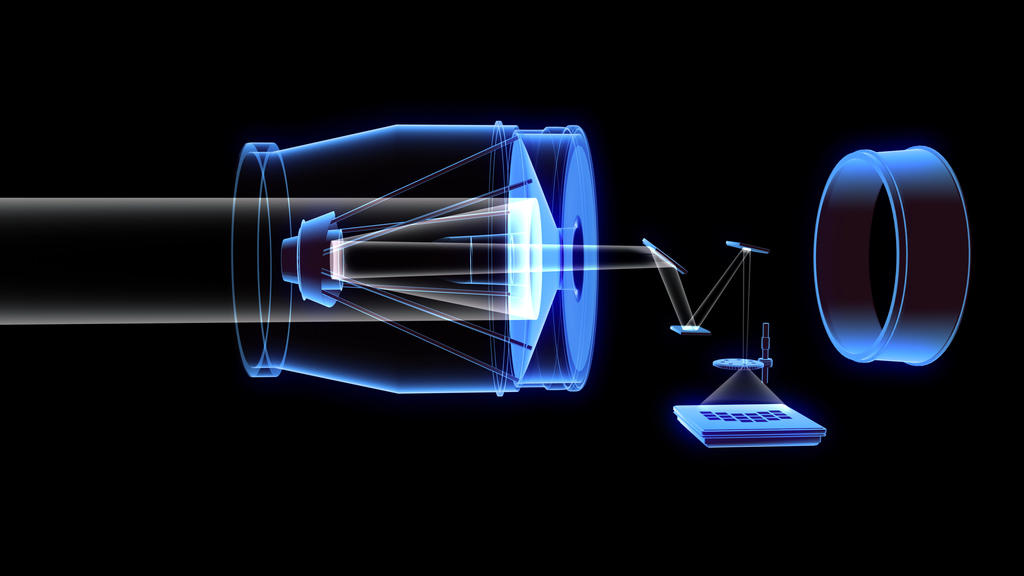
Slide 7) - The primary reflects light to the secondary mirror, which then feeds it to relay optics behind the primary, and into the instruments.
Slide 8) - Roman carries the most stable telescope NASA has ever flown. The temperature is held within the desired range one-thousand times more accurately than the AC system currently cooling this room, all to limit thermal distortions that would change its precisely tuned shape and degrade the sharpness of its images.
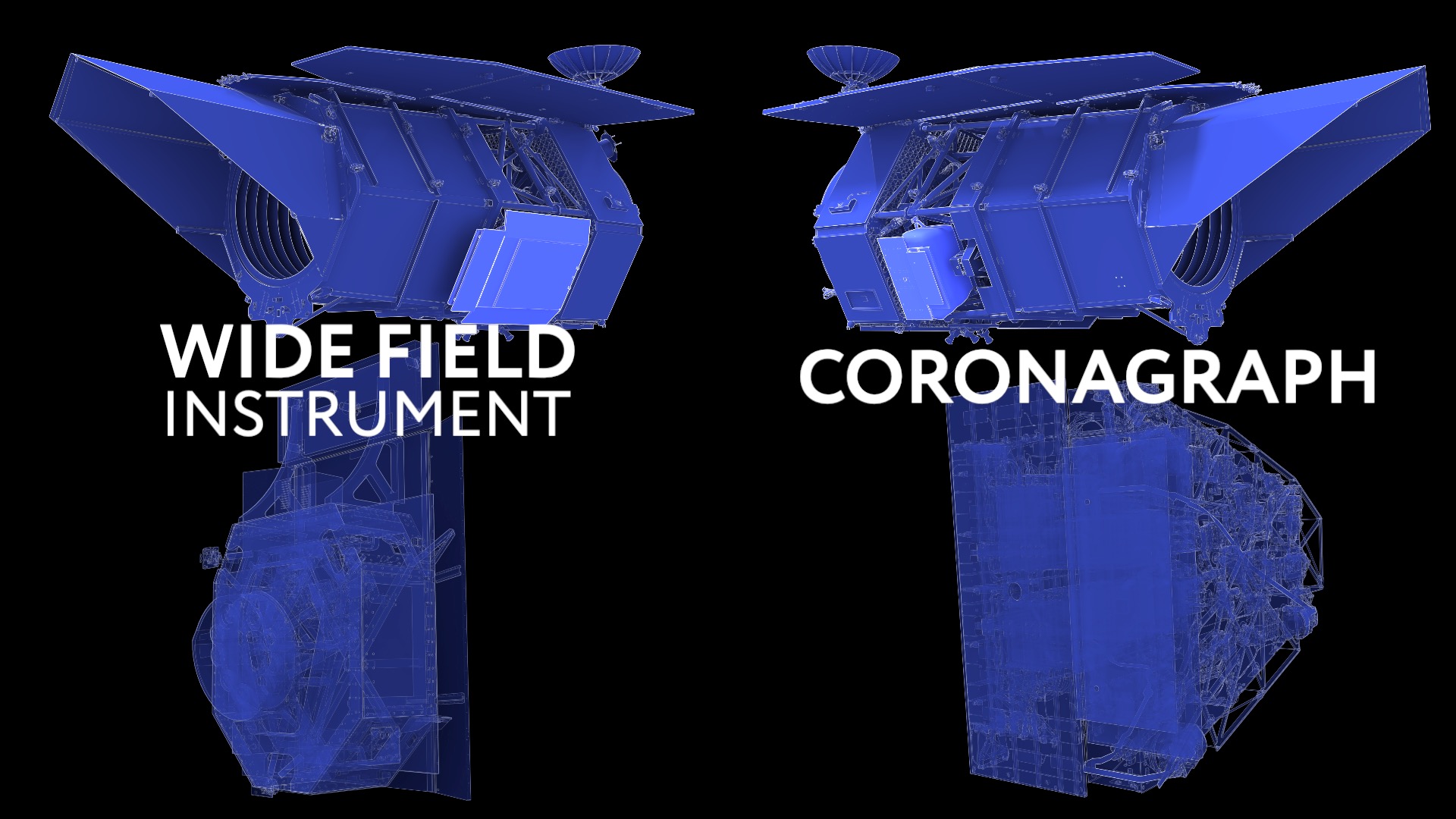
Slide 9) - Roman’s two instruments – The Wide Field Instrument and Coronagraph -- work in parallel to achieve groundbreaking science and prove new technologies.
Slide 10) - The instruments are mounted behind the telescope in a carbon fiber and titanium structure with special isolators that prevent vibrations and distortions from propagating through the system.
Slide 11) - This is an innovation unique to Roman and is a key part of the observatory’s stability and outstanding image quality. The instruments share the light coming into the telescope and each observes an adjacent portion of the sky at the same time. The wide field detectors are arranged in an arch to match the area of best image quality provided by the optics.
Due to this design, Roman can observe an area larger than the full moon with its Wide Field Instrument while the Coronagraph focuses on individual stars and their planets.
Slide 12) - Roman’s Wide Field Instrument, or WFI, is a partnership between NASA Goddard and BAE Systems. It is the workhorse camera, delivering sharp images over a large field-of-view to enable cosmic surveys of unprecedented scope and scale.
Slide 13) - Light from the relay optics first passes through WFI’s element wheel, where eight filters and other elements -- each the size of a blu-ray disk -- fine tune the color, or split light into its constituent parts, to reveal the nature of stars and galaxies in their billions.
Slide 14) - At the heart of the instrument is an array of 18 state-of-the-art detectors from partner Teledyne that are cooled to nearly 300 degrees below zero. They form a 300 megapixel digital camera, covering about 100x more sky than similar cameras in Hubble and Webb, while maintaining crisp definition and deep sensitivity. The large number of pixels, spread over many detectors, are the breakthrough that give Roman its wide-field and high-resolution vision.
Slide 15) - Roman’s Coronagraph is a technology demonstrator. Built by NASA’s Jet Propulsion Laboratory, it is designed to prove new space-based technologies that achieve the extreme sensitivity needed to directly image planets orbiting nearby stars in visible light.
Slide 16) - The coronagraph employs custom masks and shape-shifting mirrors to block and correct a star's blinding light, revealing planets 100 million times fainter – roughly 1000x better than telescopes on the ground.
It's equivalent to seeing a firefly next to stadium lights from a hundred miles away and a critical step toward directly imaging Earth-like planets.
Slide 17) - The spacecraft bus, built at NASA's Goddard Space Flight Center, carries the telescope and instruments and is Roman’s control center. It houses multiple computers, the power and propulsion systems, six 45-pound reaction wheels to quickly point Roman around the sky, and a communication system capable of downlinking more than a terabyte of data a day at rates faster than most home internet lines.
All these systems are linked by nearly 50 miles of electrical cable. The unique capabilities of the bus blend seamlessly with the telescope and instruments to pursue Roman’s incredible observations.
Slide 18) – This morning, Roman stands atop a SpaceX Falcon Heavy as a monument to a simple truth: its unparalleled capabilities are only possible due to the unwavering commitment of thousands of people, working together across nearly two decades.
Reflected in the primary mirror, imaged in the detector pixels, and stored in every bit of scientific data are the scientists, engineers, technicians, managers, communicators, administrative staff, and agency leaders that have poured years of their careers into this vision. Alongside them stand the family, friends, and colleagues that made sacrifices at home and at work.
They all chose to believe that the mission mattered and take responsibility for its success. They chose to show up with their very best every day, and collaborate across institutions, disciplines, and generations.
Roman will not merely observe the universe. It will be an embodiment of human potential. With every mission milestone reached, new technology demonstrated, and cosmic secret revealed we will be reminded that this is what we can do when we commit to something greater than ourselves.

Full PowerPoint presentation
Credits
Please give credit for this item to:
NASA's Goddard Space Flight Center
-
Producers
- Scott Wiessinger (eMITS)
- Joshua E. Schlieder (NASA/GSFC)
-
Writer
- Joshua E. Schlieder (NASA/GSFC)
-
Editor
- Scott Wiessinger (eMITS)
-
Videographers
- Scott Wiessinger (eMITS)
- Sophia Roberts (eMITS)
-
Photographer
-
Animators
- Jonathan North (eMITS)
- Scott Wiessinger (eMITS)
Missions
This page is related to the following missions:Series
This page can be found in the following series:Related
- ID: 15091
 Produced Video
Sources
- ID: 15089
 Produced Video
 - ID: 15080
![NASA’s Nancy Grace Roman Space Telescope is prepped for launch, and one phase of Roman is ending. It began with the 2010 Astronomy and Astrophysics Decadal Survey, where the community called for a wide-field infrared survey telescope: WFIRST. This was Roman’s start. Institutes and businesses across the country began developing new hardware to support this mission. At the observatory’s heart was a mirror the same size as Hubble’s and a set of 18 state-of-the-art detectors that allowed for both a massive field of view and extremely high angular resolution. This combination would allow Roman to create vast and detailed surveys of the universe unlike anything seen before. Roman also holds a Coronagraph Instrument to test hardware never before flown in space. It will be able to see distant planets orbiting other stars and is a major step toward finding life outside the solar system.Much of Roman’s hardware was developed and built in-house at NASA’s Goddard Space Flight Center. Other key systems came from places like NASA’s JPL (Jet Propulsion Laboratory), BAE Systems, and L3Harris. Beginning in 2023, all the parts converged on Goddard. Inside Goddard’s enormous clean room, a team of dedicated engineers and technicians spent over three years assembling the pieces. Throughout the process, they also used Goddard’s testing facilities to evaluate the hardware’s ability to survive launch and space. Pieces, assembled sections, and finally the entire observatory were subjected to tests like vibration and acoustic shaking, thermal vacuum freezing, and centrifuge g-force loading.The early completion and future success of the Roman Space Telescope is a testament to the unwavering commitment and effort of thousands of people working together toward a common goal. Thanks to all their efforts, Roman will broaden our understanding of the universe and our place within it.Music: “Caelum,” Dan Thiessen [BMI], Universal Production MusicWatch this video on the NASA Goddard YouTube channel.Complete transcript available.](/vis/a010000/a015000/a015080/RomanGoForLaunch_Still_searchweb.png) Produced Video
Produced Video - ID: 5673
 Visualization
 - ID: 20416
 Animation
 - ID: 14970
 Animation
 - ID: 14891

- ID: 13235
Release date
This page was originally published on Friday, September 4, 2026.
This page was last updated on Monday, September 14, 2026 at 9:39 AM EDT.