Artemis Science: Visualizing NASA’s Next Lunar Flyby
Artemis II visualization lead Ernie Wright explains how his data-driven animations are helping astronauts to prepare for a historic flyby of the Moon.
Complete transcript available.
Universal Production Music: “Black Cloud” and “Magic Trick” by Hugo Dubery [SACEM] and Philippe Galtier [SACEM]; “Connecting Ideas” by Christopher Timothy White [PRS]; “Transitions” by Ben Niblett [PRS] and Jon Cotton [PRS]
Watch this video on the NASA Goddard YouTube channel and Facebook.
NASA’s Artemis missions are sending astronauts to explore the Moon for the first time in over fifty years. In early 2026, four Artemis II crew members will fly by the lunar far side at an altitude of approximately 4,000 to 6,000 miles, testing the Orion capsule and venturing further into deep space than anyone has gone before. Artemis II Visualization Lead Ernie Wright has simulated views of the flyby using detailed topographic maps of the lunar terrain and photorealistic lighting scenarios. The Artemis II crew members are using these visualizations to prepare for their historic mission, which will pave the way for future exploration of the Moon’s surface and beyond.
VERTICAL VIDEO 1 – Ernie Wright discusses which regions of the Moon the Artemis II crew might see that were not visible to Apollo astronauts.
Universal Production Music: “Black Cloud” by Hugo Dubery [SACEM] and Philippe Galtier [SACEM]; “Connecting Ideas” by Christopher Timothy White [PRS]
Watch this video on X, Facebook, and @NASAArtemis Instagram.
VERTICAL VIDEO 2 – Ernie Wright gives an overview of the Artemis II mission and reflects on the impact of seeing our world above the Moon’s horizon.
Universal Production Music: “Black Cloud” by Hugo Dubery [SACEM] and Philippe Galtier [SACEM]; “Modern Rituals” by Alexander Ryder Mcnair [ASCAP] and Harry Gregson Williams [BMI]
Watch this video on Instagram, YouTube Shorts, X, and Facebook.
ARTIST’S CONCEPT – This animation shows the nominal trajectory for NASA’s Artemis II test flight, an approximately 10-day mission that will send four astronauts around the Moon and back. The agency’s SLS (Space Launch System) rocket and Orion spacecraft will launch from Kennedy Space Center in Florida. Orion will fly two orbits of Earth and then venture around the Moon in a figure-eight pattern before returning to Earth.
Credit: NASA/JSC/Goddard
ARTIST’S CONCEPT – Artemis II has several potential launch windows in 2026, each with different local lighting conditions at the Moon. During the initial launch window in early February, virtually the entire lunar far side will be illuminated (left), making the Artemis II crew the first humans to see it with their own eyes. Less of the far side will be illuminated during later launch windows (right). The Apollo missions launched when the Moon’s far side was mostly darkened and its near side was mostly illuminated, allowing crew members to land in daylight. During Artemis II’s flyby, the Moon’s heavily cratered far side will appear to be about the size of a basketball held at arm’s length – far more distant than it would have appeared to the orbiting Apollo astronauts. Spacecraft window model courtesy of Christian Bittner.
Credit: NASA Goddard/SVS
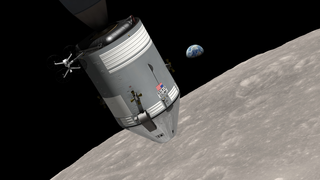
ARTIST’S CONCEPT – On December 24, 1968, the crew of Apollo 8 became the first humans to witness the Earth rising above the Moon’s barren surface. “Earthrise,” an unplanned photograph taken by astronaut Bill Anders, captured the moment to become an iconic image of the 20th century. This approximation of the astronauts’ view was created with a 3D model of the Apollo 11 capsule (courtesy of the Smithsonian) and data from NASA’s LRO mission.
Credit: NASA Goddard
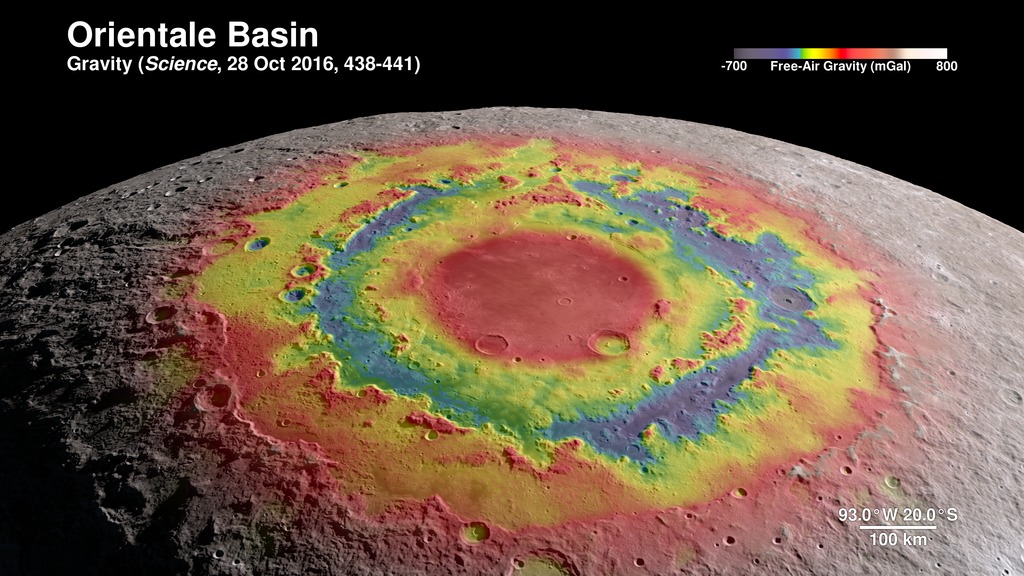
DATA VISUALIZATION – An animated map of the Moon showing the sunlit parts of the lunar surface that the Apollo astronauts could see from orbit. The darkened parts of the map were either never in sunlight or were beyond the horizon of the spacecraft. The large gap at left that includes the giant impact crater Mare Orientale spans longitudes 146°W to 70°W.
Credit: NASA Goddard/SVS
DATA VISUALIZATION – Animated globes of the Moon showing the sunlit parts of the lunar surface that the Apollo astronauts could see from orbit. The darkened parts of the globes were either never in sunlight or were beyond the horizon of the spacecraft.
Credit: NASA Goddard/SVS
DATA VISUALIZATION – Vertical version of the animation above.
Credit: NASA Goddard/SVS
DATA VISUALIZATION – Vertical version of the animation above.
Credit: NASA Goddard/SVS
ARTIST’S CONCEPT – Vertical animation depicting opposite phases on the near and far sides of the Moon. Because the Moon is tidally locked to our planet, we see only the familiar near side from Earth. During a full Moon, the near side is illuminated by the Sun while the far side is darkened – and vice versa during a new Moon. This animation begins with the near side in a waxing gibbous phase and rotates to show the far side in a waning crescent.
Credit: NASA Goddard
BROADCAST VERSION – Artemis II visualization lead Ernie Wright explains how his data-driven animations are helping astronauts to prepare for a historic flyby of the Moon. This version is formatted for NASA’s live Artemis II mission coverage.
For More Information
Credits
Please give credit for this item to:
NASA's Goddard Space Flight Center
-
Visualizer
-
Ernie Wright
(USRA)

-
Ernie Wright
(USRA)
-
Producer
- Dan Gallagher (eMITS)
-
Videographers
- Rob Andreoli (eMITS)
- John D. Philyaw (eMITS)
-
Graphics
- Dan Gallagher (eMITS)
-
Interviewee
-
Ernie Wright
(USRA)
-
Ernie Wright
(USRA)
-
Animators
- Krystofer Kim (eMITS)
- Michael Lentz (eMITS)
- Chris Smith (eMITS)
-
Photographers
- Kelsey Young (NASA/GSFC)
- James Blair (NASA/JSC)
-
Public affairs
- Lonnie Shekhtman (ADNET Systems, Inc.)
-
Support
- Molly Wasser (ADNET Systems, Inc.)
- Caela Barry (ADNET Systems, Inc.)
-
Noah Petro
(NASA/GSFC)
- Kathryn Mersmann (NASA/GSFC)
-
Research scientist
- Jacob Kegerreis (Imperial College London)
-
Technical support
- Aaron E. Lepsch (ADNET Systems, Inc.)
Missions
This page is related to the following missions:Series
This page can be found in the following series:Related
- ID: 5646
 Visualization
 - ID: 15012
 Produced Video
 - ID: 14934

- ID: 14992
 Animation
 - ID: 14929
![Team members from NASA’s Artemis missions plant a tree grown from a seed that traveled beyond the Moon and back to Earth.Complete transcript available.Universal Production Music: “Positive Progression” by Harry Gregson Williams [BMI] and Ben Andrew [PRS]; “Timeless” by Joshua Benjamin Pacey [PRS] and Harry Gregson Williams [BMI]Watch this video on the NASA Goddard YouTube channel, X, Facebook, and LinkedIn.](/vis/a010000/a014900/a014929/A1-Moon-Tree-Planting-Thumbnail.jpg) Produced Video
Produced Video - ID: 14886
![By sending astronauts to collect samples from the Moon’s South Pole, NASA’s Artemis missions may uncover clues to the formation of the solar system.Complete transcript available.Universal Production Music: “Transitions” by Harry Gregson Williams [BMI] and Ben Andrew [PRS]; “Love on the Moon” by Sebastian Barnaby Robertson [BMI] and Yaacov Kobi Hokima [BMI]Watch this video on the NASA Goddard YouTube channel.](/vis/a010000/a014800/a014886/Artemis_Sci_Young_S_Pole_Preview.jpg) Produced Video
Produced Video - ID: 13537
 Produced Video
 - ID: 4593
 Visualization
Sources
- ID: 5535
 Visualization
 - ID: 5536
 Visualization
 - ID: 4619
 Visualization
 - ID: 10930
 Produced Video
Used as a Source In
- ID: 14981
 Produced Video
Release date
This page was originally published on Monday, December 22, 2025.
This page was last updated on Monday, May 18, 2026 at 5:34 PM EDT.