Hyperwall Sun
Overview
Heliophysics related hyperwall ready visualizations
Return to Main Hyperwall Gallery.
Overview
- ID: 4288 Visualization
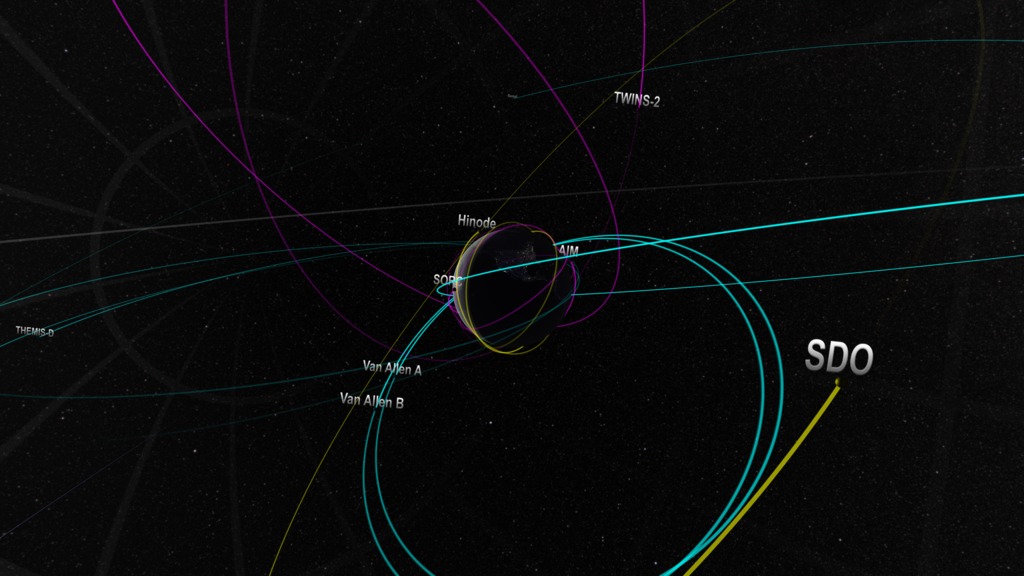
The 2015 Earth-Orbiting Heliophysics Fleet
Go to this pageMovie showing the heliosphysics missions from near Earth orbit out to the orbit of the Moon.This video is also available on our YouTube channel. || Helio2015A.MMStour.slate_RigRHS.HD1080i.0500_print.jpg (1024x576) [112.6 KB] || Helio2015A.MMStour.HD1080.webm (1920x1080) [6.7 MB] || WithoutTimeStamp (1920x1080) [128.0 KB] || Helio2015A.MMStour.HD1080.mov (1920x1080) [196.3 MB] || Helio2015_4288.pptx [198.6 MB] || Helio2015_4288.key [201.3 MB] ||
Heliosphere
Plasmas and their embedded magnetic fields affect the formation, evolution and destiny of planets and planetary systems. The heliosphere shields the solar system from galactic cosmic radiation. Our habitable planet is shielded by its magnetic fi eld, protecting it from solar and cosmic particle radiation and from erosion of the atmosphere by the solar wind. Planets without a shielding magnetic field, such as Mars and Venus, are exposed to those processes and evolve differently. And on Earth, the magnetic field changes strength and configuration during its occasional polarity reversals, altering the shielding of the planet from external radiation sources.
- Section
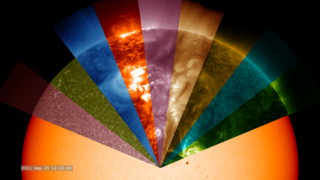
Solar Dynamics Observatory - Argo view
Go to this sectionThe movie opens with a full-disk view of the Sun in visible wavelengths. Then the filters are applied to small pie-shaped wedges of the Sun, starting with 170nm (pink), then 160nm (green), 33.5nm (blue), 30.4nm (orange), 21.1nm (violet), 19.3nm (bronze), 17.1nm (gold), 13.1nm (aqua) and 9.4nm (green). We let the set of filters sweep around the solar disk and then zoom and rotate the camera to rotate with the filters as the solar image is rotate underneath.
- Section
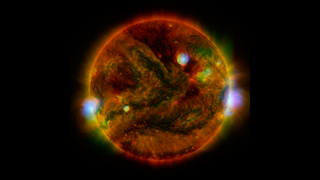
NuSTAR Sun
Go to this sectionBlue-White areas in composite image with NuSTAR data show most energetic spots.
- ID: 11868 Produced Video
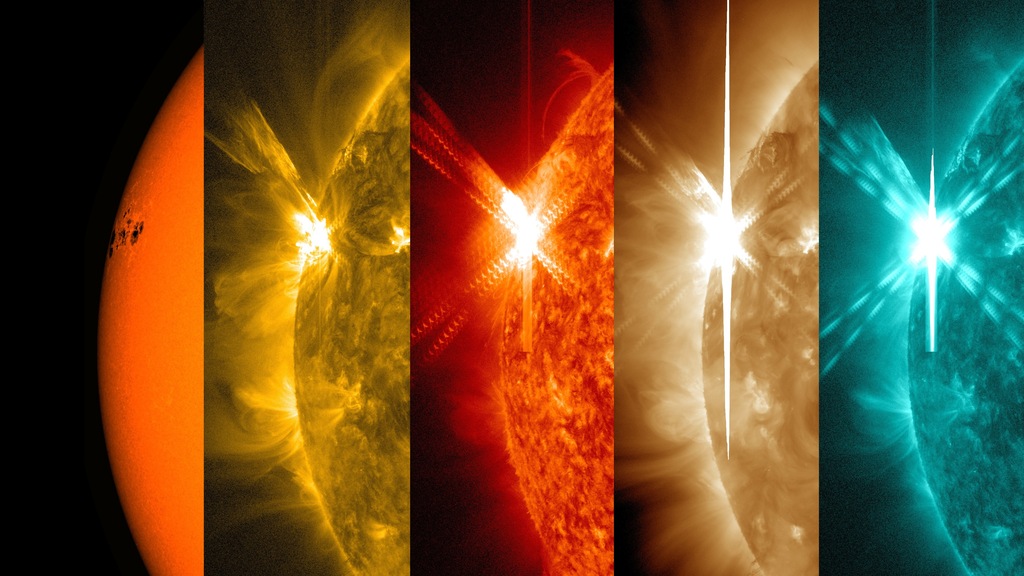
NASA's SDO Observes a Cinco de Mayo Solar Flare
Go to this pageVideo of May 5, 2015 X2.7 flare.Credit: NASA/GSFC/SDO || May_5_2015_Flare_Still_304-171.png (1920x1080) [8.1 MB] || May_5_2015_Flare_Still_304-171.jpg (1920x1080) [415.9 KB] || May_5_2015_Flare_Still_304-171_print.jpg (1024x576) [145.7 KB] || May_5_2015_Flare_Still_304-171_web.png (320x180) [83.3 KB] || 11868_May_5_X_Flare_MPEG4_1920X1080_2997.mp4 (1920x1080) [42.2 MB] || 11868_May_5_X_Flare_H264_Good_1920x1080_2997.webm (1920x1080) [4.8 MB] || 11868_May_5_X_Flare_1280x720.wmv (1280x720) [23.1 MB] || 11868_May_5_X_Flare_appletv.m4v (960x540) [19.0 MB] || 11868_May_5_X_Flare_appletv_subtitles.m4v (960x540) [19.0 MB] || 11868_May_5_X_Flare_ipod_lg.m4v (640x360) [7.1 MB] || 11868_May_5_X_Flare_ipod_sm.mp4 (320x240) [3.6 MB] || 11868_May_5_X_Flare_SRT_Captions.en_US.srt [230 bytes] || 11868_May_5_X_Flare_SRT_Captions.en_US.vtt [243 bytes] || 11868_May_5_X_Flare_ProRes_1920x1080_2997.mov (1920x1080) [674.9 MB] || 11868_May_5_X_Flare_H264_Best_1920x1080_2997.mov (1920x1080) [682.7 MB] || 11868_May_5_X_Flare_H264_Good_1920x1080_2997.mov (1920x1080) [219.1 MB] ||
Magnetospheres
Determine changes in the Earth's magnetosphere, ionosphere, and upper atmosphere in order to enable specification, prediction, and mitigation of their effects. Heliophysics seeks to develop an understanding of the response of the near-Earth plasma regions to space weather. This complex, highly coupled system protects Earth from the worst solar disturbances while redistributing energy and mass throughout.
- Section
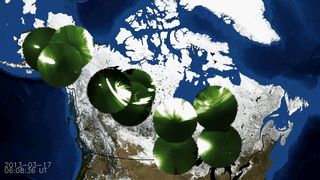
NASA Observes Auroras Across Canada
Go to this sectionThese aurora images were taken from the ground looking up with a network of all-sky cameras spread across Canada, studying auroras in collaboration with NASA’s Time History of Events and Macroscale Interactions during Substorms, or THEMIS, mission. Taking images of aurora from the ground in conjunction with satellite data taken from above the atmosphere gives scientists a more comprehensive picture of how and why the aurora form. The ground-based camera network is also observing this week’s auroras. The aurora data is provided courtesy of S. Mende at University California Berkeley and E. Donovan at the University of Calgary, logistical support in fielding and data retrieval from the ground-based stations is provided by the Canadian Space Agency. The array of aurora images is funded by NSF in support of GIMNAST through grant AGS-1004736.Credit: NASA/CSA/University of California, Berkeley/University of Calgary/NSF
Space Environment
Understand the causes and subsequent evolution of solar activity that affects Earth's space climate and environment. The climate and space environment of Earth are significantly determined by the impact of plasma, particle, and radiative outputs from the Sun. Therefore, it is essential to understand the Sun, determine how predictable solar activity truly is, and develop the capability to forecast solar activity and the evolution of disturbances as they propagate to Earth.
- Section
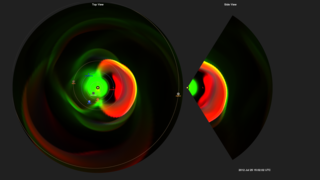
The Big CME that Missed Earth
Go to this sectionEnlil model run of the July 23, 2012 CME and events leading up to it. This view includes a 'top-down' view in the plane of Earth's orbit, as well as a slice perpendicular to the orbit which passes through Earth. We see the previous CME pass Earth, but not the July 23 event.