Signs of El Niño in 2026
This visualization compares three ocean data products, sea surface temperature anomaly (SSTA), apparent visible wavelength (AVW), and sea surface height anomaly (SSHA), over the same months in 2025 and 2026. Signals of El Niño in each data product are highlighted with pop-up labels.
NASA's Earth-observing satellites are monitoring changes in the tropical Pacific Ocean that could signal the development of a strong El Niño event in 2026.
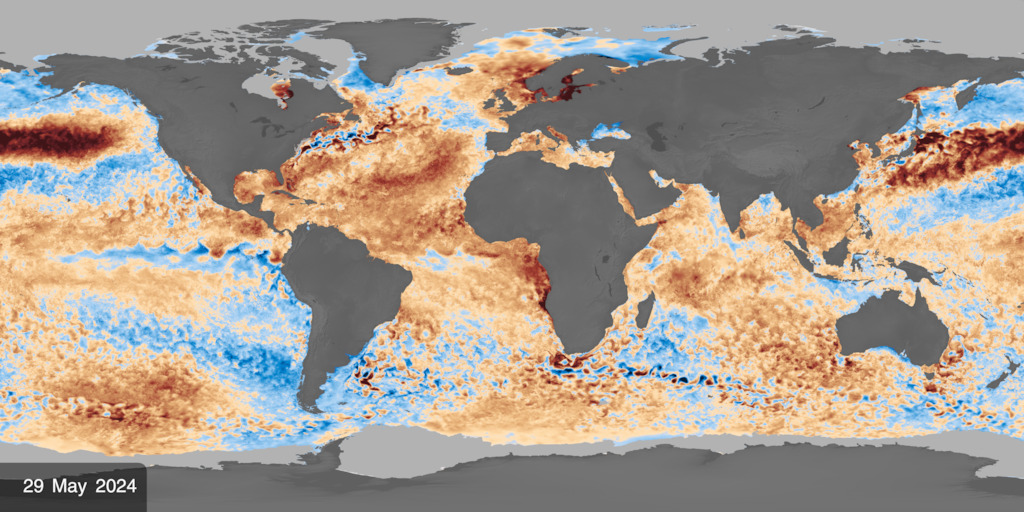
These visualizations compare ocean conditions during the same months in 2025 and 2026 using data from missions including Sentinel-6 and PACE. Three ocean data products are shown: sea surface temperature anomaly, apparent visible wavelength (ocean color), and sea surface height anomaly. Together, these datasets show unusually warm surface waters in the central and eastern tropical Pacific, higher-than-usual sea surface heights, and changes in ocean color associated with reduced phytoplankton. These changes can all be signals of developing El Niño conditions.
This visualization compares sea surface temperature anomalies (SSTA) over the same months in 2025 and 2026. Red and orange indicate areas where ocean surface temperatures are warmer than usual, while blue indicates areas where they are cooler than usual. Warmer ocean surface temperatures in the central and eastern tropical Pacific can be a signal of developing El Niño conditions.
This visualization compares apparent visible wavelength (AVW) over the same months in 2025 and 2026. Bluer ocean colors generally indicate areas with less phytoplankton, while greener and yellower colors suggest higher concentrations. Reduced phytoplankton in the tropical Pacific can be associated with developing El Niño conditions.
This visualization compares sea surface height anomalies (SSHA) over the same months in 2025 and 2026. Red and orange indicate areas where the ocean surface is higher than usual, while blue indicates areas where it is lower than usual. Higher sea surface heights in the eastern tropical Pacific can be a signal of developing El Niño conditions.
Credits
-
Data visualizer
- Kel Elkins (Science and Technology Corporation)
-
Scientists
-
Josh Willis
(JPL)

-
Peter H. Jacobs
(NASA/GSFC)
- Morgaine McKibben (SSAI)
- Matthew Kehrli (GSFC)
-
Josh Willis
(JPL)
-
Science writers
- Erica McNamee (Telophase Corp)
- Sally Younger (NASA/JPL)
-
Producer
- Jenny Marder Fadoul (Telophase)
Sources
- ID: 5663
 Visualization
 - ID: 5176
 Visualization
Release date
This page was originally published on Thursday, October 15, 2026.
This page was last updated on Thursday, October 15, 2026 at 12:32 PM EDT.