Lucy Observations of Asteroid Donaldjohanson
The asteroid Donaldjohanson as seen by the Lucy Long-Range Reconnaissance Imager (L’LORRI) on NASA’s Lucy spacecraft during its flyby.
Credit: NASA/Goddard/SwRI/Johns Hopkins APL
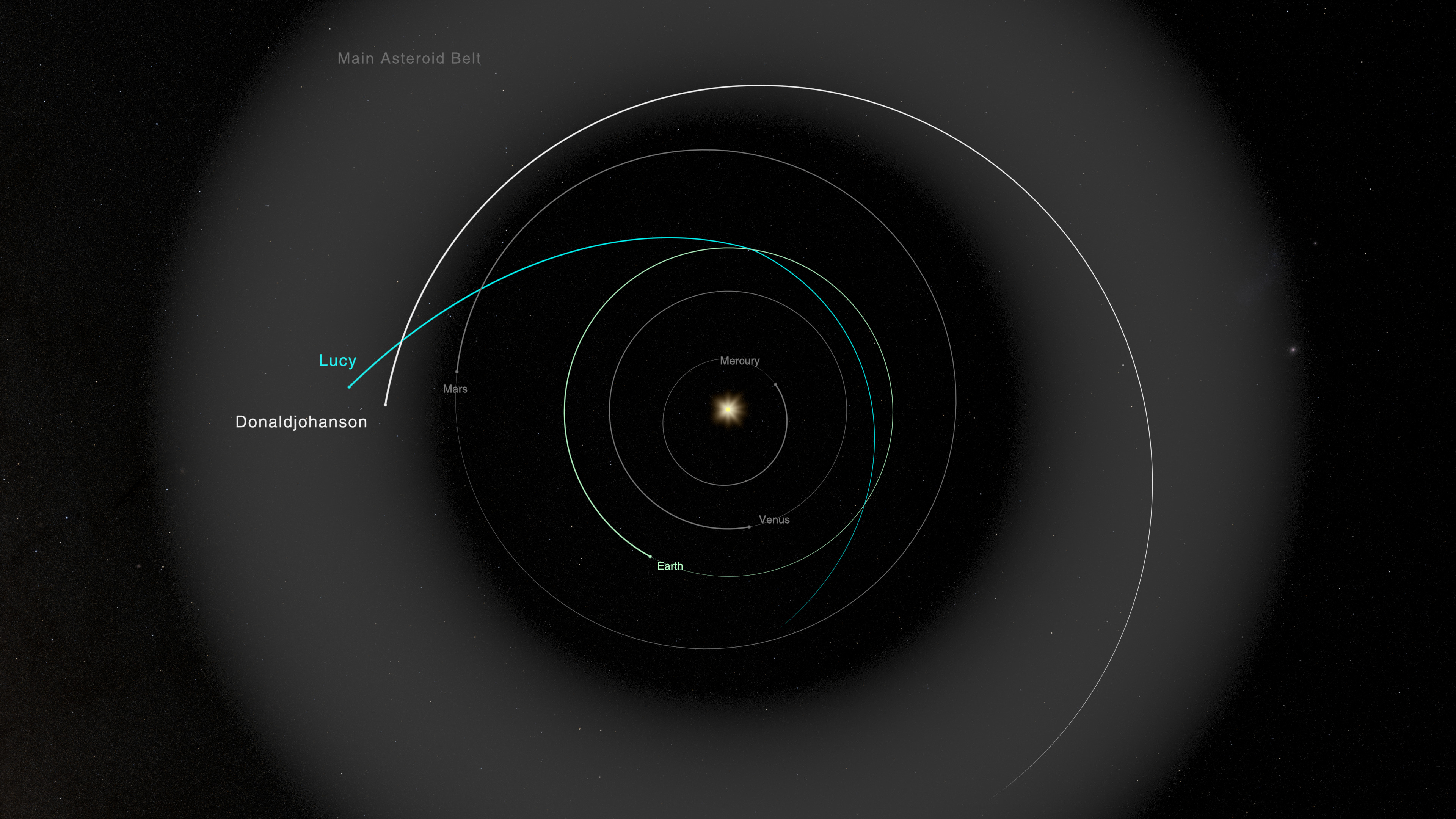
NASA’s Lucy spacecraft captured the first close-up views of asteroid Donaldjohanson during its April 20, 2025 flyby, revealing a detailed look at this peanut-shaped, tumbling object. Stretching nearly the length of 100 football fields, the asteroid appears to be a contact binary, likely formed when two separate bodies collided and merged. Lucy passed within about 600 miles, providing enough coverage to reconstruct its three-dimensional shape from multiple angles.
One of the more unusual aspects of Donaldjohanson is its rotation. Instead of spinning around a single axis, it is in a tumbling, non-principal axis rotation. It completes one rotation roughly every 10.5 days while rotating around another axis approximately every 26.4 days, creating a slow, uneven wobble.
The asteroid Donaldjohanson as seen by the Lucy Long-Range Reconnaissance Imager (L’LORRI) on NASA’s Lucy spacecraft during its flyby.
Credit: NASA/Goddard/SwRI/Johns Hopkins APL
Asteroid Donaldjohanson is shown rotating in a tumbling, non-principal axis motion. This version shows the reconstructed shape without overlaid data or reference axes. Data credit: DLR
Asteroid Donaldjohanson is shown rotating in a tumbling, non-principal axis motion. This version shows the reconstructed shape with its angular momentum vector and rotation axes indicated. Data credit: DLR
Asteroid Donaldjohanson is shown rotating in a tumbling, non-principal axis motion. Light and dark grey shading highlights regions with limited stereo image coverage, where the shape model is less well constrained. Data credit: DLR
Asteroid Donaldjohanson is shown rotating in a tumbling, non-principal axis motion. Light and dark grey shading highlights regions with limited stereo image coverage, where the shape model is less well constrained. Data credit: DLR
Asteroid Donaldjohanson is shown rotating in a tumbling, non-principal axis motion, with its angular momentum vector and rotation axes indicated. The surface is colored by slope, which measures the angle between the local surface and the effective gravity direction, taking into account both the asteroid's gravitational pull and its rotation. Higher values (warmer colors) indicate steeper terrain relative to this local effective gravity. Regions with limited stereo image coverage have been masked out, where the shape model is less well constrained. Data credit: DLR

During its April 20, 2025 encounter with the main belt asteroid Donaldjohanson, NASA’s Lucy spacecraft discovered evidence for iron-rich clays on the surface of the asteroid using its infrared spectrometer. These clays, which are similar to those found in carbon-rich meteorites such as QUE 97990, indicate that water was briefly present in the asteroid during the distant past.
Credit: NASA/Goddard/SwRI/Dan Gallagher
Image of Donaldjohanson: NASA/Goddard/SwRL/JHU-APL
Credits
-
Data visualizer
- Kel Elkins (Science and Technology Corporation)
-
Producer
- Dan Gallagher (eMITS)
-
Scientists
- Simone Marchi (SwRI)
- Katherine Kretke (SwRI)
-
Science writer
- Lonnie Shekhtman (ADNET Systems, Inc.)
Missions
This page is related to the following missions:Related
- ID: 5525
Release date
This page was originally published on Thursday, June 18, 2026.
This page was last updated on Tuesday, June 23, 2026 at 1:47 PM EDT.