NASA’s Fermi Mission Reveals Related Supernova Remnants

This multiwavelength scene shows the Jellyfish Nebula supernova remnant (right), the interstellar cloud it’s interacting with, and a distinctive curving filament to its upper left. The filament, which is shown here both in optical and ultraviolet (UV) light, is the visible part of an overlapping supernova remnant, G189.6+3.3, that is more prominent in radio and X-rays. Visible light is shown in yellow, UV from NASA’s Neil Gehrels Swift Observatory is shown in violet, and infrared light from NASA’s retired WISE (Wide-field Infrared Survey Explorer) mission appears in cyan, red, and orange. Both remnants are located about 6,000 light-years away in the constellation Gemini. The brilliant star at far right is Propus, also known as Eta Geminorum.
Credit: NASA Goddard Space Flight Center and M. Michailidis et al. 2026; optical: DSS; infrared: NASA/WISE/JPL-Caltech/UCLA; ultraviolet: NASA/Swift
Alt text: Infrared, visible, and ultraviolet image of the area around the Jellyfish Nebula
Image description: On a mottled reddish background speckled with stars, yellow threads of gas at center right trace out a dome-shaped structure from which curving tendrils extend toward the lower right. Blue and red filaments trace a ring around the dome’s base. A violet arc stretches right to left just above the center of the image, and irregular orange gas clouds become thicker toward the upper left.
A new study of two supernova remnants suggests the explosions came from stellar siblings that once orbited each other. The first star’s detonation sent its binary companion hurtling through space, and then, after traveling for thousands of years, the surviving star blew up too.
The study focused on a faint supernova remnant called G189.6+3.3, which is mainly visible in X-rays. It is upstaged by its brighter and better-known neighbor, the Jellyfish Nebula (IC 443). The two star wrecks, both located in the constellation Gemini, appear to partially overlap as seen in X-rays. Recent X-ray evidence suggests that hot plasma likely associated with G189.6+3.3 may extend across the entire region, a hint that the overlap may be nearly total.
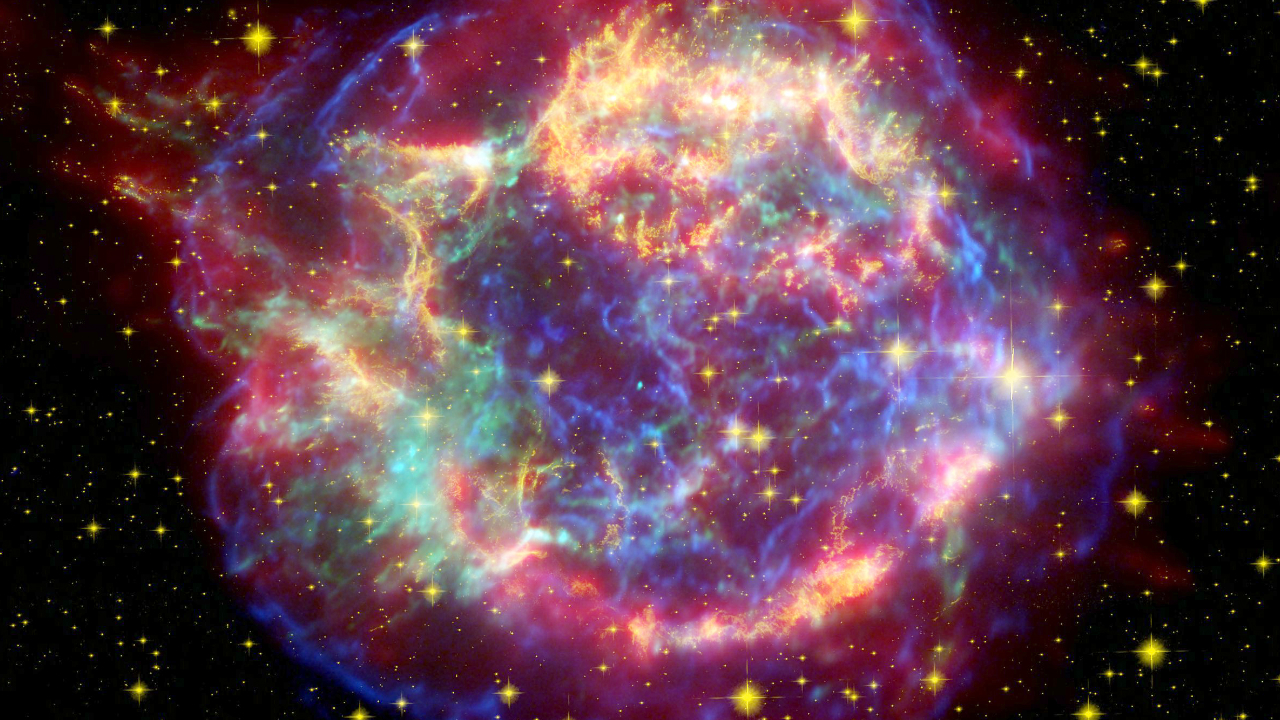
More than a decade ago, observations from NASA's Fermi Gamma-ray Space Telescope showed that the shock waves of supernova remnants accelerated particles to within a fraction of the speed of light. These high-speed particles, called cosmic rays, interact with interstellar gas to produce gamma rays, the highest-energy form of light. Protons make up 99% of cosmic ray particles.
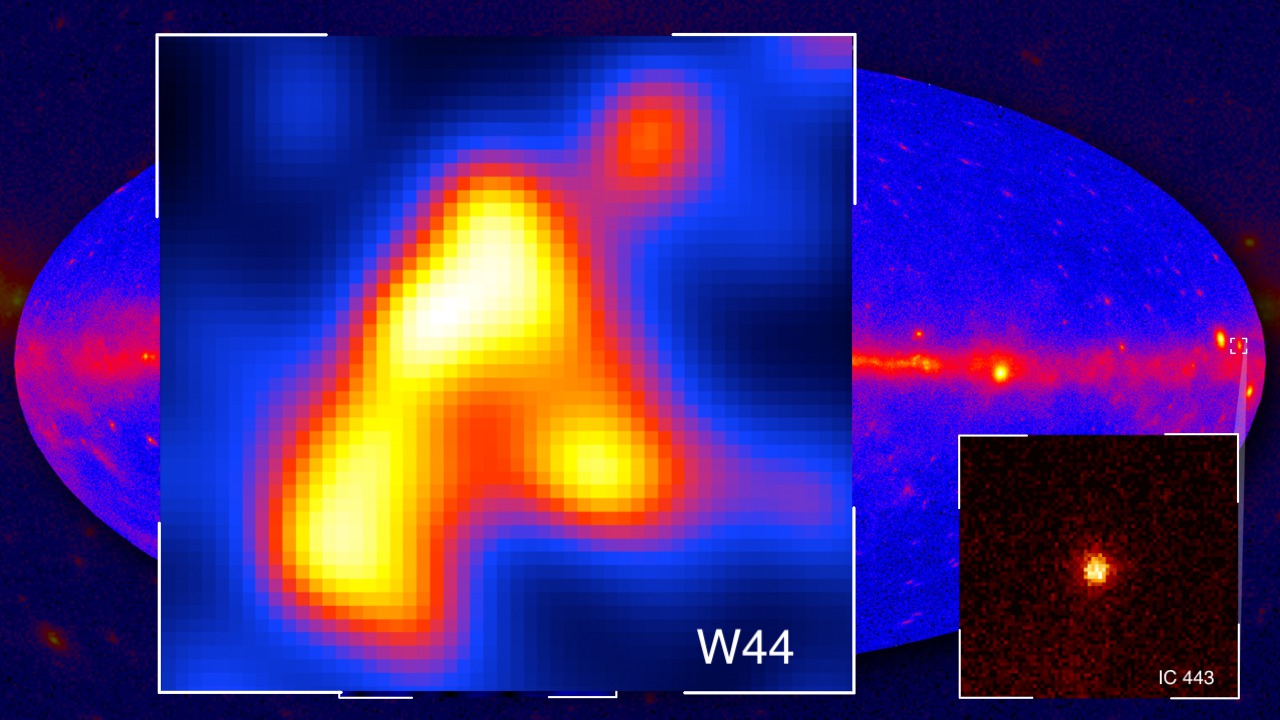
To prove that accelerated protons are responsible for the glow, astronomers search for a specific gamma-ray feature. When cosmic-ray protons smash into interstellar gas, they produce a short-lived particle called a neutral pion, which almost immediately decays into a pair of gamma rays. This emission occurs within a specific band of energies associated with the neutral pion’s mass and lies within the range detected by Fermi. In 2013, Fermi observations proved that the Jellyfish Nebula, which is interacting with part of a glowing cloud of hydrogen gas, produced gamma rays through this mechanism.
Its fainter neighbor, G189.6+3.3, was discovered in 1994. New Fermi observations have found gamma-ray emission associated with accelerated protons in the northern part of the remnant, where it interacts with the same gas cloud as IC 443. This suggests the remnants must share a common distance from us.
The team concludes the remnants lie about 6,000 light-years away, their explosion centers are separated by roughly 40 light-years projected onto the plane of the sky, and the original stars may have been 20 or more times the Sun’s mass.
Estimates of the remnants’ ages vary widely, but the team concludes that the age of the Jellyfish Nebula is 8,000 to 9,000 years, while G189.6+3.3 is between 20,000 to 110,000 years old. This means the delay between the explosions could have extended for up to 100,000 years.
Additional evidence, including including computer simulations teacking the evolution of a million massive binary systems, paint a compelling picture that the original stars were members of the same binary system and that IC 443 and G189.6+3.3 are sibling supernova remnants.
This cartoon outlines how the IC 443/G189.6+3.3 complex may have come about. First, two massive stars are born as a binary system. The larger member is 30 to 40 times the Sun’s mass, the other is 25 to 35 solar masses. Then, the more massive star explodes, possibly forming a neutron star or black hole, and the event kicks away its companion. The lone star travels through space for 20,000 to 100,000 years, then explodes itself. The two supernova remnants expand and partially merge, as we see them today.
Credit: M. Michailidis et al. 2026
Alt text: Cartoon showing the origin of the remnant complex
Image description: This is a single panel split into four sections. Each section is labeled with a blue circle and a numeral in the top left. 1: Two blue stars of different sizes stand side by side, enclosed by a dashed black line. A label at the top reads “1 Massive binary system: Two massive stars orbit each other.” Text under the biggest star, at left, reads “Star A (~30–40 M☉)” and under the smaller star reads “Star B (~25–35 M☉).” Labels at the bottom read “Bound binary” and “(before explosions).” 2: At the top, text reads “2 First supernova: Star A explodes.” An illustration of a purple and blue explosion, with arrows radiating away from the bright center, appears below. Text reads “Compact remnant (NS or BH).” Next to the explosion, the smaller star is connected to a curving arrow pointing to the right. The text below reads “Companion star kicked away.” At the bottom of the section text reads “Binary disrupted” and “~0 years.” 3: A label at top reads “3 Companion evolves and explodes: After tens of thousands of years, the companion becomes a supernova.” Below is a small purple ball with a black dashed line with an arrowhead pointing right to an orange explosion radiating arrows from a bright center. Text under the explosion reads “Second supernova.” Labels at the bottom read “Two supernovae” and “~20,000–100,000 years.” 4: Text at the top reads “4 Today: We observe two supernova remnants in the same region of space.” An illustration shows two intersecting purple and orange spheres with a star-and-nebula background. Beneath the purple remnant text reads “G189.6+3.3,” while the orange remnant is labeled “IC 443.” At the bottom, labels read “Two SNRs overlap” and “Today.”
This composite of radio, infrared, optical, and UV data shows the region around IC 443, a famous supernova remnant also known as the Jellyfish Nebula. The filament, which is shown here both in optical and ultraviolet (UV) light, is the visible part of an overlapping supernova remnant, G189.6+3.3, that is more prominent in radio and X-rays. Visible light is shown in yellow, infrared light from NASA’s retired WISE (Wide-field Infrared Survey Explorer) mission appears in red, and radio data (orange and brown) indicates thicker interstellar material. A small violet filament (center) is highlighted using UV data from NASA’s Neil Gehrels Swift Observatory. The filament is part of a second, older supernova remnant, called G189+3.3, that overlaps IC 443.
Separate wavelength layers are also available.
Credit: NASA Goddard Space Flight Center and M. Michailidis et al. 2026; optical: DSS; radio: MWSIP, ESA/Planck; infrared: NASA/WISE/JPL-Caltech/UCLA; ultraviolet: NASA/Swift
Alt text: Multiwavelength composite of supernova remnants IC 443 and G189.6+3.3 in radio, infrared, optical, and ultraviolet light
Image description: A large, red, irregularly shaped cloud sprawls across the upper half of the image. The background is sprinkled with yellow-white stars, with two brilliant ones, located in the middle and about 25% from the left and right sides of the image, forming large circles with diffraction spikes. At center is a short arc of gas in violet. To its right, yellow-white streamers of gas form a dome-like structure, while at the base of the dome the streamers seem to become uncontained, spreading in curving arcs. An irregular red streamer forms a ring at the dome’s base, about halfway into the full structure. Splotches of orange and brown form less obvious clouds throughout the scene.
Same as above, but with the addition of low-energy X-rays (blue-green) from the German eROSITA (extended ROentgen Survey with an Imaging Telescope Array) instrument on the Russian SRG (Spectrum X-Gamma) mission.
Images highlighting the contributions from the individual remnants are also available.
Credit: NASA Goddard Space Flight Center and M. Michailidis et al. 2026; optical: DSS; radio: MWSIP, ESA/Planck; infrared: NASA/WISE/JPL-Caltech/UCLA; ultraviolet: NASA/Swift; X-ray: SRG/eROSITA
Alt text: Multiwavelength composite of supernova remnants IC 443 and G189.6+3.3 in radio, infrared, optical, ultraviolet, and X-ray light
Image description: A large, red, irregularly shaped cloud sprawls across the upper half of the image. The background is sprinkled with yellow-white stars, with two brilliant ones, located in the middle and about 25% from the left and right sides of the image, forming large circles with diffraction spikes. An irregular blue-green cloud is superimposed on the central parts of the image. On the right, it seems more solid and covers the bright yellow-white Jellyfish Nebula. The blue-green cloud extends far to the left, becoming patchier. At center is a short arc of gas in violet. Splotches of orange and brown form less obvious clouds throughout the scene.
Same as above, but with the addition of gamma rays having energies above 1 GeV (billion electron volts), collected over 16 years by the Large Area Telescope on NASA’s Fermi Gamma-ray Space Telescope. Because the entire region glows at these energies, it is impossible to separate the individual contributions of each remnant. Gamma rays are the highest-energy form of light.
A version showing only the X-rays from G189.6+3.3 is also available.
Credit: NASA Goddard Space Flight Center and M. Michailidis et al. 2026; optical: DSS; radio: MWSIP, ESA/Planck; infrared: NASA/WISE/JPL-Caltech/UCLA; ultraviolet: NASA/Swift; X-ray: SRG/eROSITA; gamma ray: NASA/DOE/Fermi LAT Collaboration
Alt text: Multiwavelength composite of supernova remnants IC 443 and G189.6+3.3 in radio, infrared, optical, ultraviolet, X-ray, and gamma-ray light
Image description: A magenta glow covers up most of the image, completely enclosing the patchy, blue-green emission from the two supernova remnants. Outside the magenta circle, red, orange, and brown forms irregularly shaped clouds on a background sprinkled with yellow-white stars. Two brilliant stars, located in the middle and about 25% from the left and right sides of the image, form large circles with diffraction spikes. An irregular blue-green cloud is superimposed on the central parts of the image but looks blue-white where it combines with the magenta. At center is a short arc of gas in violet. Splotches of orange and brown form less obvious clouds throughout the scene.
Same as above, but with gamma rays having energies above 5 GeV (billion electron volts), collected over 16 years by the Large Area Telescope on NASA’s Fermi Gamma-ray Space Telescope. The telescope’s gamma-ray view becomes sharper at higher energies, allowing emission structures related to G189.6+3.3 to be observed.
Versions showing only X-rays from G189.6+3.3 and removing modeled gamma rays from IC 443 are also available.
Credit: NASA Goddard Space Flight Center and M. Michailidis et al. 2026; optical: DSS; radio: MWSIP, ESA/Planck; infrared: NASA/WISE/JPL-Caltech/UCLA; ultraviolet: NASA/Swift; X-ray: SRG/eROSITA; gamma ray: NASA/DOE/Fermi LAT Collaboration
Alt text: Multiwavelength composite of supernova remnants IC 443 and G189.6+3.3 in radio, infrared, optical, ultraviolet, X-ray, and gamma-ray light
Image description: An irregular magenta glow covers up most of the central part of image, completely enclosing the patchy blue-green emission from IC 443 as well as parts of G189.6+3.3. Outside the magenta area, red, orange, and brown form irregularly shaped clouds across the upper half of the image. The background is sprinkled with yellow-white stars, with two brilliant ones forming large circles with diffraction spikes in the middle and about 25% from the left and right sides of the image. An irregular blue-green cloud is superimposed on the central parts of the image but looks blue-white where it combines with the magenta. Splotches of orange and brown form less obvious clouds around the edges of the scene.
In this view, X-rays and gamma rays from IC 443 have been removed, revealing two prominent areas of gamma-ray production in its neighboring remnant, G189.6+3.3. Magenta regions show gamma rays with energies above 10 GeV (billion electron volts), collected over 16 years by the Large Area Telescope on NASA’s Fermi Gamma-ray Space Telescope. The upper region overlaps the bright filament observed in visible and ultraviolet light, as well as a dense part of the nearby gas cloud. Measurements indicate that protons boosted to high energies by the explosion’s shock wave produce the gamma rays when they collide with dense gas. Since both remnants are interacting with the same cloud, they must be at similar distances from us, both about 6,000 light-years away. Other evidence likewise suggests the stars that produced these remnants likely once orbited each other. The emission region at the bottom is produced by a different mechanism, where electrons accelerated by the remnant boost low-energy light into gamma rays.
Versions showing X-rays and gamma rays from both remnants are also available.
Credit: NASA Goddard Space Flight Center and M. Michailidis et al. 2026; optical: DSS; radio: MWSIP, ESA/Planck; infrared: NASA/WISE/JPL-Caltech/UCLA; ultraviolet: NASA/Swift; X-ray: SRG/eROSITA; gamma ray: NASA/DOE/Fermi LAT Collaboration
Alt text: Multiwavelength composite highlighting high-energy light from the G189.6+3.3 supernova remnant
Image description: Against a starry background, irregular red and orange clouds make up most of the scene. An irregular red ring marks the middle of the Jellyfish Nebula, which looks like a yellow-white version of its namesake seemingly swimming toward the upper left. A patchy green mist fills a roughly circular area to its left, marking the location of supernova remnant G189.6+3.3. Magenta blobs cover two areas of the X-ray glow, one near the image center and the other below and to its left.
This image shows a portion of the gamma-ray sky centered on supernova remnant IC 443 as seen by the Large Area Telescope on NASA’s Fermi Gamma-ray Space Telescope. The remnant is among the sky’s brightest sources at these energies, comparable to the Geminga and Crab Nebula pulsars. Lighter colors indicate brighter gamma-ray sources. A prominent feature is the bright, diffuse glow running along the middle of the map, which marks the central plane of our Milky Way galaxy. The image was constructed from 15 years of observations using gamma rays with energies greater than 1 GeV (billion electron volts; for comparison, the energy of visible light is around 2 to 3 electron volts).
An unlabeled version is also available.
Credit: NASA/DOE/Fermi LAT Collaboration
Alt text: Detail of galactic anticenter region, Fermi 15-year all-sky gamma-ray map
Image description: On a colorful rectangular map are three prominent yellow-white dots. A few smaller red-yellow and red dots are also present. The background is predominantly royal blue, with irregular blobs of red and orange running horizontally across the bottom two-thirds of the picture. Labels for the three prominent dots read, from top to bottom, “Geminga,” “IC 443 (Jellyfish Nebula),” and “Crab Nebula pulsar.”
For More Information
See NASA.gov
Credits
Please give credit for this item to:
NASA's Goddard Space Flight Center. However, please credit individual items as indicated above.
-
Science writer
- Francis Reddy (University of Maryland College Park)
-
Scientist
- Elizabeth Hays (NASA/GSFC)
Related
- ID: 14976
 Produced Video
 - ID: 11209
 Produced Video
 - ID: 10690
 Produced Video
 - ID: 10566
 Produced Video
Release date
This page was originally published on Wednesday, June 17, 2026.
This page was last updated on Monday, June 15, 2026 at 2:36 PM EDT.