NASA Experiment to Track Space ‘Doughnut’ Encircling Earth
NASA is launching a new experiment to track charged particles in a "space doughnut" that encircles our planet.
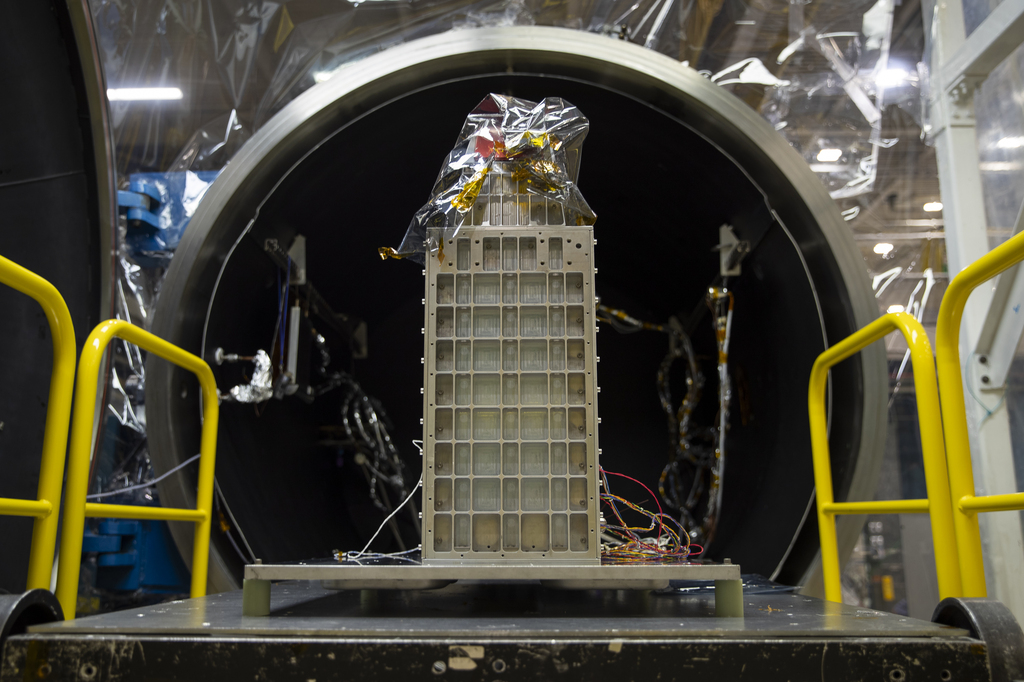
Installed on the exterior of the International Space Station, the new experiment will study the ring current — a doughnut-shaped swarm of particles that can surge when a solar blast hits Earth, disrupting our satellites in space and power systems on the ground.
The new experiment, called STORIE (Storm Time O+ Ring current Imaging Evolution), will study how particles enter and exit the ring current, helping us better protect our society from the threat of solar storms.
Learn more: https://science.nasa.gov/science-research/heliophysics/nasas-storie-mission-to-tell-tale-of-earths-ring-current/
Produced Video
Watch this video on the NASA Goddard YouTube channel.
Complete transcript available.
Music Credit: "A Gift” by Nicholas Smith [PRS] from Universal Production Music
Additional Imagery: J. Goldstein, Johns Hopkins APL
Sound Effects: Pixabay
After being installed on the International Space Station, NASA’s STORIE mission will scan outward, away from Earth, to image energetic neutral atoms (ENAs) from Earth’s ring current. It will view one slice of the ring current at a time, but as it orbits Earth, STORIE will build up a complete view of this invisible, doughnut-shaped band of particles. In this animation, the curved orange lines represent field lines in Earth’s magnetic field, and the moving wedge of green rays represents STORIE’s field of view as the space station orbits the planet. The graph at the bottom shows a simulation of STORIE’s observations of the ring current as it observes one side of the ring and then the other.
Credit: NASA/Gonzalo Cucho-Padin
This model shows how particles flow between Earth’s magnetotail (left) and the inner magnetosphere (right). The curved white line in the lower chart depicts the approximate boundary between those regions. Earth is represented as the black-and-white circle. The solar wind flows in from the right. The colors represent the velocity (speed and direction) that particles are flowing, either sunward (blue) or anti-sunward (red). The line plot in the upper chart represents the speed of flows as they enter the inner magnetosphere at different locations along the white curved boundary.
Credit: NASA/Alex Glocer
This simulation shows fluctuations in the doughnut-shaped ring current during a solar storm. In the color scale used here, yellow shows where the ring current is most intense while purple shows where it is least intense. The ring current can be very dynamic in time, and its intensity can vary significantly at different locations in space.
Credit: NASA/Austin Brenner
Credits
Please give credit for this item to:
NASA's Goddard Space Flight Center
-
Producer
- Lacey Young (eMITS)
-
Writers
- Lacey Young (eMITS)
- Miles S. Hatfield (Telophase)
- Joy Ng (eMITS)
-
Talent
- Alex Glocer (NASA/GSFC)
-
Videographers
- Lacey Young (eMITS)
- Joy Ng (eMITS)
-
Teleprompter operator
- Rob Andreoli (eMITS)
Related
- ID: 15043
 Produced Video
 - ID: 15013
 Produced Video
Sources
- ID: 14874
- ID: 14869
 Produced Video
Release date
This page was originally published on Friday, May 1, 2026.
This page was last updated on Friday, May 1, 2026 at 11:33 AM EDT.