Solar Wind Animations
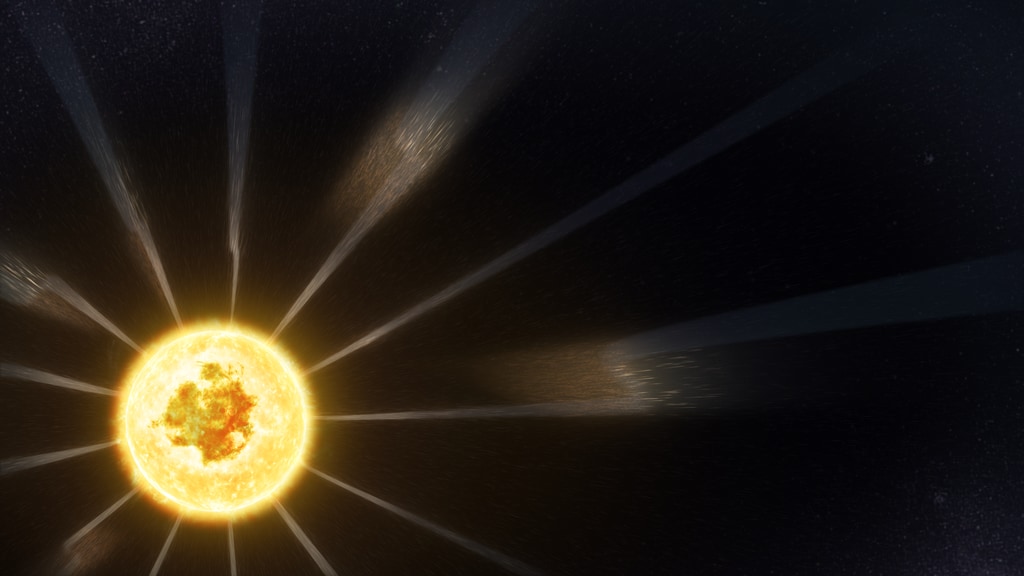
The Sun releases a constant stream of charged particles, called the solar wind. The solar wind originates in the outermost layer of the Sun’s atmosphere, the corona, when plasma is heated to a point that the Sun’s gravity can’t hold it down. When this plasma escapes – often reaching speeds of over one million miles per hour – it drags the Sun’s magnetic out across the solar system.
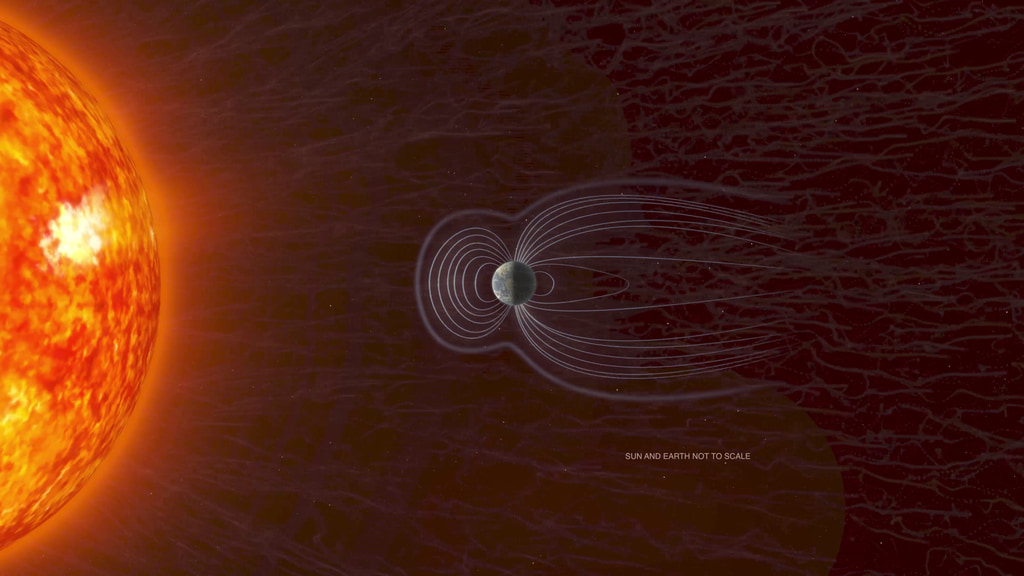
When the solar wind encounters Earth, it is deflected by our planet's magnetic shield, causing most of the solar wind's energetic particles to flow around and beyond us. However, some of these high-energy particles can sneak past Earth’s natural magnetic defenses and produce hazardous conditions for satellites and astronauts, as well as power grids and infrastructure on Earth.
Learn more about the solar wind: https://science.nasa.gov/sun/what-is-the-solar-wind/
Conceptual Animation
Artist interpretation of flying by the Earth, Sun and Heliopause.
Credit: NASA Goddard/CILJonathan North
Scientific Visualization
This movie shows the particle flow around the Earth as the CME strikes.
Credit: NASA Goddard/SVS/Greg Shirah, Horace Mitchell, Tom Bridgman
Conceptual Animation
Exactly where the solar wind transitions from a rotational flow to a perfectly radial flow has implications for how the Sun sheds energy. NASA's Parker Solar Probe located a transition region in the solar wind's flow that point may help us better understand the lifecycle of other stars or the formation of protoplanetary disks, the dense disks of gas and dust around young stars that eventually coalesce into planets.
Credit: NASA Goddard/CIL/Jonathan North
Conceptual Animation
Observed near Earth, the solar wind is a relatively uniform flow of plasma, with occasional turbulent tumbles. But by that point it’s traveled over ninety million miles — and the signatures of the Sun's exact mechanisms for heating and accelerating the solar wind are wiped out. Closer to the solar wind's source, NASA's Parker Solar Probe saw a much different picture: a complicated, active system.
Credit: NASA Goddard/CIL/Adriana Manrique Gutierrez
Conceptual Animation
This animation shows energetic particles from the Sun interacting with Earth’s magnetic field, called the magnetosphere. The magnetosphere is another one of Earth’s fundamental global fields. It originates from the churning of hot, liquid metals in our planet’s core and extends thousands of miles out into space. Our magnetosphere protects us from much of the radiation we encounter in the universe, including the Sun’s energetic particles (shown here coming from the left side of the animation). When these particles run into the magnetosphere, they tend to flow around it like air deflected by the nose of a supersonic jet.
Credit: NASA Goddard/CIL/Wes Buchanan, Krystofer Kim
Conceptual Animation
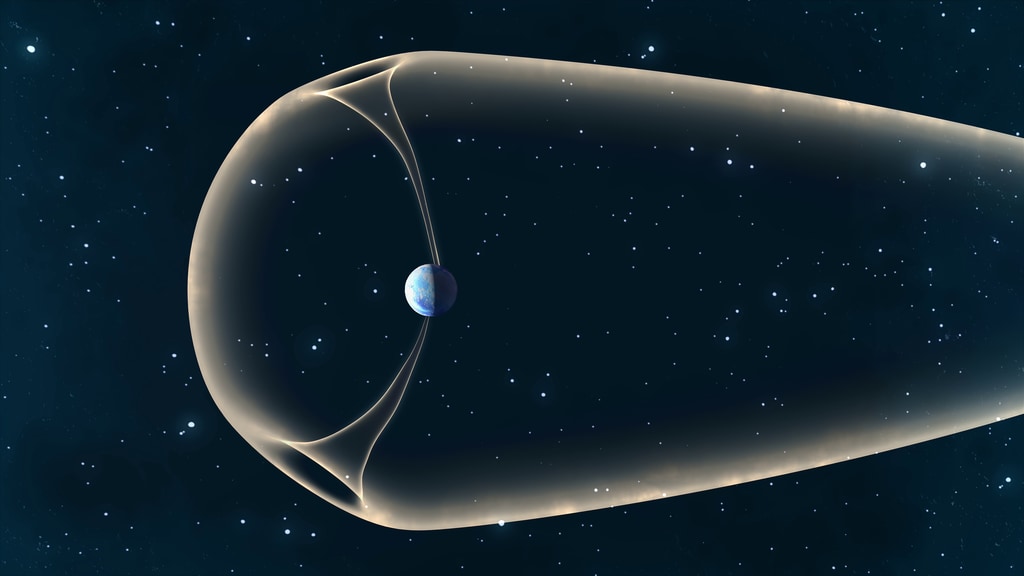
This artist’s concept shows Earth’s magnetosphere immersed in the so-called “fast” solar wind, which averages between about 300 - 500 miles per second (approx. 500 - 800 kilometers per second). The fast solar wind originates from coronal holes: darker, lower density patches of the Sun’s atmosphere where the Sun’s magnetic field lines connect to interplanetary space, allowing solar material to escape out in a high-speed stream. Coronal holes are more common closer to the Sun’s poles but can occasionally appear on any area of the Sun. When a fast stream of solar wind reaches Earth, it can compress Earth’s magnetosphere like a windsock blowing in the wind.
Credit: NASA Goddard/CIL/Bailee DesRocher
Conceptual Animation
This artist’s concept shows a representative state of Earth’s magnetosphere immersed in the so-called “slow” solar wind, which averages between about 180 - 300 miles per second (approx. 300 - 500 kilometers per second). The slow solar wind originates from coronal streamers and other solar features most commonly found around the Sun’s equator, which make the slow solar wind the typical state of the solar wind along the equatorial plane in which the planets orbit.
Credit: NASA Goddard/CIL/Bailee DesRocher
Conceptual Animation
A conceptual animation showing solar wind interacting with Earth's magnetic field and causing atmospheric loss at the polar cusps.
Credit: NASA Goddard/CIL/Josh Masters
Credits
Please give credit for this item to:
NASA's Goddard Space Flight Center
-
Producer
- Lacey Young (eMITS)
Related
- ID: 14956
 Produced Video
 - ID: 14683

- ID: 14628
![Discovering Earth's Third Global Energy FieldWatch this video on the NASA Goddard YouTube channel.Complete transcript available.Music credit: "Atoms in Motion" by Phillip John Gregory [PRS], “Curious By Nature” by Eddie Saffron [PRS], “Perfect Vibes” by Thomas Gallicani [SACEM], “Natural Response” by Jonathan Elisa [ASCAP] and Sarah Trevino [ASCAP] from Universal Production MusicSound effects: Pixabay](/vis/a010000/a014600/a014628/Thumbnail02.jpg) Produced Video
Produced Video - ID: 20347
 Animation
 - ID: 13506
 Produced Video
 - ID: 20299
 Animation
 - ID: 3902
 Visualization
Release date
This page was originally published on Friday, August 29, 2025.
This page was last updated on Friday, August 29, 2025 at 12:37 PM EDT.