NASA and NOAA Take to the Air to Chase Smoke
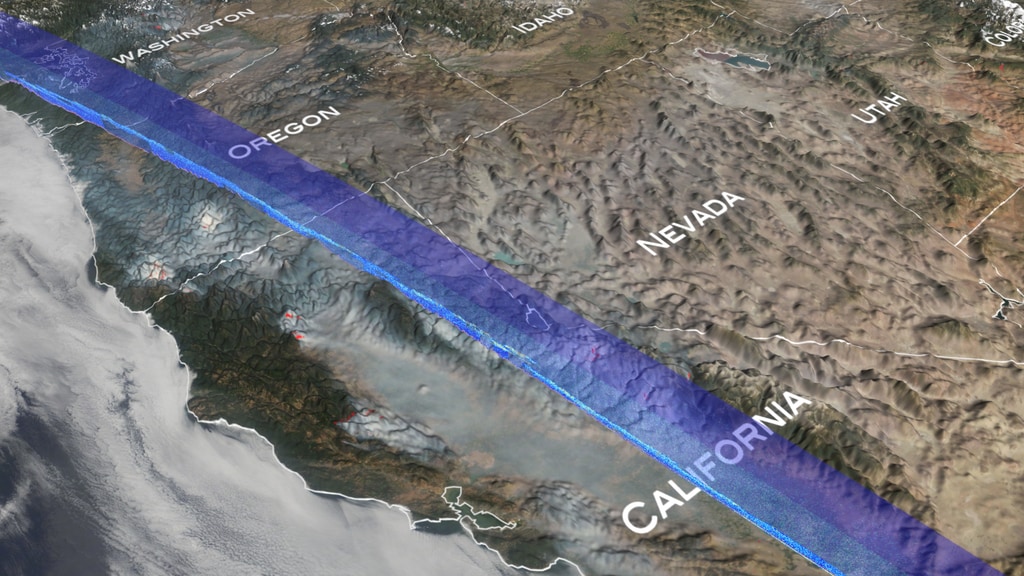
NASA, NOAA and university partners are taking to the skies, and the ground, to chase smoke from fires burning across the United States. The Fire Influence on Regional to Global Environments and Air Quality (FIREX-AQ) is starting in Boise, Idaho, with a long-term of goal of improving our understanding of how smoke from fires affects air quality across North America.
Credits
Please give credit for this item to:
NASA's Goddard Space Flight Center
-
Producers
- Kathryn Mersmann (USRA)
- LK Ward (USRA)
- Ellen T. Gray (ADNET Systems, Inc.)
-
Writer
- Samson K. Reiny (Wyle Information Systems)
-
Visualizer
-
Alex Kekesi
(Global Science and Technology, Inc.)

-
Alex Kekesi
(Global Science and Technology, Inc.)
Series
This page can be found in the following series:Related
- ID: 13281
![Music: Stepping Stone Bridge by Timothy Michael Hammond [PRS], Wayne Roberts [PRS]Watching Ladybirds by Benjamin James Parsons [PRS] This video can be freely shared and downloaded. While the video in its entirety can be shared without permission, some individual imagery provided by pond5.com and Artbeats is obtained through permission and may not be excised or remixed in other products. Specific details on stock footage may be found here. For more information on NASA’s media guidelines, visit https://www.nasa.gov/multimedia/guidelines/index.html. Complete transcript available.](/vis/a010000/a013200/a013281/Thumbnail_Arctic_Fires_Print.jpg) Produced Video
Produced Video - ID: 13263
Sources
- ID: 12772
![Tracking aerosols over land and water from August 1 to November 1, 2017. Hurricanes and tropical storms are obvious from the large amounts of sea salt particles caught up in their swirling winds. The dust blowing off the Sahara, however, gets caught by water droplets and is rained out of the storm system. Smoke from the massive fires in the Pacific Northwest region of North America are blown across the Atlantic to the UK and Europe. This visualization is a result of combining NASA satellite data with sophisticated mathematical models that describe the underlying physical processes.Music: Elapsing Time by Christian Telford [ASCAP], Robert Anthony Navarro [ASCAP]Complete transcript available.Watch this video on the NASA Goddard YouTube channel.](/vis/a010000/a012700/a012772/12772_hurricanes_and_aerosols_1080p_youtube_1080.00001_print.jpg) Produced Video
Produced Video - ID: 4729
 Visualization
Release date
This page was originally published on Monday, July 22, 2019.
This page was last updated on Wednesday, May 3, 2023 at 1:45 PM EDT.