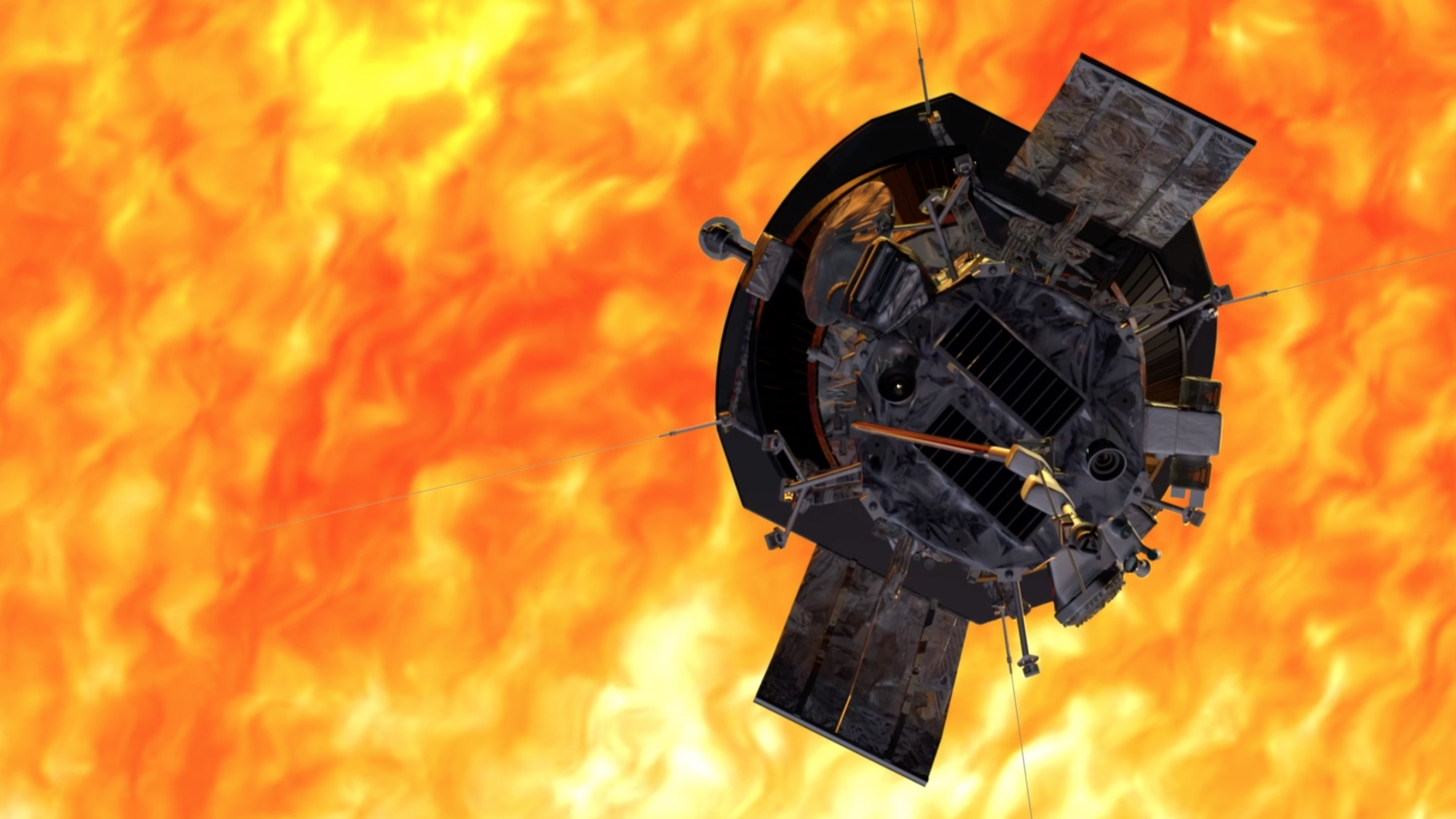
Why Won't it Melt? How NASA's Solar Probe will Survive the Sun
Music credit: Cheeky Chappy [Main Track] by Jimmy Kaleth, Ross Andrew McLean from www.killertracks.com This music requires a license for use.
Watch this video on the NASA Goddard YouTube channel.
Complete transcript available.
NASA's Parker Solar Probe is heading to the Sun. Why won't the spacecraft melt? Thermal engineer Betsy Congdon (Johns Hopkins APL) outlines why Parker can take the heat.
Credits
Please give credit for this item to:
NASA's Goddard Space Flight Center
-
Producer
- Genna Duberstein (USRA)
-
Editor
- Genna Duberstein (USRA)
-
Videographer
- Rob Andreoli (Advocates in Manpower Management, Inc.)
-
Engineer
- Betsy Congdon (Johns Hopkins University/APL)
-
Narrator
- Ryan Fitzgibbons (USRA)
-
Writer
- Genna Duberstein (USRA)
-
Animators
- Steve Gribben (Johns Hopkins University/APL)
- Brian Monroe (USRA)
- Josh Masters (USRA)
- Michael Lentz (USRA)
- Genna Duberstein (USRA)
-
Illustrator
- Mary P. Hrybyk-Keith (TRAX International)
Series
This page can be found in the following series:Related
- ID: 13282
 Produced Video
 - ID: 13457
 Produced Video
 - ID: 12903
![Discovering the Sun’s Mysteriously Hot Atmosphere Something mysterious is going on at the Sun. In defiance of all logic, its atmosphere gets much, much hotter the farther it stretches from the Sun’s blazing surface.Temperatures in the corona — the Sun’s outer atmosphere — spike to 3 million degrees Fahrenheit, while just 1,000 miles below, the underlying surface simmers at a balmy 10,000 F. How the Sun manages this feat is a mystery that dates back nearly 150 years, and remains one of the greatest unanswered questions in astrophysics. Scientists call it the coronal heating problem.Watch the video to learn how astronomers first discovered evidence for this mystery during an eclipse in the 1800s, and what scientists today think could explain it.Music credits: 'Developing Over Time' by Ben Niblett [PRS], Jon Cotton [PRS], 'Eternal Circle' by Laurent Dury [SACEM], ‘Starlight Andromeda' by Ben Niblett [PRS], Jon Cotton [PRS]Coronal spectrum image credit: Constantine EmmanouilidiComplete transcript available.Watch this video on the NASA Goddard YouTube channel.](/vis/a010000/a012900/a012903/CHP_Discovery_1080_4.00001_print.jpg) Produced Video
Produced Video
Release date
This page was originally published on Thursday, July 19, 2018.
This page was last updated on Wednesday, May 3, 2023 at 1:46 PM EDT.