General Comet Information
Visuals
- ID: 11307 Produced Video
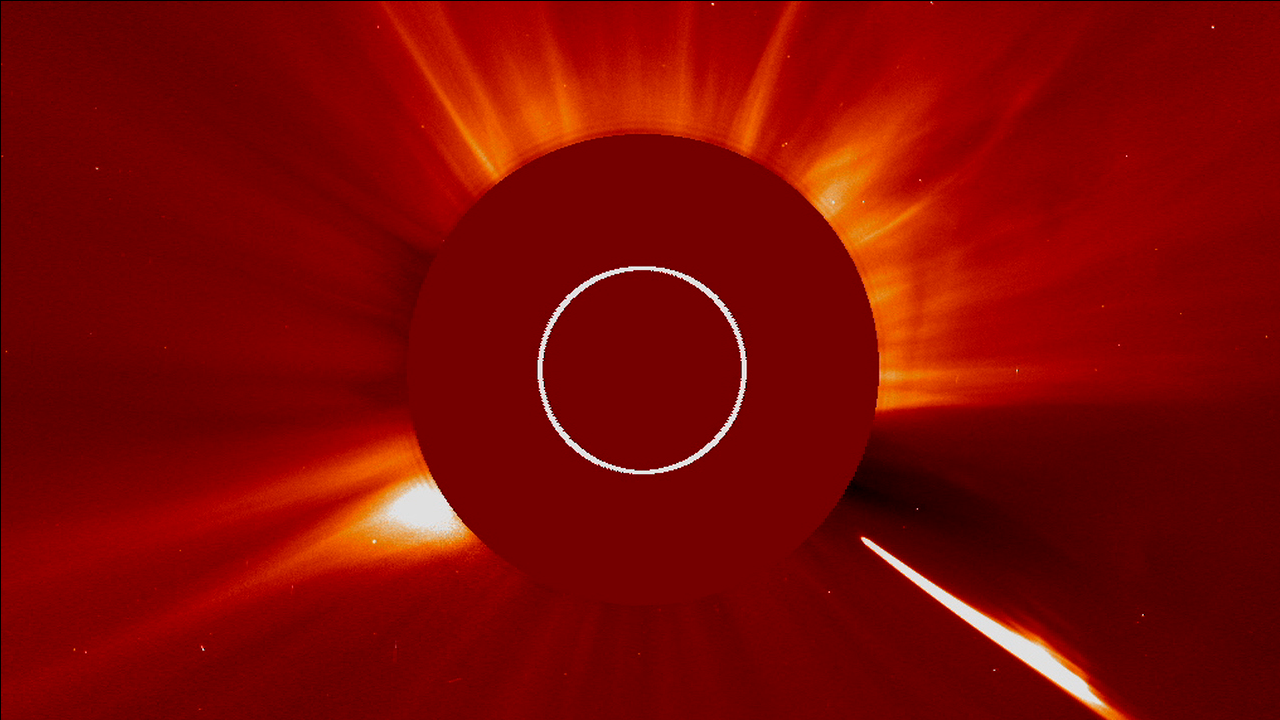
What is a Sungrazing Comet?
Go to this pageSungrazing comets are a special class of comets that come very close to the sun at their nearest approach, a point called perihelion. To be considered a sungrazer, a comet needs to get within about 850,000 miles from the sun at perihelion. Many come even closer, even to within a few thousand miles. Being so close to the sun is very hard on comets for many reasons. They are subjected to a lot of solar radiation which boils off their water or other volatiles. The physical push of the radiation and the solar wind also helps form the tails. And as they get closer to the sun, the comets experience extremely strong tidal forces, or gravitational stress. In this hostile environment, many sungrazers do not survive their trip around the sun. Although they don't actually crash into the solar surface, the sun is able to destroy them anyway. Many sungrazing comets follow a similar orbit, called the Kreutz Path, and collectively belong to a population called the Kreutz Group. In fact, close to 85% of the sungrazers seen by the SOHO satellite are on this orbital highway. Scientists think one extremely large sungrazing comet broke up hundreds, or even thousands, of years ago, and the current comets on the Kreutz Path are the leftover fragments of it. As clumps of remnants make their way back around the sun, we experience a sharp increase in sungrazing comets, which appears to be going on now. Comet Lovejoy, which reached perihelion on December 15, 2011 is the best known recent Kreutz-group sungrazer. And so far, it is the only one that NASA's solar-observing fleet has seen survive its trip around the sun. Comet ISON, an upcoming sungrazer with a perihelion of 730,000 miles on November 28, 2013, is not on the Kreutz Path. In fact, ISON's orbit suggests that it may gain enough momentum to escape the solar system entirely, and never return. Before it does so, it will pass within about 40 million miles from Earth on December 26th. Assuming it survives its trip around the sun. ||
- ID: 11156 Produced Video
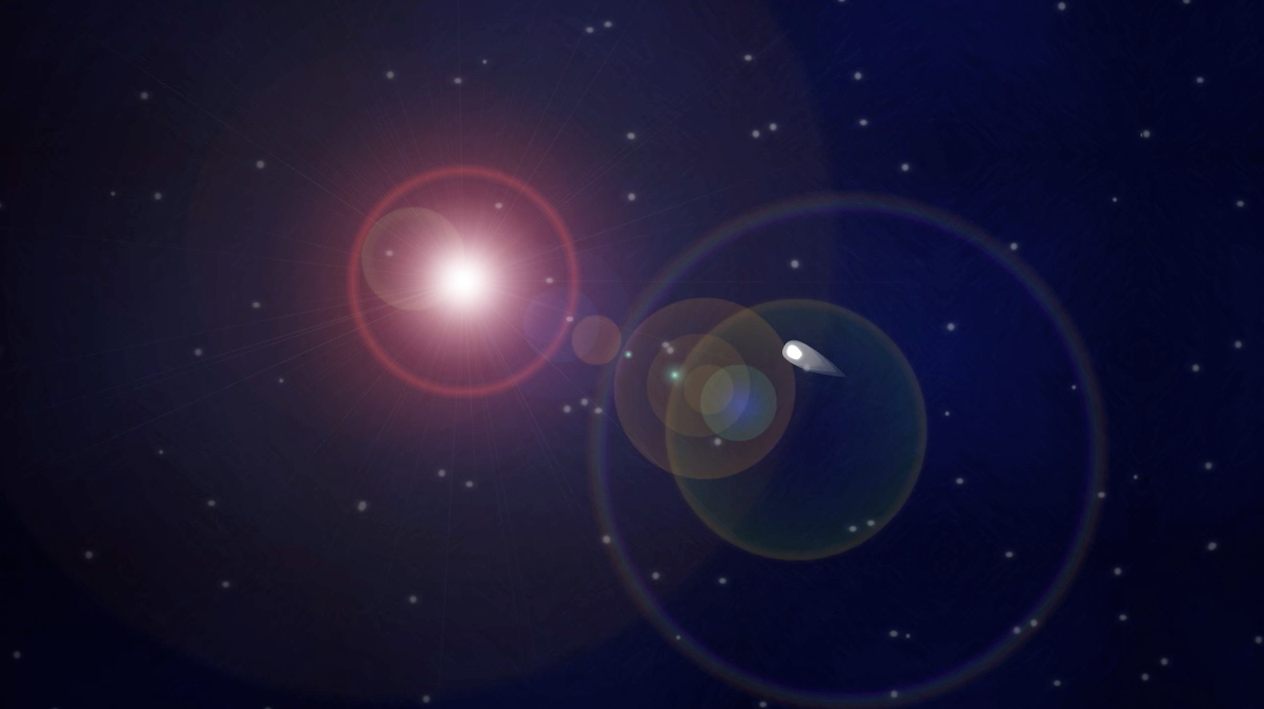
Sungrazers Galore
Go to this pageBefore 1979, there were less than a dozen known sungrazing comets. As of December 2012, we know of 2,500. Why did this number increase? With solar observatories like SOHO, STEREO, and SDO, we have not only better means of viewing the sun, but also the comets that approach it. SOHO allows us to see smaller, fainter comets closer to the sun than we have ever been able to see before. Even though many of these comets do not survive their journey past the sun, they survive long enough to be observed, and be added to our record of sungrazing comets. ||
- ID: 11158 Produced Video

Sun Grazing Comets as Solar Probes
Go to this pageTo observe how winds move high in Earth's atmosphere, scientists sometimes release clouds of barium as tracers to track how the material corkscrews and sweeps around — but scientists have no similar technique to study the turbulent atmosphere of the sun. So researchers were excited in December 2011, when Comet Lovejoy swept right through the sun's corona with its long tail streaming behind it. NASA's Solar Dynamics Observatory (SDO) captured images of the comet, showing how its long tail was buffeted by systems around the sun, offering scientists a unique way of observing movement as if they'd orchestrated the experiment themselves. Since comet tails have ionized gases, they are also affected by the sun's magnetic field, and can act as tracers of the complex magnetic system higher up in the atmosphere. Comets can also aid in the study of coronal mass ejections and the solar wind.Watch this video on YouTube. ||
- ID: 4018 Visualization
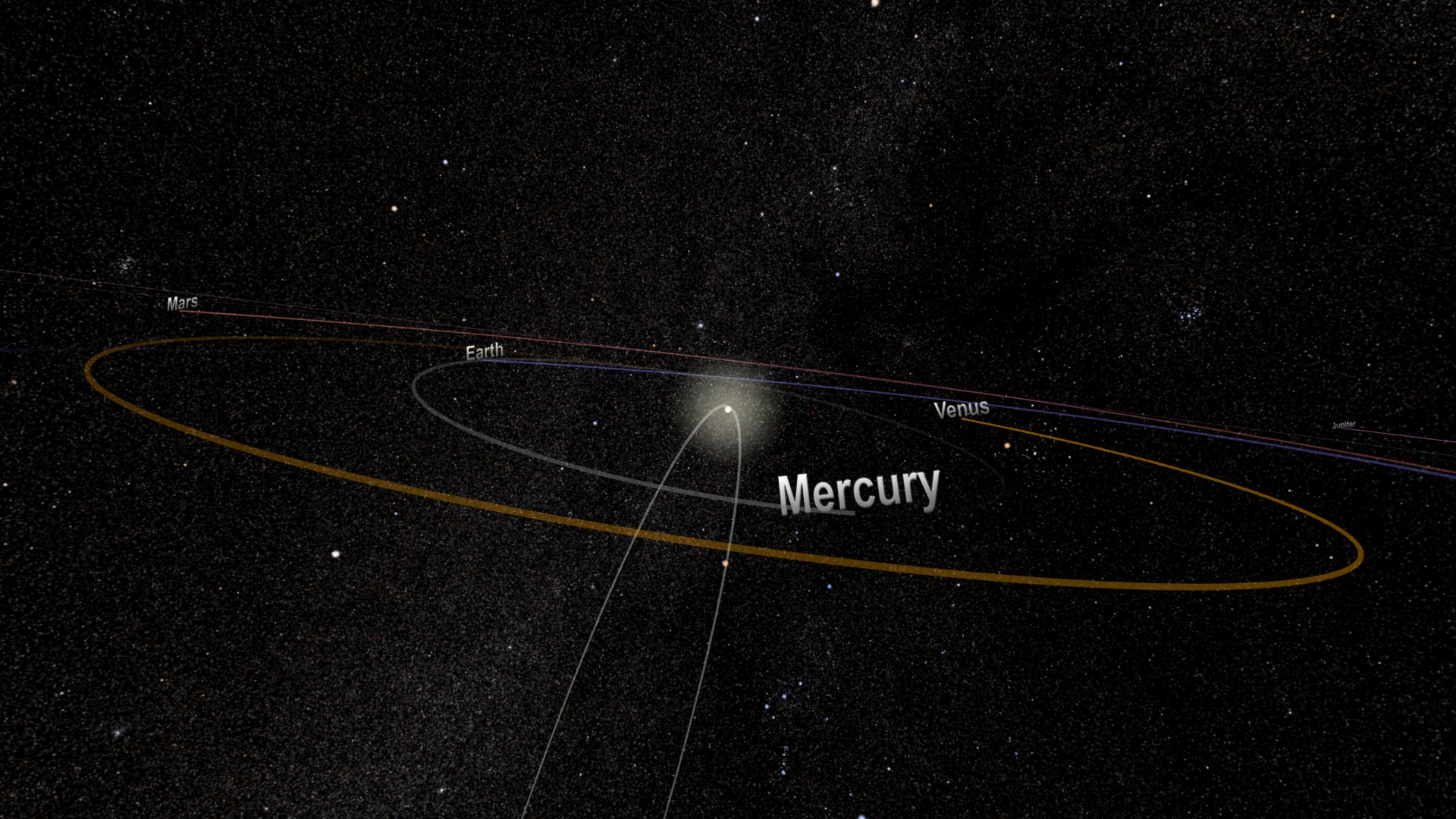
Kreutz Comet Orbits
Go to this pageHD movie of representative orbit of a sungrazing comet. || Kreutz.noslate_HEEmove.HD1080i.0350.jpg (1920x1080) [582.0 KB] || Kreutz.noslate_HEEmove.HD1080i.0350_web.png (320x180) [92.0 KB] || Kreutz.noslate_HEEmove.HD1080i.0350_thm.png (80x40) [4.5 KB] || Kreutz-Lovejoy_HD1080.mov (1920x1080) [13.2 MB] || Kreutz-Lovejoy_HD1080.mp4 (1920x1080) [13.2 MB] || 1920x1080_16x9_30p (1920x1080) [64.0 KB] || Kreutz-Lovejoy_HD1080.webmhd.webm (960x540) [2.9 MB] || Kreutz-Lovejoy_iPod.m4v (640x360) [3.0 MB] ||