Carruthers Geocorona Observatory
Overview
The Carruthers Geocorona Observatory is a SmallSat mission at the Sun-Earth Lagrange point 1 (L1) where it uses advanced ultraviolet imagers to monitor Earth’s exosphere, the outermost layer of the atmosphere.. Carruthers is the first SmallSat to operate at L1 and the first mission dedicated to observing the exosphere, including its response to solar-driven space weather
The Carruthers Geocorona Observatory launched on Sept. 24, 2025, from NASA’s Kennedy Space Center in Florida.
Learn more: https://science.nasa.gov/mission/carruthers-geocorona-observatory/
Carruthers Produced Content
- ID: 14887 Produced Video
![Produced VideoWatch this video on the NASA Goddard YouTube channel.Complete transcript available.Music Credit: "Time in Motion” by Rick Hearson [PRS], “Proud Patterns by Paul Joseph Smith [PRS] from Universal Production Music](/vis/a010000/a014800/a014887/14887_Thumbnail.jpg)
NASA Mission to Study Giant ‘Halo’ Surrounding Earth
Go to this pageIn 1972, Apollo 16 astronauts placed an ultraviolet camera on the Moon that captured the first images of Earth’s geocorona, the light emitted by Earth’s outermost atmospheric layer. A new NASA mission bearing the name of the telescope’s creator, Dr. George R. Carruthers, will launch into space to build on that legacy. From a vantage point roughly one million miles closer to the Sun than Earth is, the Carruthers Geocorona Observatory will capture the most comprehensive views of the geocorona to date. The observations will reveal new insights into the structure of our atmosphere, how solar eruptions impact Earth, and how a planet’s surface water can escape to space, aiding the search for habitable planets elsewhere in the universe.Learn more about Carruthers Geocorona Observatory science: https://science.nasa.gov/science-research/heliophysics/new-nasa-mission-to-reveal-earths-invisible-haloLearn more about the Carruthers Geocorona Observatory: https://science.nasa.gov/mission/carruthers-geocorona-observatory/ ||
- ID: 14249 Produced Video
![Watch this video on the NASA Goddard YouTube channel.Complete transcript available.Image credits: U.S. Naval Research LaboratoryMusic credits: “Bright Life” Tristan Lewis Noon [PRS]](/vis/a010000/a014200/a014249/14249_CarruthersGeocoronaObservatoryRenaming_YouTube.00095_print.jpg)
NASA Names Mission in Honor of Apollo-Era Visionary Dr. George R. Carruthers
Go to this pageDr. George R. Carruthers (1939 - 2020) was a visionary scientist, inventor, engineer and educator. On Dec. 2, he became the namesake of a new NASA mission. The Carruthers Geocorona Observatory will observe Earth from space. The mission will capture light from Earth’s geocorona, the part of the outer atmosphere that emits ultraviolet light and will be ready to launch in 2025. ||
Carruthers Science Animations
- ID: 14855 Produced Video
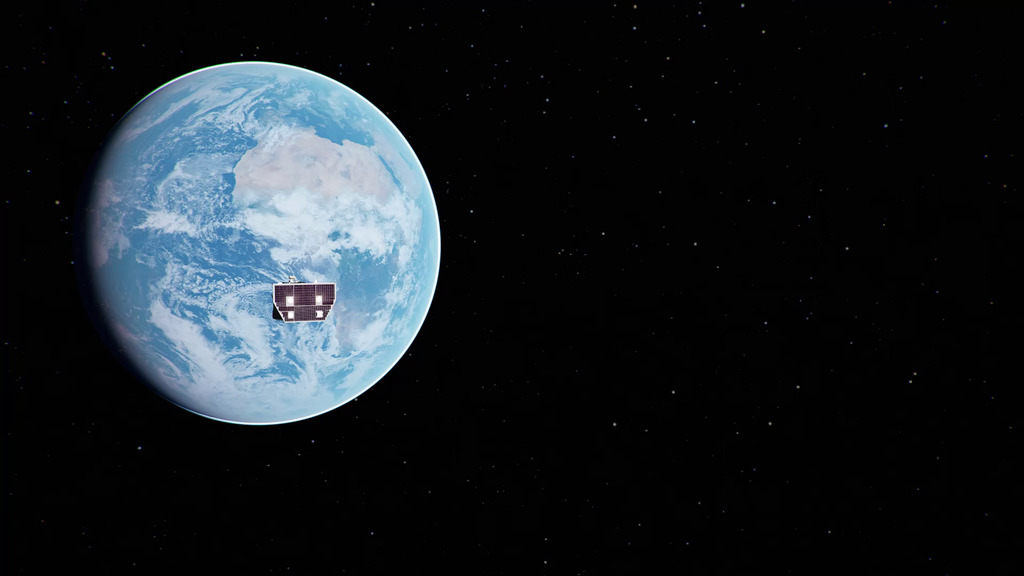
Carruthers Geocorona Observatory Beauty Pass Animations
Go to this pageThe Carruthers Geocorona Observatory is a SmallSat mission at Lagrange Point 1 (L1) where it will use an advanced ultraviolet imager to monitor Earth’s exosphere — the outermost layer of the atmosphere — and the exosphere’s response to solar-driven space weather. Carruthers is poised to become the first SmallSat to operate at L1 and the first to deliver continuous exospheric observations from this vantage point.Led by the University of Illinois Urbana-Champaign, the mission is scheduled to launch no earlier than 2025 as a rideshare component of NASA’s Interstellar Mapping and Acceleration Probe (IMAP) mission, which will explore the boundaries of the heliosphere, the bubble that is inflated by the solar wind and surrounds the Sun and planets. The Carruthers Geocorona Observatory is a vital addition to NASA’s fleet of heliophysics satellites. NASA Heliophysics Division missions study a vast, interconnected system from the Sun to the space surrounding Earth and other planets to the farthest limits of the Sun’s constantly flowing streams of solar wind. ||
- ID: 20407 Animation
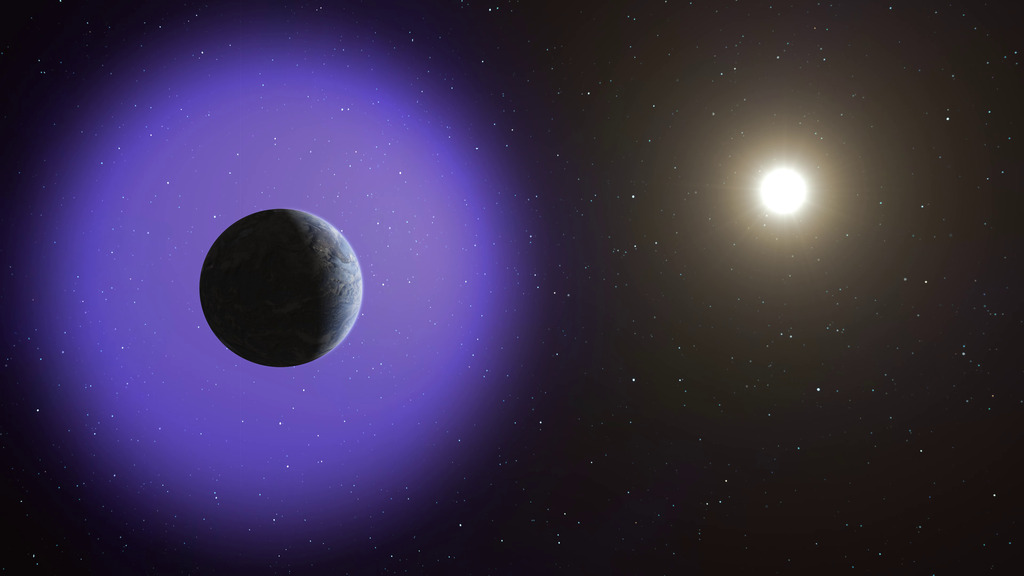
Carruthers Geocorona Animation
Go to this pageThe Carruthers Geocorona Observatory is a SmallSat mission at Lagrange Point 1 (L1) where it will use an advanced ultraviolet imager to monitor Earth’s exosphere — the outermost layer of the atmosphere — and the exosphere’s response to solar-driven space weather. Carruthers is poised to become the first SmallSat to operate at L1 and the first to deliver continuous exospheric observations from this vantage point.In this animation, atomic hydrogen floats in Earth’s exosphere. As the lightest chemical in existence, atomic hydrogen tends to float away, or evaporate, off the top of Earth’s atmosphere. When the Sun shines on these atoms, they scatter that light in all directions, causing a glow around Earth. This fuzzy halo of light that’s given off by those exospheric atoms is called the geocorona. ||
- ID: 20405 Animation
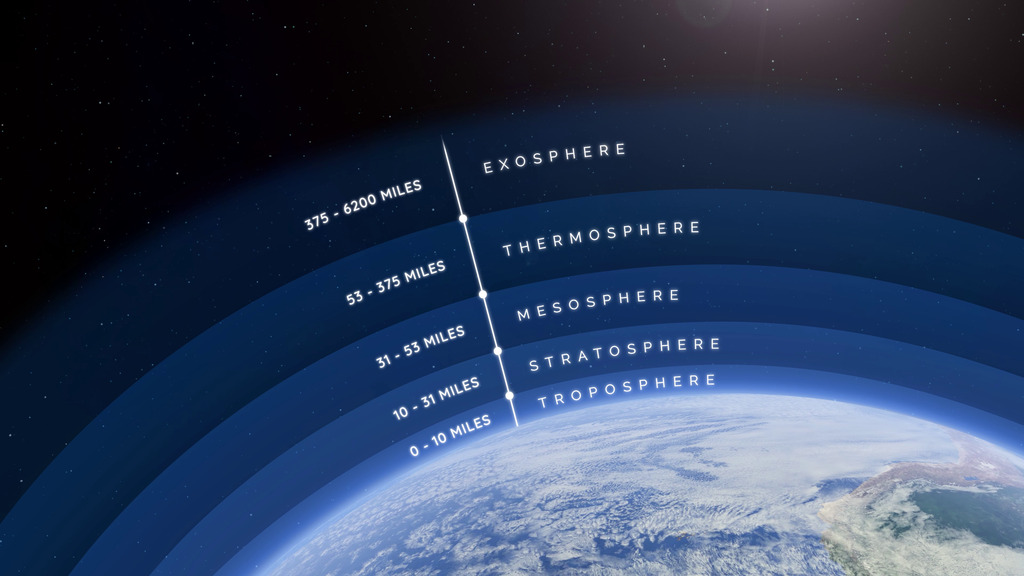
Carruthers Atmospheric Layers Animation
Go to this pageEarth’s atmosphere is divided into five main layers, differentiated by factors such as temperature, chemical composition, and air density. The troposphere is the lowest layer, extending from Earth's surface up to about 10 miles above it, and is where almost all weather phenomena occur. Above the troposphere is the stratosphere, which reaches up to around 31 miles. It contains the ozone layer, which absorbs harmful ultraviolet (UV) radiation from the Sun. Next is the mesosphere, which extends from about 31 to 53 miles above Earth. It is the coldest layer of the atmosphere, and it is where most meteors burn up upon entering. Above the mesosphere is the thermosphere, ranging from about 53 to 375 miles above Earth. Known as the upper atmosphere, this region contains the ionosphere, a region filled with charged particles that enable radio communications and where auroras often occur. The outermost layer is the exosphere, which gradually transitions into outer space. It is extremely thin and composed mainly of hydrogen and helium. Together, these layers form a protective shield that regulates Earth’s energy balance and helps sustain life. ||
Carruthers B-Roll & Photos
- ID: 14904 Produced Video

NASA, NOAA Launch Three Spacecraft to Map Sun’s Influence Across Space
Go to this pageNASA and the National Oceanic and Atmospheric Administration (NOAA) launched three new missions Wednesday, Sept. 24, 2025, to investigate the Sun’s influence across the solar system.At 7:30 a.m. EDT, a SpaceX Falcon 9 rocket lifted off from Launch Complex 39A at NASA’s Kennedy Space Center in Florida carrying the agency’s IMAP (Interstellar Mapping and Acceleration Probe), Carruthers Geocorona Observatory, and NOAA’s SWFO-L1 (Space Weather Follow On-Lagrange 1) spacecraft.Learn more about IMAP: https://science.nasa.gov/mission/imap/Learn more about Carruthers Geocorona Observatory: https://science.nasa.gov/mission/carruthers-geocorona-observatory/Learn more about SWFO-L1: https://science.nasa.gov/mission/swfo-l1/ ||
- ID: 14830 Produced Video

Carruthers Geocorona Observatory Images
Go to this pageThe Carruthers Geocorona Observatory is a SmallSat mission at Lagrange Point 1 (L1) where it will use an advanced ultraviolet imager to monitor Earth’s exosphere — the outermost layer of the atmosphere — and the exosphere’s response to solar-driven space weather. Carruthers is poised to become the first SmallSat to operate at L1 and the first to deliver continuous exospheric observations from this vantage point.Led by the University of Illinois Urbana-Champaign, the mission is scheduled to launch no earlier than 2025 as a rideshare component of NASA’s Interstellar Mapping and Acceleration Probe (IMAP) mission, which will explore the boundaries of the heliosphere, the bubble that is inflated by the solar wind and surrounds the Sun and planets. The Carruthers Geocorona Observatory is a vital addition to NASA’s fleet of heliophysics satellites. NASA Heliophysics Division missions study a vast, interconnected system from the Sun to the space surrounding Earth and other planets to the farthest limits of the Sun’s constantly flowing streams of solar wind. ||
- ID: 14841 Produced Video
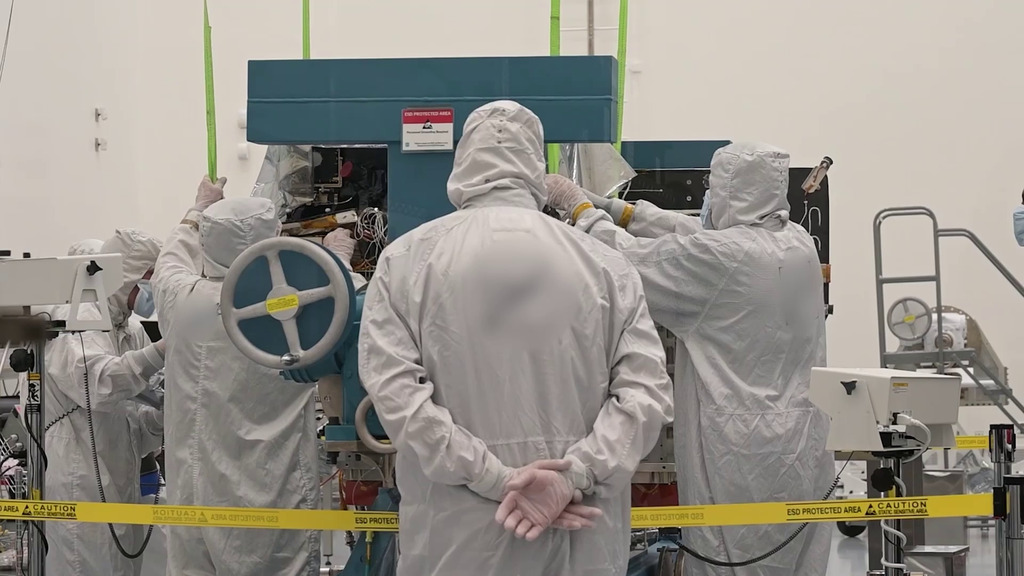
Carruthers Geocorona Observatory Assembly & Testing at BAE Systems
Go to this pageThe Carruthers Geocorona Observatory is a SmallSat mission at Lagrange Point 1 (L1) where it will use an advanced ultraviolet imager to monitor Earth’s exosphere — the outermost layer of the atmosphere — and the exosphere’s response to solar-driven space weather. Carruthers is poised to become the first SmallSat to operate at L1 and the first to deliver continuous exospheric observations from this vantage point.Led by the University of Illinois Urbana-Champaign, the mission is scheduled to launch no earlier than 2025 as a rideshare component of NASA’s Interstellar Mapping and Acceleration Probe (IMAP) mission, which will explore the boundaries of the heliosphere, the bubble that is inflated by the solar wind and surrounds the Sun and planets. The Carruthers Geocorona Observatory is a vital addition to NASA’s fleet of heliophysics satellites. NASA Heliophysics Division missions study a vast, interconnected system from the Sun to the space surrounding Earth and other planets to the farthest limits of the Sun’s constantly flowing streams of solar wind. ||
- ID: 14875 Produced Video
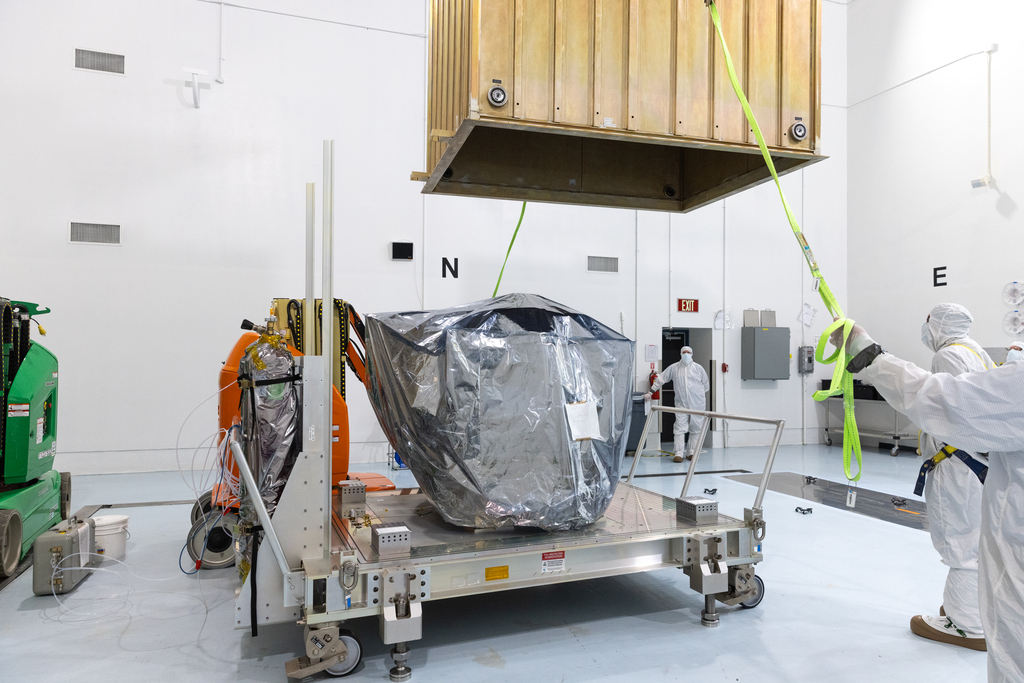
Carruthers Geocorona Observatory Arrives at Kennedy Space Center
Go to this pageNASA's Carruthers Geocorona Observatory arrived at the Astrotech Space Operations Facility near the agency’s Kennedy Space Center in Florida on Monday, July 21, 2025. The Carruthers Geocorona Observatory is a small satellite set to operate at Lagrange Point 1 (L1), an orbit point between the Earth and Sun about one million miles away. Carruthers will use its ultraviolet cameras to monitor how space weather from the Sun impacts the exosphere, the outermost part of Earth’s atmosphere. The observatory will launch as a rideshare with NASA’s Interstellar Mapping and Acceleration Probe no earlier than September 2025. ||
Carruthers Orbit at Lagrange Point 1
- ID: 5419 Visualization

The Carruthers Geocorona Observatory at the Earth-Sun Lagrange Point 1
Go to this pageThe Carruthers Geocorona Obervatory observes Earth's exosphere, or geocorona, from the Earth-Sun Lagrange Point 1.
- ID: 5567 Visualization
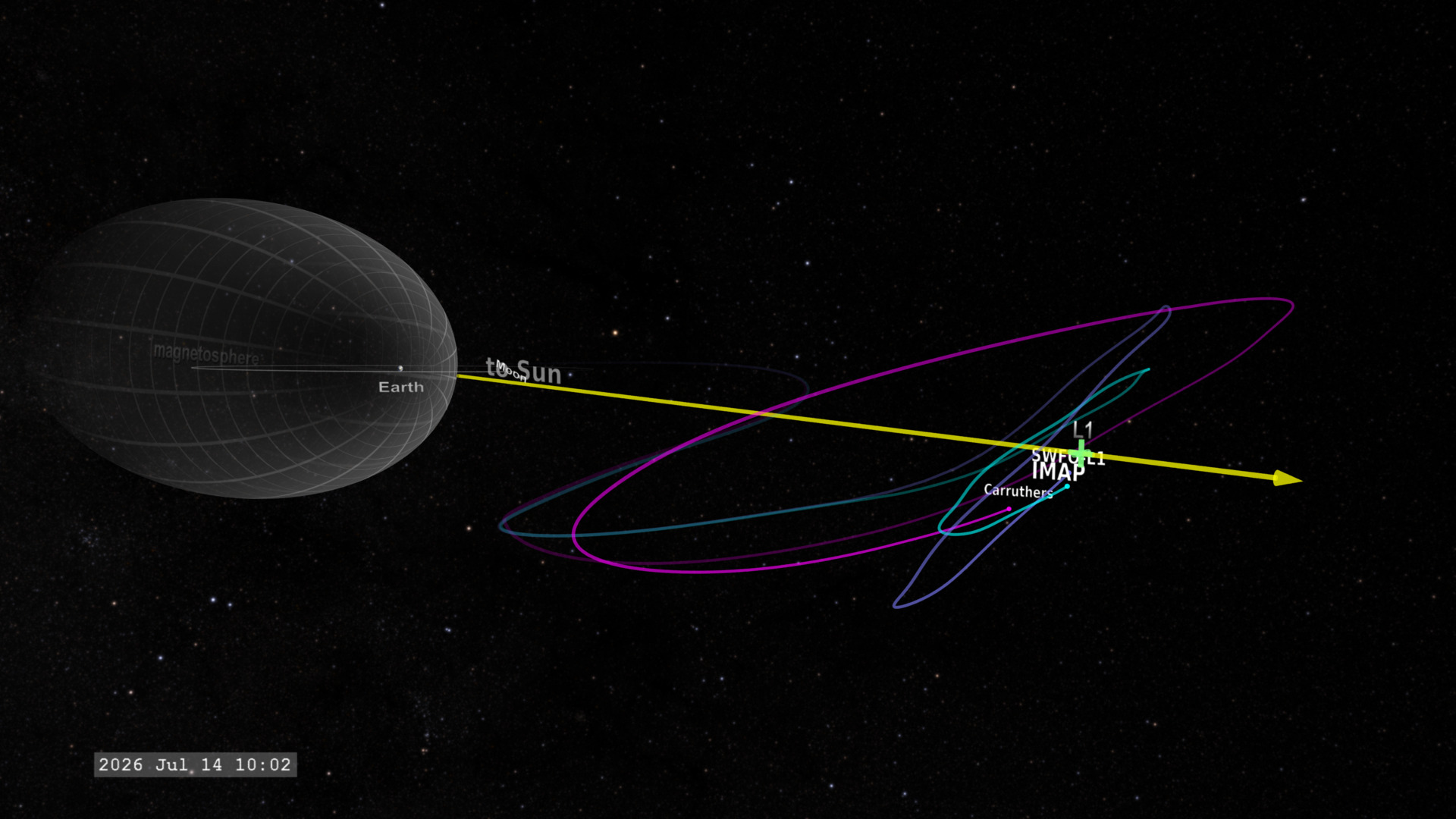
New Missions to L1
Go to this pageThree missions, Carruthers, IMAP and SWFO-L1 will be launched to the Sun-Earth Lagrange Point, L1.
- ID: 14873 Produced Video
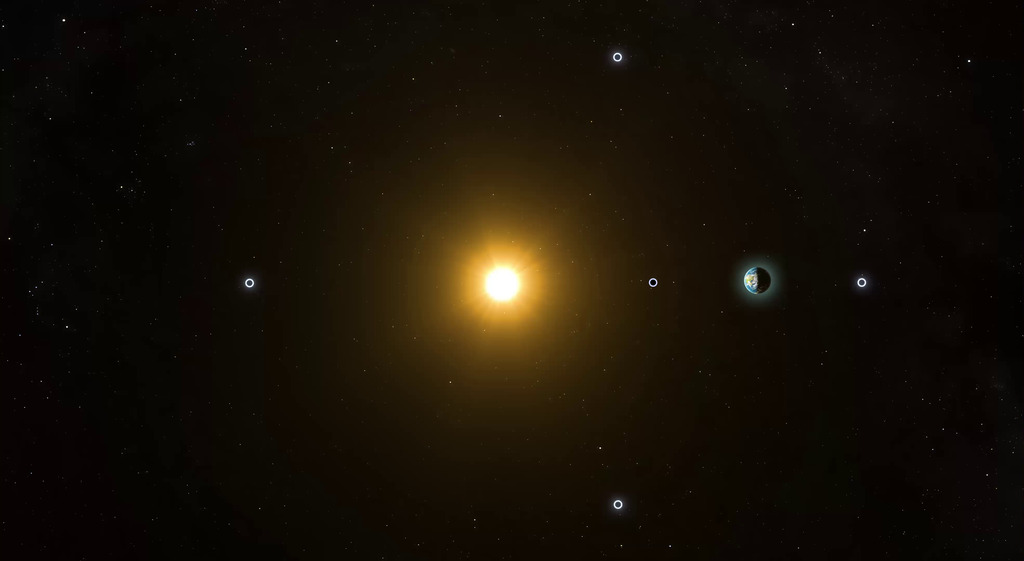
Lagrange Point 1 Animation
Go to this pageLagrange points are positions in space where objects sent there tend to stay put. At Lagrange points, the gravitational pull of two large masses precisely equals the centripetal force required for a small object to move with them. These points in space can be used by spacecraft to reduce fuel consumption needed to remain in position.Of the five Lagrange points, three are unstable and two are stable. The unstable Lagrange points - labeled L1, L2 and L3 - lie along the line connecting the two large masses. The stable Lagrange points - labeled L4 and L5 - form the apex of two equilateral triangles that have the large masses at their vertices. L4 leads the orbit of earth and L5 follows.The L1 point of the Earth-Sun system affords an uninterrupted view of the Sun and will be home to three new heliophysics missions in 2025 - NASA's Interstellar Mapping and Acceleration Probe (IMAP), NASA's Carruthers Geocorona Observatory, and NOAA's Space Weather Follow On-Lagrange 1 (SWFO-L1). ||