How Gravitational Waves Can Reveal New Worlds
Watch to learn how the presence of a planet modifies the gravitational wave signal from tightly orbiting white dwarfs. The LISA (Laser Interferometer Space Antenna) observatory could detect a Jupiter-mass planet in such systems up to thousands of light-years away.
Credit: NASA Goddard Space Flight Center
Music: “A Light Left Burning” Lukas Knoebl [SESAC], Universal Production Music
Watch this video on the NASA Goddard YouTube channel.
Alt text: Video explainer of LISA exoplanet detection
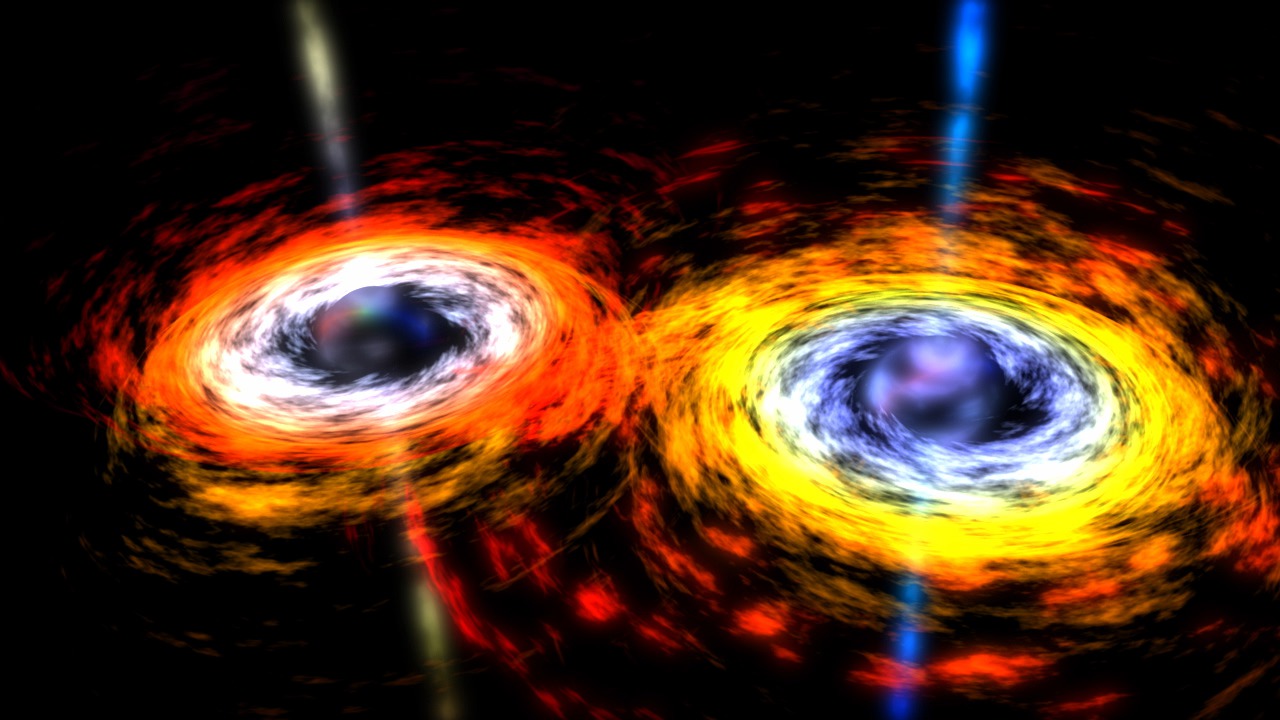
0:00 Distorting orange waves travel outward as black holes orbit on a purple gradient background with lines and crosses on a grid.
0:04 Text reads "Orbiting objects make gravitational waves, outward-moving ripples in space-time."
0:11 Orbiting white dwarf stars appear against a starry background. We first view the system from above its orbital plane and tip toward a nearly side-on view. Text reads "Close binaries made of white dwarfs, neutron stars, and stellar-mass black holes produce strong gravitational wave signals." A purple spiral emanates from the binary as the camera pulls back.
0:21 A pure tone sounds as a graph appears below the binary. The left axis is labeled "Power," the bottom axis reads "Frequency." A single purple bar rises midway across the graph. Text reads "This tone, boosted into the range of human hearing, simulates that signal."
0:30 Text reads "If planets orbit such binaries, those signals become modified in a simple way."
0:31 A new system fades in, where a big planet orbits two white dwarfs.
0:36 Purple gravitational waves again appear, but in a different configuration. Text reads: "The planet’s gravitational tug moves the binary."
0:43 The graph reappears, and the central bar now has two smaller companions on each side. The smallest ones are farthest from the center. Text reads "And this changes the signal."
0:45 A tone again emerges but now resembles a ringing signal.
0:49 Against a starry sky, a yellow Sun appears with Earth tracing an orbit around it. A red triangle representing the LISA observatory spins as it follows Earth, and a red line traces its orbit.
0:53 Text reads "A space-based gravitational wave detector like ESA’s LISA mission"
1:01 The camera sweeps through a starfield and settles on a smattering of stars. Double circles appear around four of them. Text reads "could find a wide range of planets throughout our galaxy in this way."
1:04 A flash and a grid showing 12 exoplanets appears.
1:07 The camera pulls back and more planets appear.
1:09 The NASA insignia appears.
The LISA (Laser Interferometer Space Antenna) observatory, now in development, will detect gravitational waves, the tiny ripples in space-time caused by orbiting masses. New studies explore how LISA could reveal a new and unique population of exoplanets — worlds beyond our solar system — throughout our galaxy.
The most common source for LISA is expected to be double white dwarf systems, which are binaries composed of white dwarfs in tight orbits. If an exoplanet also orbits within one of these systems, its presence becomes imprinted on the gravitational wave signal in a way we’ll be able to uncover.
The LISA detection method is similar to one called radial velocity that uses light and is already employed to find exoplanets around nearby stars. As a planet orbits, its gravity tugs on its host star, imparting a small reflex motion, or wobble, onto it. This wobble causes the star’s spectrum to oscillate, with spectral lines shifting from redder wavelengths as the star moves away from us to bluer ones as the star moves toward us. The shift is due to a phenomenon called the Doppler effect.
Something similar occurs with gravitational waves. By themselves, double white dwarfs will emit gravitational waves at a nearly continuous frequency. Add a sufficiently massive planet to the system, and its presence causes the binary to experience reflex motion, adding a Doppler modulation to the gravitational signal. For LISA, this modulation will appear as sidebands, secondary signals at both higher and lower frequencies than the primary one.
Scientists liken the situation to modern radio communication, where some of the energy of a main radio carrier frequency goes into forming sidebands at adjacent upper and lower frequencies that carry messages (like voices or music). For gravitational waves, the sidebands carry messages about the presence of a planet.
Using this technique for a test case system at a distance of 500 light-years, researchers have found that LISA could detect a sub-Jupiter exoplanet under ideal circumstances.
Watch to learn how the presence of a planet modifies the gravitational wave signal from tightly orbiting white dwarfs. The LISA (Laser Interferometer Space Antenna) observatory could detect a Jupiter-mass planet in such systems up to thousands of light-years away.
Credit: NASA Goddard Space Flight Center
Music: “A Light Left Burning” Lukas Knoebl [SESAC], Universal Production Music
Alt text: Vertical video explainer of LISA exoplanet detection
Visual description same as above.
Watch to learn how the presence of a planet modifies the gravitational wave signal from tightly orbiting white dwarfs. The LISA (Laser Interferometer Space Antenna) observatory could detect a Jupiter-mass planet in such systems up to thousands of light-years away.
Credit: NASA Goddard Space Flight Center
Music: “A Light Left Burning” Lukas Knoebl [SESAC], Universal Production Music
Alt text: 4x5 vertical Video explainer of LISA exoplanet detection
Visual description same as above.
The gravitational waves generated by double white dwarf systems produce a signal with a nearly continuous frequency. The tone heard here simulates what LISA might detect from such a system but has been moved into the range of human hearing.
Credit: NASA Goddard Space Flight Center
Description: Orbiting white dwarf stars appear almost side-on against a starry background. A purple spiral emanates from the binary. A pure tone sounds, and a graph appears below the binary; a single purple bar rises midway across the graph. The left axis is labeled "Power," the bottom axis reads "Frequency." Text reads "Here's the tone from just the white dwarf binary stars."
The gravitational waves generated by double white dwarf systems become modified when an exoplanet is added. The tone heard here simulates what LISA might detect from such a system but has been moved into the range of human hearing.
Credit: NASA Goddard Space Flight Center
Description: Orbiting white dwarf stars appear almost side-on against a starry background; a planet orbits the stellar pair. A purple spiral emanates from the binary but has a different pattern due to the planet's presence. A tone with a ringing sound is heard, a graph appears below the binary. A single purple bar rises at the graph's center but is flanked by two smaller bars — evidence of the planet's presence. The left axis is labeled "Power," the bottom axis reads "Frequency." Text reads "Here's the tone with an exoplanet added."
For More Information
See NASA.gov
Credits
Please give credit for this item to:
NASA's Goddard Space Flight Center
-
Producer
- Scott Wiessinger (eMITS)
-
Science writer
- Francis Reddy (University of Maryland College Park)
-
Scientist
- Scott Noble (NASA/GSFC)
-
Animator
- Adriana Manrique Gutierrez (eMITS)
Related
- ID: 14698
 Produced Video
- ID: 30569
 Hyperwall Visual
- ID: 10140
 Produced Video
- ID: 10143
 Produced Video
Release date
This page was originally published on Tuesday, November 10, 2026.
This page was last updated on Tuesday, November 10, 2026 at 10:35 AM EST.