NASA, Partners Prepare EXCITE for Antarctic Flight

The EXCITE (EXoplanet Climate Infrared TElescope) payload hangs inside the Integration and Testing complex at NASA’s Goddard Space Flight Center in Greenbelt, Md., on June 11, 2026. The team, including Principal Investigator Peter Nagler, seen at lower right, prepared EXCITE for shipment to NASA’s CSBF (Columbia Scientific Balloon Facility) in Palestine, Texas.
Credit: NASA/Scott Wiessinger
Alt text: EXCITE hangs from a crane in a large space.
Image description: A large telescope hangs from a crane in a cavernous space. The telescope sits inside a white base and pokes out from under a white triangular cover. Various pieces of electrical components with dangling wires and tubes are attached to the front of the base. Two solar panels are attached to the back of the telescope and extend to either side. A man in a yellow vest and white hard hat sits at a desk to the right of the telescope, and a row of tool chests is lined up along the right.
During the first half of 2026, the EXCITE (EXoplanet Climate Infrared TElescope) team prepared their scientific payload for its long-duration balloon flight from McMurdo Station in Antarctica. The hardware shipped from NASA’s CSBF (Columbia Scientific Balloon Facility) in Palestine, Texas, in August.
EXCITE’s goal is to study the atmospheres around hot Jupiters, gas giant exoplanets that complete an orbit once every one to two days and have surface temperatures reaching thousands of degrees.
The telescope is designed fly to about 132,000 feet (40 kilometers) via a scientific balloon filled with helium. That takes it above 99.5% of Earth’s atmosphere. At that altitude, it can observe important infrared wavelengths that are not possible to detect from the ground. The long-duration flight from Antarctica, which could last weeks, will provide the optimum chance for observing planets for their entire orbit.
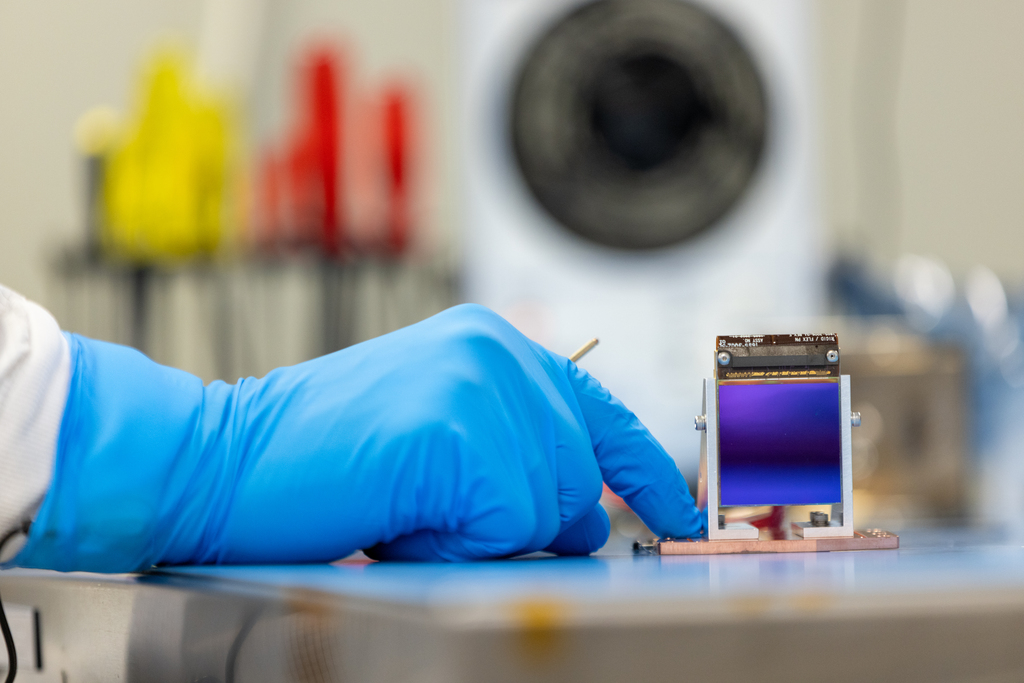
Nagler and Tim Rehm, a post-doctoral fellow working on EXCITE, examine the telescope at NASA Goddard on June 11, 2026. EXCITE’s near-infrared detector is a flight candidate from NASA’s James Webb Space Telescope’s Near InfraRed Spectrograph instrument.
Credit: NASA/Sophia Roberts
Alt text: EXCITE hangs from a crane in a large room.
Image description: A large telescope hangs from a crane in a cavernous space. The telescope sits inside a white base and pokes out from under a white triangular cover. Two solar panels are attached to the back of the telescope and extend to either side. Two people in white hard hats and yellow safety vests stand to the left. The space around the telescope is cordoned off by metal gates and stacks of equipment.
Rehm and Nagler work on EXCITE at NASA Goddard on June 11, 2026.
Credit: NASA/Scott Wiessinger
Alt text: EXCITE hangs from a crane in a large room.
Image description: A large telescope hangs from a crane in a cavernous space. The telescope sits inside a white base and pokes out from under a white triangular cover. Two solar panels are attached to the back of the telescope and extend to either side. A man in a yellow safety vest and white hard hat stands to the right. A second person’s hard hat is visible behind him. There is a line of tool chests on the left. A black and yellow safety barrier cordons off the area around the telescope.
Rehm (left) and Nagler examine EXCITE at NASA Goddard on June 11, 2026.
Credit: NASA/Sophia Roberts
Alt text: Two people look at the EXCITE telescope.
Image description: Two people in yellow safety vests and white hard hats stand on either side of a large telescope. The camera looks up at them and the telescope. The telescope hangs from a crane that is out of frame. It sits inside a white base and pokes out from under a white triangular cover. Two solar panels are attached to the back of the telescope and extend to either side. Various pieces of electrical components with dangling wires and tubes are attached to the front of the base.
Nagler stands next to the EXCITE telescope at NASA Goddard on June 11, 2026.
Credit: NASA/Sophia Roberts
Alt text: A man stands next to the EXCITE telescope.
Image description: A man in a yellow safety vest and white hard hat stands next to a telescope. The telescope sits inside a white base and pokes out from under a white triangular cover. Two solar panels are attached to the back of the telescope and extend to either side. Various pieces of electrical components with dangling wires and tubes are attached to the front of the base. The NASA worm insignia is stuck to the side of a box attached to the base.

The EXCITE team runs nighttime tests on the telescope on July 9, 2026, at NASA CSBF. From left to right: Rehm, Nagler, Khing Klangboonkrong (Brown University) almost out of sight behind a computer screen, Oliver Carey (Brown University), and Greg Tucker (Brown University).
Credit: NASA/Kyle Helson
Alt text: People sit at computers around a telescope in a dark space.
Image description: Five people look at brightly lit computer screens in a dark space, divided by the looming shape of a telescope. To the left, a man in a dark shirt stands behind two people sitting at desks. To the right, two more people sit at desks.

Klangboonkrong, Rehm, and Nagler look at EXCITE’s instrument readouts on July 10, 2026, at NASA CSBF. The team conducted nighttime pointing exercises with the telescope to evaluate all systems before it shipped to Antarctica ahead of a long-duration flight.
Credit: NASA/Kyle Helson
Alt text: Three people look at computer screens in a dark space.
Image description: Three people look at brightly lit computer screens in a dark space. Two sit at a desk in front of the computers, and the third stands behind them. A series of pipes and gauges are attached to the wall behind them.

An open hangar door at NASA CSBF frames the Big Dipper on July 10, 2026, as the EXCITE payload faces outward.
Credit: NASA/Kyle Helson
Alt text: A telescope is positioned in front of an open hangar door.
Image description: The EXCITE telescope peers out at the night sky from the bottom right corner of this image. The camera looks out and up at a large open hangar door to a sky dotted with stars. A line of yellow caution tape cordons off the open doorway.
The EXCITE telescope hangs from a crane inside a hangar at NASA CSBF and looks out at the sky on July 11, 2026.
Credit: NASA/Lee Bernard
Alt text: A telescope looks out at the night sky.
Image description: A white telescope hands from a crane inside a large hangar at night. It faces an open hangar door. Red light inside the hangar illuminates the telescope.
The EXCITE telescope sits outside at NASA CSBF on July 18, 2026. The silver squares attached to the bottom are the radiator panels, which channel heat away from the instrumentation. The bar attached to the cap carries communications equipment so the CSBF and EXCITE teams can receive data from the telescope during flight.
Credit: Brown University/Khing Klangboonkrong
Alt text: EXCITE sits outside on an overcast day.
Image description: A large telescope sits outside in a paved area between buildings. The telescope sits inside a white base and pokes out from under a white triangular cover. Two solar panels are attached to the back of the telescope and extend to either side. Various pieces of electrical components with dangling wires and tubes are attached to the front of the base. Two silver squares are attached to a pole along the bottom. A bar with panels and boxes is attached to the top. The sky is overcast.

The EXCITE telescope hangs from a crane outside at NASA CSBF on July 21, 2026. The mission and balloon teams conducted a compatibility test, which demonstrates that EXCITE can communicate with the ground under its own power during flight.
Credit: NASA/Kyle Helson
Alt text: EXCITE hangs from a crane.
Image description: A large telescope hangs from an out-of-frame crane on a sunny day. The telescope sits inside a base covered in silver foil and underneath a white triangular cover. Two solar panels are attached to the back of the telescope and extend to either side. The top of the telescope is also covered in silver foil. Two silver squares are attached to the bottom of the base, and a bar with panels and boxes is attached to the cap. Square solar panels are attached to the bottom and side.

A group of NASA CSBF electricians and engineers examine the EXCITE telescope during the compatibility test on July 21, 2026.
Credit: NASA/Kyle Helson
Alt text: People work on the EXCITE telescope.
Image description: A group of people wearing hard hats stand around a telescope hanging from a crane under a cloudless sky. Some wear orange or yellow safety vests, others wear blue electrostatic discharge jackets. The telescope sits inside a white base and pokes out from under a white triangular cover. Two solar panels are attached to the back of the telescope and extend to either side. There is a large hangar with an open door to the right of the telescope.

A group of NASA CSBF electricians and engineers examine the EXCITE telescope during the compatibility test on July 21, 2026.
Credit: NASA/Kyle Helson
Alt text: People work on the EXCITE telescope.
Image description: A group of people wearing hard hats stand around a telescope hanging from a crane under a cloudless sky. Some wear orange or yellow safety vests, others wear blue electrostatic discharge jackets. The telescope sits inside a white base and pokes out from under a white triangular cover. Two solar panels are attached to the back of the telescope and extend to either side. There is a large tree in the background.
Credits
Please give credit for this item to:
NASA's Goddard Space Flight Center. However, individual items should be credited as indicated above.
-
Science writer
- Jeanette Kazmierczak (University of Maryland College Park)
-
Photographers
- Kyle Helson
- Scott Wiessinger (eMITS)
- Sophia Roberts (eMITS)
Series
This page can be found in the following series:Related
- ID: 14650
 Produced Video
 - ID: 14725
 Produced Video
 - ID: 14726
 Produced Video
Release date
This page was originally published on Tuesday, September 15, 2026.
This page was last updated on Tuesday, September 15, 2026 at 2:55 PM EDT.