Roman and Hubble Scale Graphic with Andromeda Galaxy and Moon

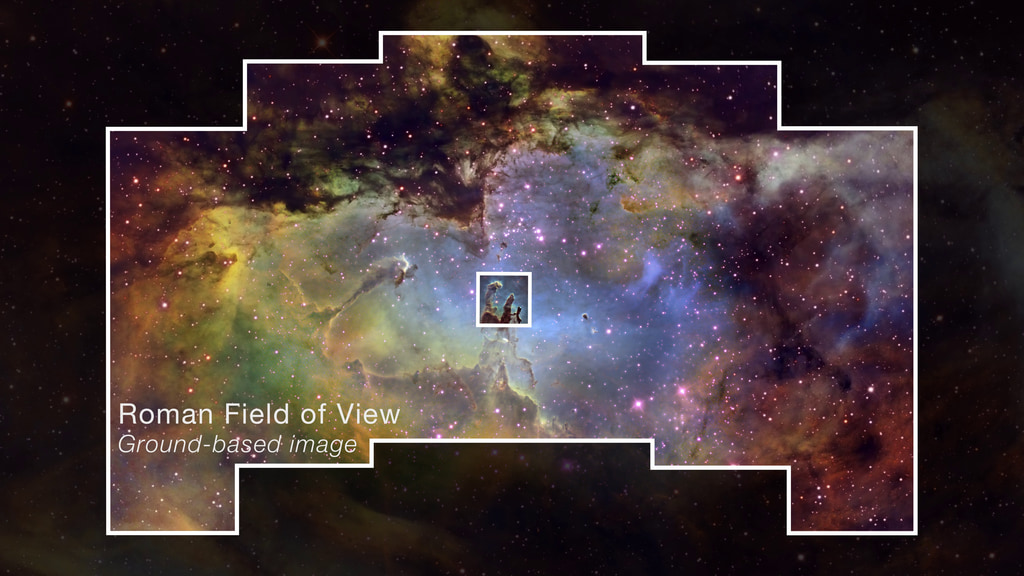
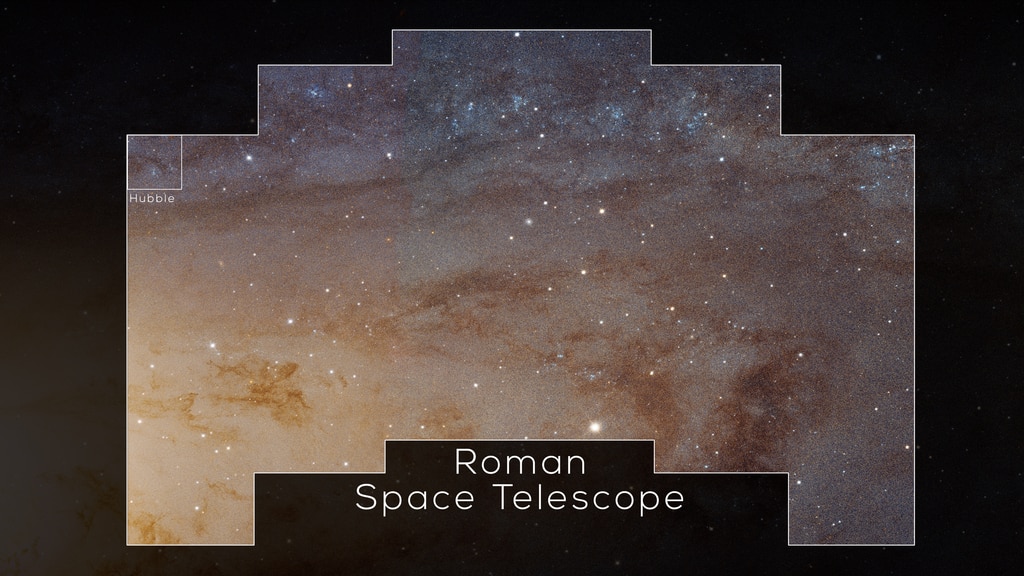
This ground-based image of the Andromeda Galaxy highlights the large field of view of NASA's soon-to-launch Nancy Grace Roman Space Telescope, with Hubble's field of view and a full moon shown for comparison.
Credit: Background image: Digitized Sky Survey and R. Gendler; Moon image: NASA’s Goddard Space Flight Center and Arizona State University
Alt text: An image of a spiral galaxy seen from a down-tilted view. It’s titled Andromeda Galaxy and nearly half of it is covered with a grid of squares, stacked in three arched rows of six squares each. The squares are labeled Roman field of view. At the upper left of them, a much smaller orange square is labeled Hubble field of view; it’s significantly smaller than even just a single Roman square. An image of the Moon is overlain on the bottom right, labeled Moon to scale. It’s about 70% of the size of the Roman squares.
Reformatted version with 16x9 dimensions.
This ground-based image of the Andromeda Galaxy highlights the large field of view of NASA's soon-to-launch Nancy Grace Roman Space Telescope, with Hubble's field of view and a full moon shown for comparison.
Credit: Background image: Digitized Sky Survey and R. Gendler; Moon image: NASA’s Goddard Space Flight Center and Arizona State University
Alt text: An image of a spiral galaxy seen from a down-tilted view. It’s titled Andromeda Galaxy and nearly half of it is covered with a grid of squares, stacked in three arched rows of six squares each. The squares are labeled Roman field of view. At the upper left of them, a much smaller orange square is labeled Hubble field of view; it’s significantly smaller than even just a single Roman square. An image of the Moon is overlain on the bottom right, labeled Moon to scale. It’s about 70% of the size of the Roman squares.
Credits
Please give credit for this item to:
NASA's Goddard Space Flight Center. However, individual items should be credited as indicated above.
-
Science writer
- Ashley Balzer (eMITS)
-
Producer
- Scott Wiessinger (eMITS)
Missions
This page is related to the following missions:Series
This page can be found in the following series:Related
- ID: 15073

- ID: 13672
 Produced Video
 - ID: 13583
- ID: 12308
 Produced Video
Release date
This page was originally published on Friday, July 31, 2026.
This page was last updated on Friday, July 31, 2026 at 12:09 PM EDT.