Fermi's 15-year View of the Gamma-Ray Sky

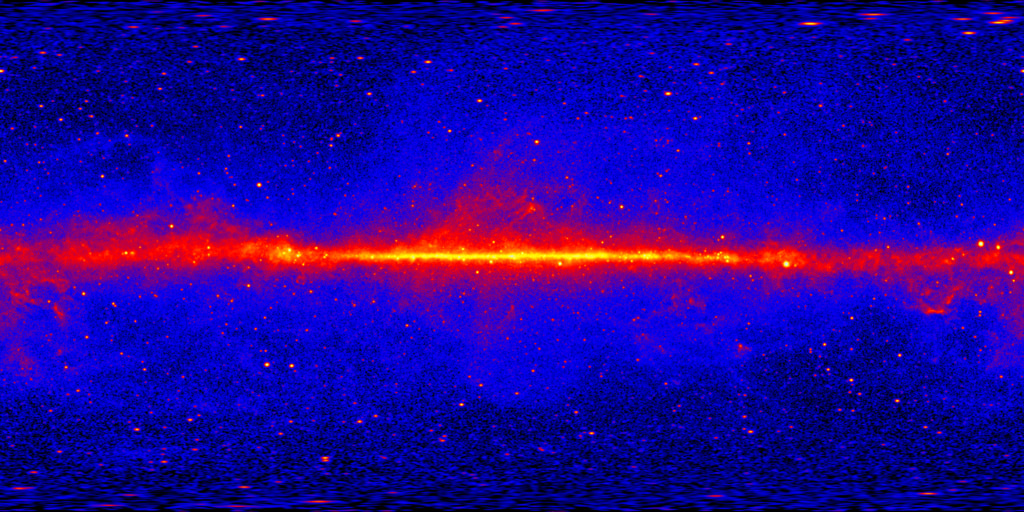
This image shows the entire sky as seen by Fermi's Large Area Telescope. Lighter colors indicate brighter gamma-ray sources. The map is centered on the center of our galaxy. The most prominent feature is the bright, diffuse glow running along the middle of the map, which marks the central plane of our Milky Way galaxy. The gamma rays there are mostly produced when energetic particles accelerated in the shock waves of supernova remnants collide with gas atoms and even light between the stars. Many of the star-like features above and below the Milky Way plane are distant galaxies powered by supermassive black holes. Many of the bright sources along the plane are pulsars. The image was constructed from 15 years of observations using front-converting gamma rays with energies greater than 1 GeV. Hammer projection with black background.
Credit: NASA/DOE/Fermi LAT Collaboration
Alt text: Fermi 15-year all-sky gamma-ray map
Image description: A colorful oval map sits in the middle of a black background. The oval is predominantly royal blue, striped with an irregular bright red, orange, and yellow band horizontally across the center, which shows the plane of our Milky Way galaxy. Smaller dots and splotches in red, orange, yellow, and white appear throughout the oval.
These maps show how the entire sky appears at energies greater than 1 billion electron volts (GeV) according to 15 years of data from NASA's Fermi Gamma-ray Space Telescope. (For comparison, the energy of visible light is between 2 and 3 electron volts.) The bright midplane of our galaxy runs across the middle of these images, which were produced from 180 months of data collected by Fermi's Large Area Telescope. For better angular resolution, the maps show only gamma rays detected at the front of the instrument's tracker. The 15-year maps represent more than 9.2 million gamma rays.
Same as above but with a transparent background.
Credit: NASA/DOE/Fermi LAT Collaboration
Same as above but in the equidistant cylindrical projection.
Credit: NASA/DOE/Fermi LAT Collaboration
Alt text: Fermi 15-year all-sky gamma-ray map, cylindrical projection
Image description: A colorful rectangular map sits in the middle of a black background. The map is predominantly royal blue, striped with an irregular bright red, orange, and yellow band horizontally across the center, which shows the plane of our Milky Way galaxy. Smaller dots and splotches in pink, orange, and yellow, appear throughout the image.
This image shows the entire sky as seen by Fermi's Large Area Telescope. Lighter colors indicate brighter gamma-ray sources. The map is centered on the point opposite the center of our galaxy. The most prominent feature is the bright, diffuse glow running along the middle of the map, which marks the central plane of our Milky Way galaxy. The gamma rays there are mostly produced when energetic particles accelerated in the shock waves of supernova remnants collide with gas atoms and even light between the stars. Many of the star-like features above and below the Milky Way plane are distant galaxies powered by supermassive black holes. Many of the bright sources along the plane are pulsars. The image was constructed from 15 years of observations using front-converting gamma rays with energies greater than 1 GeV. Hammer projection with black background.
Credit: NASA/DOE/Fermi LAT Collaboration
Alt text: Fermi 15-year all-sky gamma-ray map, galactic anticenter
Image description: A colorful oval map sits in the middle of a black background. The map is predominantly royal blue, striped with an irregular bright red, orange, and yellow band horizontally across the center, which shows the plane of our Milky Way galaxy. Smaller dots and splotches in pink, orange, and yellow, appear throughout the image.
Same as above but with a transparent background.
Credit: NASA/DOE/Fermi LAT Collaboration
Credits
Please give credit for this item to:
NASA's Goddard Space Flight Center. However, individual items should be credited as indicated above.
-
Visualizer
- Seth Digel (SLAC National Accelerator Laboratory)
-
Producer
- Scott Wiessinger (eMITS)
-
Science writer
- Francis Reddy (University of Maryland College Park)
Related
- ID: 15053
 Produced Video
 - ID: 14090
 Produced Video
 - ID: 11342
 Produced Video
Release date
This page was originally published on Friday, February 20, 2026.
This page was last updated on Wednesday, February 25, 2026 at 1:09 PM EST.