XRISM Finds Elemental Bounty in Supernova Remnant

Observations of the Cassiopeia A supernova remnant by the Resolve instrument aboard the NASA-JAXA XRISM (X-ray Imaging and Spectroscopy Mission) spacecraft revealed strong evidence for potassium (green squares) in the southeast and northern parts of the remnant. Grids superposed on a multiwavelength image of the remnant represent the fields of view of two Resolve measurements made in December 2023. Each square represents one pixel of Resolve’s detector. Weaker evidence of potassium (yellow squares) in the west suggests that the original star may have had underlying asymmetries before it exploded.
Credit: NASA’s Goddard Space Flight Center; X-ray: NASA/CXC/SAO; Optical: NASA/ESA/STScI; IR: NASA/ESA/CSA/STScI/Milisavljevic et al., NASA/JPL/CalTech; Image Processing: NASA/CXC/SAO/J. Schmidt and K. Arcand
Alt text: The Cassiopeia A supernova remnant with the XRISM Resolve fields of view
Image description: Supernova remnant Cassiopeia A appears as a large circular object outlined by electric blue filaments, set against a black background. Strings of vibrant colors weave throughout, with blue representing Chandra data, red, green, and blue representing Webb data, and Hubble data showing a multitude of stars that dot the view. Two nearly square grids are laid on top of the remnant slightly overlapping. The upper grid has six squares filled yellow, representing weaker evidence for potassium. In the opposite corner of that grid, five squares are filled green, representing a positive potassium detection. The lower grid has six boxes filled green in a wide M-like shape. The image is labeled “North” at the top center, “West” on the right, and “Southeast” to the left.
For the first time, scientists have made a clear X-ray detection of chlorine and potassium in the wreckage of a star using data from the Japan-led XRISM (X-ray Imaging and Spectroscopy Mission) spacecraft.
The Resolve instrument aboard XRISM, pronounced “crism,” discovered these elements in a supernova remnant called Cassiopeia A or Cas A, for short. The expanding cloud of debris is located about 11,000 light-years away in the northern constellation Cassiopeia.
Stars produce almost all the elements in the universe heavier than hydrogen and helium through nuclear reactions. Heat and pressure fuse lighter ones, like carbon, into progressively heavier ones, like neon, creating onion-like layers of materials in stellar interiors.
Nuclear reactions also take place during explosive events like supernovae, which occur when stars run out of fuel, collapse, and explode. Elemental abundances and locations in the wreckage can, respectively, tell scientists about the star and its explosion, even after hundreds or thousands of years.
Some elements — like oxygen, carbon, and neon — are more common than others and are easier to detect and trace back to a particular part of the star’s life.
Other elements — like chlorine and potassium — are more elusive. Since scientists have less data about them, it’s more difficult to model where in the star they formed. These rarer elements still play important roles in life on Earth. Potassium, for example, helps the cells and muscles in our bodies function, so astronomers are interested in tracing its cosmic origins.
The roughly circular Cas A supernova remnant spans about 10 light-years, is over 340 years old, and has a superdense neutron star at its center — the remains of the original star's core. Scientists using NASA’s Chandra X-ray Observatory had previously identified signatures of iron, silicon, sulfur, and other elements within Cas A.
In the hunt for other elements, astronomers used the Resolve instrument aboard XRISM to look at the remnant twice in December 2023. The researchers were able to pick out the signatures for chlorine and potassium, determining that the remnant contains ratios much higher than expected. Resolve also detected a possible indication of phosphorous, which was previously discovered in Cas A by infrared missions.
The astronomers think stellar activity could have disrupted the layers of nuclear fusion inside the star before it exploded. That kind of upheaval might have led to persistent, large-scale churning of material inside the star that created conditions where chlorine and potassium formed in abundance.
The scientists also mapped the Resolve observations onto an image of Cas A captured by Chandra and showed that the elements were concentrated in the southeast and northern parts of the remnant.
This lopsided distribution may mean that the star itself had underlying asymmetries before it exploded, which Chandra data has also indicated.
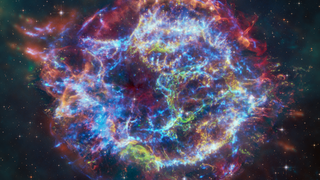
The Cassiopeia A supernova remnant glows in X-ray, visible, and infrared light in this image that combines data from NASA’s Chandra X-ray Observatory and Hubble, Webb, and Spitzer space telescopes. A new study by the XRISM (X-ray Imaging and Spectroscopy Mission) spacecraft has made the first-ever X-ray detections of chlorine and potassium from the wreckage. Known as Cas A for short, the remnant is about 11,000 light-years away in the northern constellation Cassiopeia and is around 340 years old.
Credit: X-ray: NASA/CXC/SAO; Optical: NASA/ESA/STScI; IR: NASA/ESA/CSA/STScI/Milisavljevic et al., NASA/JPL/CalTech; Image Processing: NASA/CXC/SAO/J. Schmidt and K. Arcand
Alt text: The Cassiopeia A supernova remnant
Image description: This image of Cassiopeia A resembles a disk of electric light with red clouds, glowing white streaks, red and orange flames, and an area near the center of the remnant resembling a somewhat circular region of green lightning. X-rays from Chandra are blue and reveal hot gas, mostly debris from the destroyed star, that includes elements like silicon and iron. X-rays are also present as thin arcs in the outer regions of the remnant. Infrared data from Webb is red, green, and blue. Webb highlights infrared emission from dust heated by the hot gas seen by Chandra, as well as from much cooler supernova debris. The softer, outermost parts of the image include data from Spitzer in red, green, and blue. Hubble data shows a multitude of stars that permeate the field of view.
For More Information
Credits
Please give credit for this item to:
NASA's Goddard Space Flight Center. However, individual items should be credited as indicated above.
-
Producers
- Sophia Roberts (eMITS)
- Francis Reddy (University of Maryland College Park)
-
Technical support
- Aaron E. Lepsch (ADNET Systems, Inc.)
-
Science writer
- Jeanette Kazmierczak (University of Maryland College Park)
Missions
This page is related to the following missions:Series
This page can be found in the following series:Related papers
Related
- ID: 14968
 Produced Video
 - ID: 31288
 Hyperwall Visual
 - ID: 14463
 Produced Video
Release date
This page was originally published on Thursday, December 4, 2025.
This page was last updated on Thursday, December 4, 2025 at 9:50 AM EST.