Roman Galactic Plane Survey

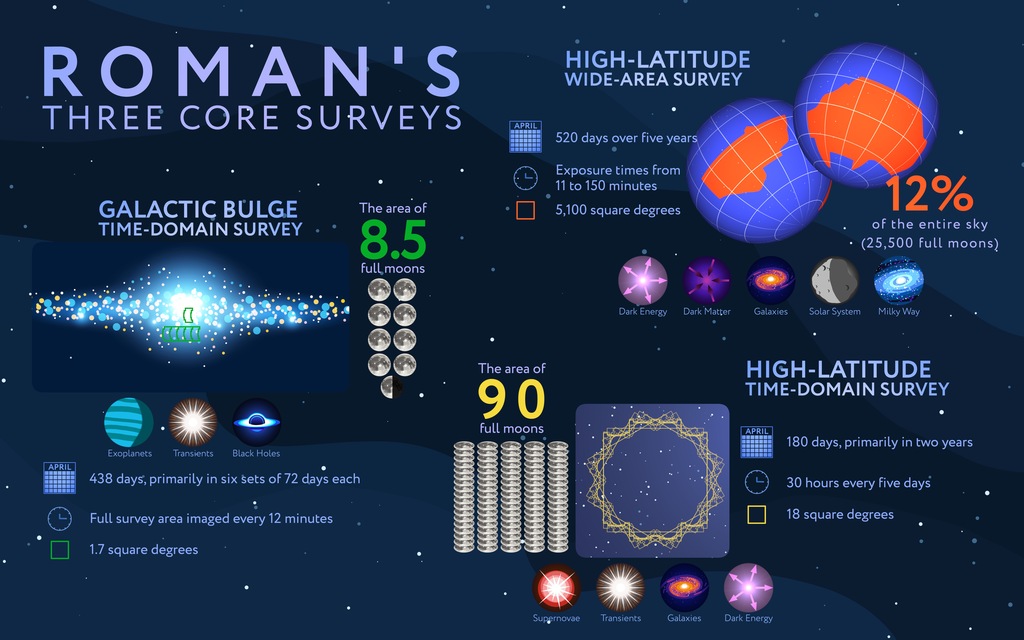
This infographic describes the 29-day Galactic Plane Survey that will be conducted by NASA’s Nancy Grace Roman Space Telescope. The survey’s main component will cover 691 square degrees — a region of sky as large as around 3,500 full moons — in 22.5 days. Roman will also view a smaller area — 19 square degrees, the area of 95 full moons — repeatedly for about 5.5 days total to capture things that change over time. The survey’s final component will image a smattering of even smaller areas, adding up to about 4 square degrees (the area of 20 full moons) and 31 total hours, with Roman’s full suite of filters and spectroscopic tools. The survey will reveal our home galaxy in unprecedented detail including many in regions we’ve never been able to see before because they’re blocked by dust, unveiling tens of billions of stars and other objects.
Credit: NASA’s Goddard Space Flight Center
NASA’s Nancy Grace Roman Space Telescope team has announced detailed plans for a major survey that will reveal our home galaxy, the Milky Way, in unprecedented detail. In one month of observations spread across two years, the survey will unveil tens of billions of stars and explore previously uncharted structures.
“The Galactic Plane Survey will revolutionize our understanding of the Milky Way,” said Julie McEnery, Roman’s senior project scientist at NASA’s Goddard Space Flight Center in Greenbelt, Maryland. “We’ll be able to explore the mysterious far side of our galaxy and its star-studded heart. Because of the survey's breadth and depth, it will be a scientific mother lode.”
While ESA’s (European Space Agency’s) retired Gaia spacecraft mapped around 2 billion Milky Way stars in visible light, many parts of the galaxy remain hidden by dust. By surveying in infrared light, Roman will use powerful heat vision that can pierce this veil to see what lies beyond.
“It blows my mind that we will be able to see through the densest part of our galaxy and explore it properly for the first time,” said Rachel Street, a senior scientist at Las Cumbres Observatory in Santa Barbara, California, and a co-chair of the committee that selected the Galactic Plane Survey design.
The survey will cover nearly 700 square degrees (a region of sky as large as about 3,500 full moons) along the glowing band of the Milky Way — our edge-on view of the disk-shaped structure containing most of our galaxy’s stars, gas, and dust. Scientists expect the survey to map up to 20 billion stars and detect tiny shifts in their positions with repeated high-resolution observations. And it will only take 29 days spread over the course of the mission’s first two years.
Read the full story here.
This visualization begins with a view of the Homunculus Nebula, which houses the massive binary star Eta Carinae, as imaged by the Hubble Space Telescope. The view pulls back to reveal the wider Carina Nebula — a giant, relatively nearby star-forming region in the southern sky. A single Nancy Grace Roman Space Telescope pointing will cover more than the Hubble image, which was built from multiple pointings. Roman will view more of the Carina Nebula repeatedly over time with six pointings, allowing astronomers to observe any changes that take place. The entire nebula as well as its surroundings, including a 10,000 light-year-long swath of the spiral arm it resides in, are included in the overall Roman Galactic Plane Survey. The full survey will cover 691 square degrees and is to be completed over the course of two years. The observations will offer an unparalleled opportunity to watch how stars grow, interact, and sculpt their environments, and it’s just one of many thousands of highlights astronomers are looking forward to from this Roman survey.
Includes version with music.
Overall credit: NASA's Goddard Space Flight Center
Music Credit: “Code Wave,” Max Cameron Concors [ASCAP], Universal Production Music
Individual image credits:
• Eta Carinae credit: NASA, ESA, and the Hubble SM4 ERO Team
• Carina Nebula close view credit: Hubble Image: NASA, ESA, N. Smith (University of California, Berkeley), and The Hubble Heritage Team (STScI/AURA); CTIO Image: N. Smith (University of California, Berkeley) and NOAO/AURA/NSF
• Carina Nebula wide view credit: Harel Boren
• Milky Way image provided by Axel Mellinger
Watch this video on YouTube.
Slider


These images of the Lagoon Nebula from NASA’s Hubble Space Telescope show how viewing space in infrared light shows astronomers details that are hidden in visible light observations. The visible-light image at left is full of dense dust clouds blocking stars embedded deep within them. Those stars shine freely in the infrared image of the same region at right. High-resolution infrared imaging by NASA’s Nancy Grace Roman Space Telescope will help astronomers peer through dust and also distinguish stars that usually blur together, which is especially critical when viewing regions of the galaxy where stars are densely concentrated.
Credit: NASA, ESA, and STScI
Credits
Please give credit for this item to:
NASA's Goddard Space Flight Center. However, individual items should be credited as indicated above.
-
Producer
- Scott Wiessinger (eMITS)
-
Visualizer
- Scott Wiessinger (eMITS)
-
Designer
- Scott Wiessinger (eMITS)
-
Science writer
- Ashley Balzer (eMITS)
Missions
This page is related to the following missions:Series
This page can be found in the following series:Related
- ID: 15073

- ID: 14820
 Infographic
Used as a Source In
- ID: 15091
 Produced Video
 - ID: 14937
![NASA’s freshly assembled Nancy Grace Roman Space Telescope will revolutionize our understanding of the universe with its deep, crisp, sweeping infrared views of space. The mission will transform virtually every branch of astronomy and bring us closer to understanding the mysteries of dark energy, dark matter, and how common planets like Earth are throughout our galaxy. Roman is on track for launch by May 2027, with teams working toward a launch as early as fall 2026. Credit: NASA’s Goddard Space Flight CenterMusic: “Forever Clouds,” Cyrus Reynolds [BMI], Universal Production MusicOpening Webb visualization credits: NASA, ESA, CSA, STScI, Danielle Kirshenblat (STScI); Acknowledgment: VISTA, DSS, Akira Fujii Watch this video on the NASA Goddard YouTube channel.Complete transcript available.](/vis/a010000/a014900/a014937/WideningOurGaze_Still.jpg) Produced Video
Produced Video
Release date
This page was originally published on Friday, December 12, 2025.
This page was last updated on Thursday, December 11, 2025 at 4:37 PM EST.