Carbon Dioxide in 3-D

An unprecedented 3-D view of Earth's carbon dioxide.
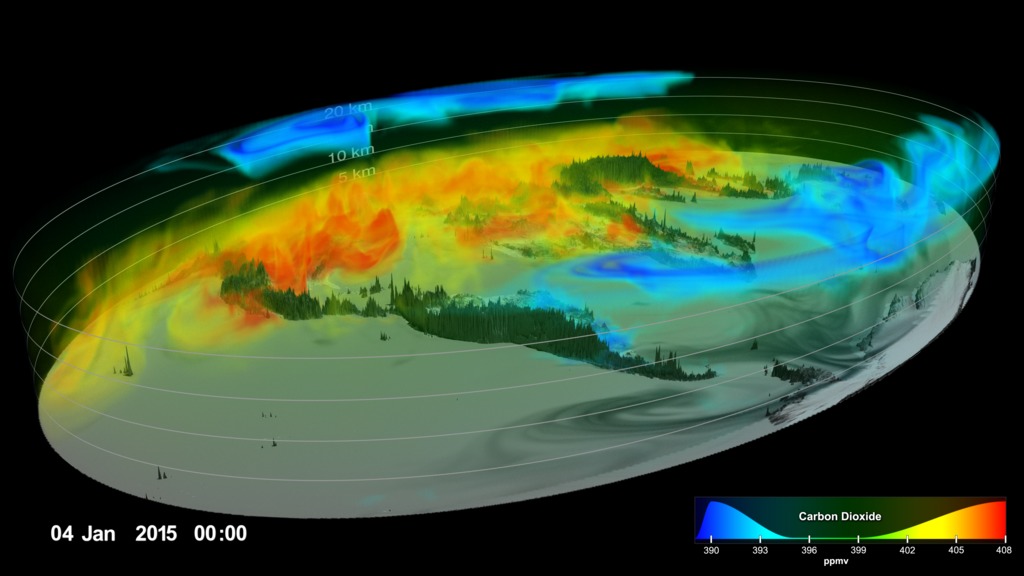
Carbon dioxide plays a significant role in trapping heat in Earth's atmosphere. This 3-D, high-resolution visualization reveals in startling detail the complex patterns in which carbon dioxide in the atmosphere increases, decreases and moves around the globe with the seasons and the weather over the course of September 2014 to September 2015. Scientists with NASA's Global Modeling and Assimilation Office used data from the agency's Orbiting Carbon Observatory-2 (OCO-2) satellite to create this model of carbon dioxide behavior, which will help them answer questions about where to find its sources and sinks, including from human emissions, and how those may change in the future. Watch the video to see the ebb and flow of this potent greenhouse gas.
Watch satellite observations of carbon dioxide rendered in 3-D travel throughout the world from Sept. 2014 to Sept. 2015.
In the Northern Hemisphere (right) carbon dioxide accumulates in the winter and spring when plants are dormant.
25% of yearly carbon dioxide emissions are taken up by the ocean and 25% are taken up by photosynthesis on land, as seen here in September.
For More Information
See NASA.gov
Credits
Please give credit for this item to:
NASA's Scientific Visualization Studio
-
Animators
-
Greg Shirah
(NASA/GSFC)

- Horace Mitchell (NASA/GSFC)
-
Greg Shirah
(NASA/GSFC)
-
Writer
- Patrick Lynch (NASA/GSFC)
-
Producers
- Matthew R. Radcliff (USRA)
- Kathryn Mersmann (USRA)
-
Scientists
-
Lesley Ott
(NASA/GSFC)
- Steven Pawson (NASA/GSFC)
- Brad Weir (Morgan State University)
-
Lesley Ott
(NASA/GSFC)
Sources
- ID: 4514
 Visualization
 - ID: 12445
![The height of Earth’s atmosphere and topography have been vertically exaggerated and appear approximately 40 times higher than normal to show the complexity of the atmospheric flow.Music credit: Life Cycles by Theo Golding [PRS]Complete transcript available.Watch this video on the NASA Goddard YouTube channel.](/vis/a010000/a012400/a012445/LARGE_MP4-12445_VolumetricCO2_large.00398_print.jpg) Produced Video
Produced Video
Release date
This page was originally published on Monday, January 23, 2017.
This page was last updated on Wednesday, May 3, 2023 at 1:47 PM EDT.