Hyperwall ISS
Overview
The presence of the space station in low-Earth orbit provides a unique vantage point for collecting Earth and space science data. From an average altitude of about 400 km, details in such features as glaciers, agricultural fields, cities, and coral reefs taken from the ISS can be layered with other sources of data, such as orbiting satellites, to compile the most comprehensive information available.
New
- ID: 30624 Hyperwall Visual

One-Year Crew Docking to the International Space Station
Go to this pageThis video has been prepared for use on the hyperwall. It has been speeded up by a factor of 50 from real-time.This video was taken by the crewmembers aboard the Soyuz TMA-16M spacecraft which docked to the International Space Station at 9:33 PM EDT March 27, 2015. NASA astronaut Scott Kelly and Russian cosmonauts Mikhail Kornienko and Gennady Padalka arrived just six hours after launching from Baikonur, Kazakhstan, completing four orbits around the Earth before catching up with the orbiting laboratory. The vehicle docked to the Poisk module (also known as the Mini-Research Module 2) on the space-facing side of the Russian Service Module. The spinning object in view is an antenna that is part of the automatic rendezvous and docking system known as KURS.Kelly and Kornienko will spend about a year living and working aboard the space station to help scientists better understand how the human body reacts and adapts to the harsh environment of space. Most expeditions to the space station last four to six months. By doubling the length of this mission, researchers hope to better understand how the human body reacts and adapts to long-duration spaceflight. This knowledge is critical as NASA looks toward human journeys deeper into the solar system, including to and from Mars, which could last 500 days or longer. It also carries potential benefits for humans here on Earth, from helping patients recover from long periods of bed rest to improving monitoring for people whose bodies are unable to fight infections. ||
- Section
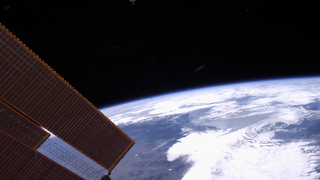
4k Video from the ISS
Go to this sectionA high resolution montage of video taken from the International Space Station reveals Earth in 4k resolution at standard video rates. The video starts with a beautiful sunrise, followed by views of clouds, landforms, a sunset and moonrise, and a tropical storm. The video was captured with an Epic Dragon camera by RED, a digital cinema company. The camera was delivered on the fifth SpaceX cargo resupply mission and is capable of shooting at resolutions up to 6K, specifically 6144 x 3160 pixels.
Overview
- Section

- Section

NASA Science Facilities on the International Space Station
Go to this sectionNASA Science facilities on the International Space Station.
- Section
- Section
