Animations of the August 12, 2026, Total Solar Eclipse
Following the shadow: An animated visualization of the path of the August 12, 2026, total solar eclipse. The virtual camera follows the shadow. Country borders revised on August 19, 2026.
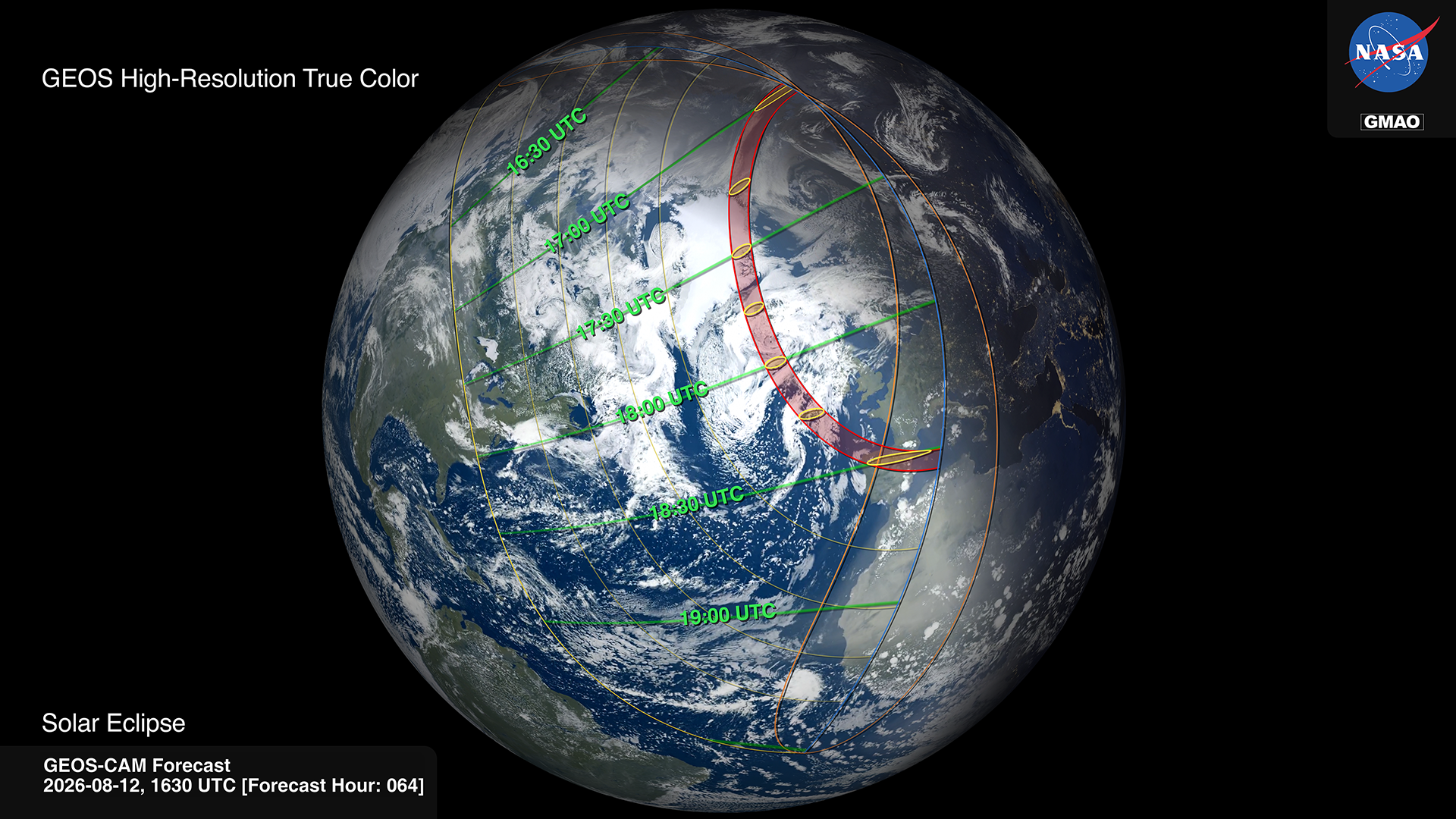
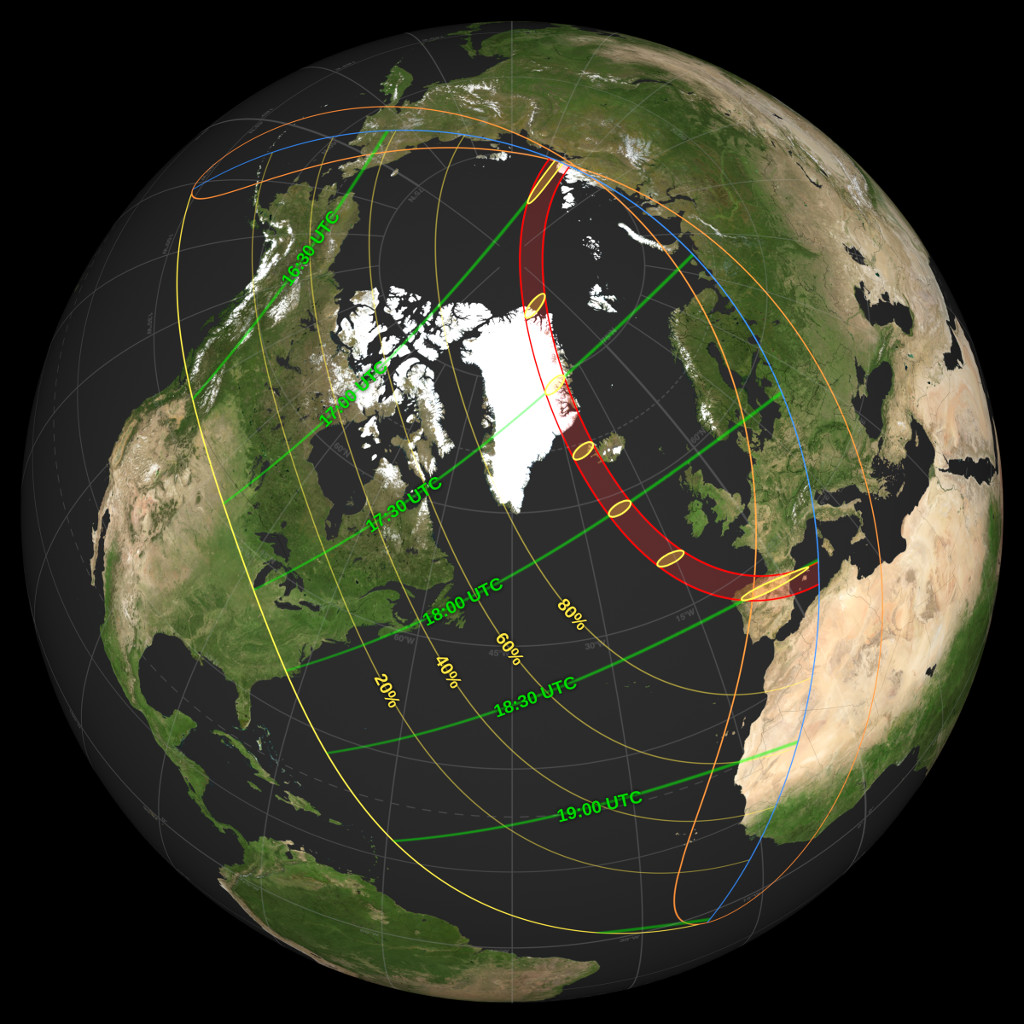
On Wednesday, August 12, 2026, the Moon passes in front of the Sun, casting its shadow across a wide swath of Earth's Northern Hemisphere. The path of totality begins in far northern Siberia, near the North Pole, and travels south through the oceans of the Arctic and North Atlantic, passing over western Iceland (including Reykjavik) and northern Spain. The rest of Europe and parts of North America and Africa experience a partial eclipse.
The Moon's shadow can be divided into two parts: the very narrow umbra, where the Sun is completely blocked, and the much broader penumbra, where the Sun is only partially blocked. The red swath marks the path of totality, where a total solar eclipse is visible. The black oval traveling along this path is the umbra. The penumbra is rendered in discrete shades in 20% intervals of obscuration (area of the Sun blocked by the Moon). Loops at either end of the path indicate where the eclipse is in progress during sunrise or sunset.
In the first animation, captioned "Following the shadow," the virtual camera flies on a path that keeps the shadow near the center of the view but makes Earth's rotation difficult to discern. In the second animation, captioned "Fixed in space," the camera doesn't move. Strictly speaking, the camera is stationary in the J2000 coordinate system centered on Earth — nothing is truly motionless except in relation to a particular reference. Other views are stationary over Iceland and Spain and over the United States.
Fixed in space: An animated visualization of the August 12, 2026, total solar eclipse. The virtual camera is located at a fixed point in space, making Earth's rotation easier to see. Country borders revised on August 19, 2026.
An animated visualization of the August 12, 2026, total solar eclipse, in a vertical aspect ratio suitable for mobile devices. The virtual camera follows the shadow. Country borders revised on August 19, 2026.
An animated visualization of the August 12, 2026, total solar eclipse. This closer view is stationary over Iceland and Spain. The movie with the filename ending in "p0.1.mp4" plays in real time and can be synchronized with the event. Country borders revised on August 19, 2026.
An animated visualization of the August 12, 2026, total solar eclipse, in a vertical aspect suitable for mobile devices. The view is stationary over Iceland and Spain.
An animated visualization of the August 12, 2026, total solar eclipse. This view is stationary over the United States, where the eclipse is partial in the Northeast and parts of the Mid-Atlantic and Upper Midwest and is not visible elsewhere in the country. The movie with the filename ending in "p0.1.mp4" plays in real time and can be synchronized with the event.
Credits
NASA's Scientific Visualization Studio
-
Visualizer
-
Ernie Wright
(USRA)

-
Ernie Wright
(USRA)
-
Producer
- Joy Ng (eMITS)
Datasets used
-
DE421 (JPL DE421)
ID: 752Planetary ephemerides
This dataset can be found at: http://ssd.jpl.nasa.gov/?ephemerides#planets
See all pages that use this dataset -
BMNG (Blue Marble: Next Generation) [Terra and Aqua: MODIS]
ID: 508Credit: The Blue Marble data is courtesy of Reto Stockli (NASA/GSFC).
This dataset can be found at: http://earthobservatory.nasa.gov/Newsroom/BlueMarble/
See all pages that use this dataset -
Five Millennium Canon of Solar Eclipses (Five Millennium Canon of Solar Eclipses)
ID: 1204Compilation of every solar eclipse occurring between 2000 BCE and 3000 CE
Credit: Fred Espenak and Jean Meeus, 2006. NASA Technical Publication TP-2006-214141
This dataset can be found at: https://eclipse.gsfc.nasa.gov/SEpubs/5MCSE.html
See all pages that use this dataset -
LSIB (Large Scale International Boundaries)
ID: 1293Credit: U.S. Department of State, Office of the Geographer and Global Issues
This dataset can be found at: https://geodata.state.gov/geonetwork/srv/eng/catalog.search#/metadata/3bdb81a0-c1b9-439a-a0b1-85dac30c59b2
See all pages that use this dataset
Note: While we identify the data sets used on this page, we do not store any further details, nor the data sets themselves on our site.
Related
- ID: 5670
- ID: 15065
![Complete transcript available.Watch this video on the NASA Goddard YouTube channel.Music Credit: “Uncovered Discovered” by Emanuel Kallins [BMI] and Chieli Minucci [ASCAP] from Universal Production Music](/vis/a010000/a015000/a015065/15065_Thumbnail.jpg) Produced Video
Produced Video - ID: 5647
 Visualization
Release date
This page was originally published on Monday, July 13, 2026.
This page was last updated on Wednesday, August 19, 2026 at 4:24 PM EDT.