Asteroid Apophis 2029 Earth Flyby – Orbit Visualizations
This top-down view of Earth and the Moon’s orbit shows Apophis during its April 13, 2029 Earth flyby, followed by the OSIRIS-APEX spacecraft on its way to rendezvous with the asteroid.
OSIRIS-APEX is a mission to study the physical changes to asteroid Apophis that will result from its rare close encounter with Earth in April 2029. That year, Apophis’ orbit will bring it within 20,000 miles (32,000 kilometers) of Earth’s surface – closer to Earth than our highest-altitude satellites. Our planet’s gravitational pull is expected to alter the asteroid’s orbit, change how fast it spins on its axis, and possibly cause quakes or landslides that will alter its surface.
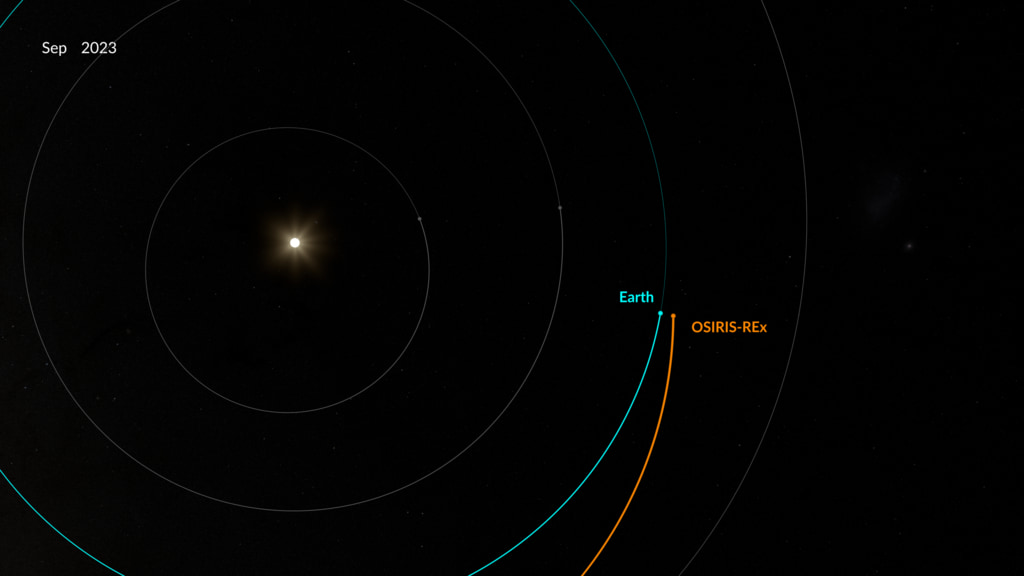
The OSIRIS-APEX spacecraft will observe these changes as it passes by Earth within an hour of Apophis, on track for a rendezvous with the asteroid in mid-2029. These orbit visualizations illustrate Apophis' historically close encounter with Earth and OSIRIS-APEX’s journey to the asteroid.
This side view of Earth and the Moon’s orbit shows Apophis during its April 13, 2029 Earth flyby followed by the OSIRIS-APEX spacecraft on its way to rendezvous with the asteroid. The view illustrates how OSIRIS-APEX’s Earth flyby adjusts the plane of its orbit to match that of Apophis.
This view of Earth and the Moon’s orbit shows Apophis during its April 13, 2029 Earth flyby followed by the OSIRIS-APEX spacecraft on its way to rendezvous with the asteroid. The camera transitions from a top-down view to a side view.
This closer view of the Apophis and OSIRIS-APEX Earth flybys also depicts active satellites around Earth as faint cyan trails.
Credits
-
Data visualizer
- Kel Elkins (Science and Technology Corporation)
-
Producer
- Dan Gallagher (eMITS)
-
Engineer
- Michael Moreau (NASA/GSFC)
Missions
This page is related to the following missions:Datasets used
-
SPICE Ephemerides (SPICE Ephemerides)
ID: 755Satellite and planetary ephemerides
See all pages that use this dataset
Note: While we identify the data sets used on this page, we do not store any further details, nor the data sets themselves on our site.
Related
- ID: 20414

- ID: 5133
 Visualization
Used as a Source In
- ID: 15101
 Produced Video
Release date
This page was originally published on Wednesday, September 23, 2026.
This page was last updated on Tuesday, September 22, 2026 at 3:11 PM EDT.