March 3, 2026 Total Lunar Eclipse: Telescopic View
Dial-A-Moon
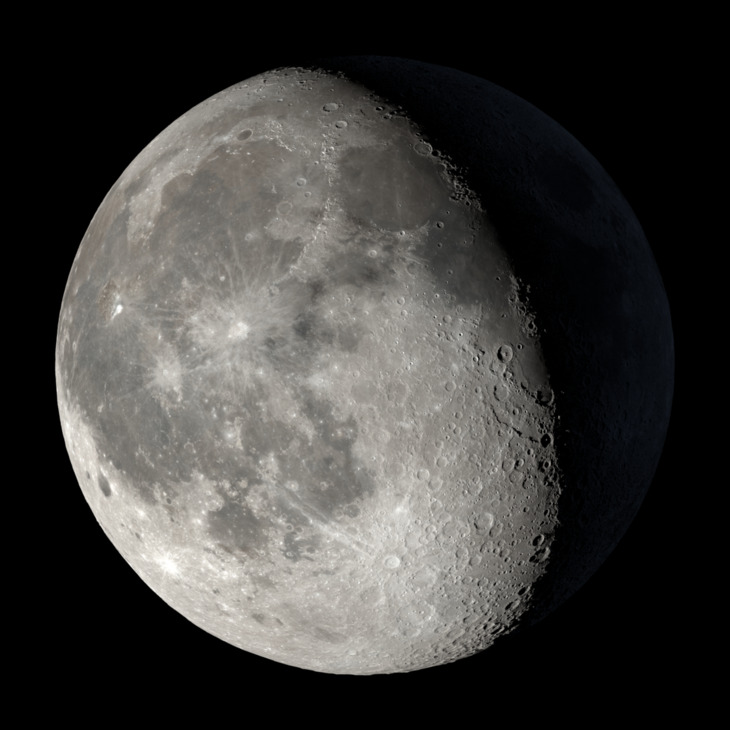
Enter a time to see what the moon looked like (or will look like) at that time.
| Time (UTC) | 2023-01-01T00:00 |
|---|---|
| Phase | 00.0% (0d 0h 0m) |
| Diameter | 0000.0 arcseconds |
| Distance | 00.0 km (0.00 Earth diameters) |
| J2000 Right Ascension, Declination | 0h 0m 0s, 0° 0' 0" |
| Sub-Solar Longitude, Latitude | 0.000°, 0.000° |
| Sub-Earth Longitude, Latitude | 0.000°, 0.000° |
| Position Angle | 0.000° |
Also see the shadow diagram and visibility map for this eclipse.
The March 3, 2026 total lunar eclipse is the first one visible in the Americas since March of 2025. Celestial north is up in this imagery, corresponding to the view from mid-northern latitudes. Rotating the images by 180 degrees would create the south-up view for southern hemisphere observers. The obscuration percentage in the table is the fraction of the Moon covered by the Earth's umbra, the part of its shadow in which the Sun is completely blocked. The part of the shadow in which the Sun is only partially blocked is called the penumbra.
The animations on this page run from 8:06:00 to 15:38:50 UTC, which is also the valid range of times for this Dial-a-Moon. The exposure setting of the virtual camera changes around totality in order to capture the wide dynamic range of the eclipse. The parts of the Moon outside the umbra during the partial phases are almost as bright as an ordinary full moon, making the obstructed parts appear nearly black. But during totality, our eyes adjust and reveal a range of hues painted on the Moon by all of Earth's sunrises and sunsets.
All phases of a lunar eclipse are safe to view, both with your naked eye and an unfiltered telescope.
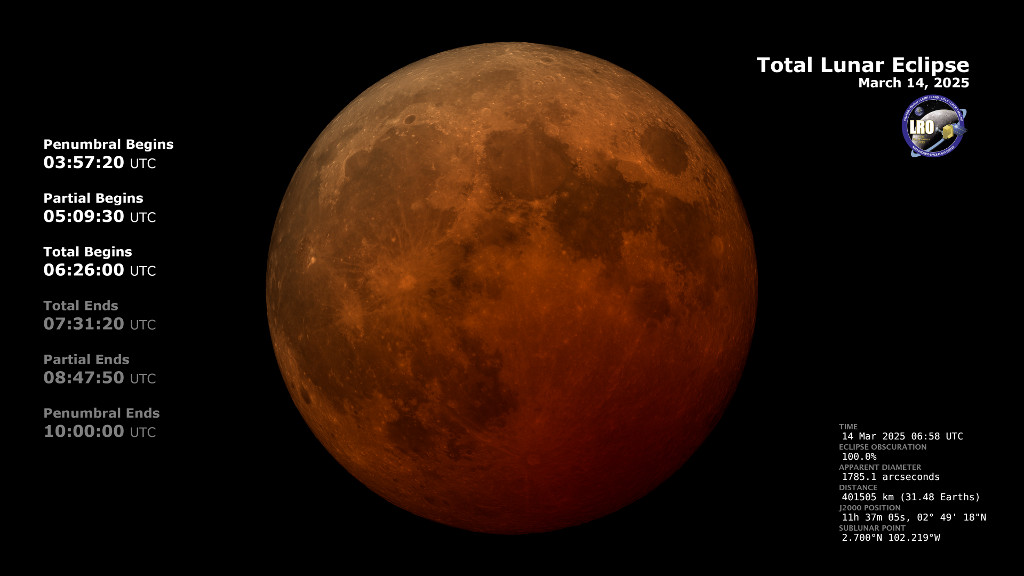
The appearance of the Moon during the March 2026 total lunar eclipse. Includes annotations of the contact times and various eclipse statistics.
The appearance of the Moon during the March 2026 total lunar eclipse, without annotations. The frame sets include an alpha channel.
Credits
NASA's Scientific Visualization Studio
-
Visualizer
-
Ernie Wright
(USRA)

-
Ernie Wright
(USRA)
Missions
This page is related to the following missions:Related papers
Five Millennium Canon of Lunar Eclipses: -1999 to +3000
NASA/TP-2009-214172
This paper can be found at: https://eclipse.gsfc.nasa.gov/SEpubs/5MCLE.html
Datasets used
-
LROC WAC Color Mosaic (Natural Color Hapke Normalized WAC Mosaic) [Lunar Reconnaissance Orbiter: LRO Camera]
ID: 1015This natural-color global mosaic is based on the 'Hapke normalized' mosaic from LRO's wide-angle camera. The data has been gamma corrected, white balanced, and range adjusted to more closely match human vision.
See all pages that use this dataset -
DEM (Digital Elevation Map) [LRO: LOLA]
ID: 653 -
DE421 (JPL DE421)
ID: 752Planetary ephemerides
This dataset can be found at: http://ssd.jpl.nasa.gov/?ephemerides#planets
See all pages that use this dataset
Note: While we identify the data sets used on this page, we do not store any further details, nor the data sets themselves on our site.
Related
- ID: 5604
 Visualization
 - ID: 5606
 Visualization
 - ID: 5472
 Visualization
Used as a Source In
- ID: 14981
 Produced Video
Release date
This page was originally published on Tuesday, January 27, 2026.
This page was last updated on Tuesday, January 27, 2026 at 4:57 PM EST.