ICESat-2 Winter Sea Ice Thickness (2020-2025)
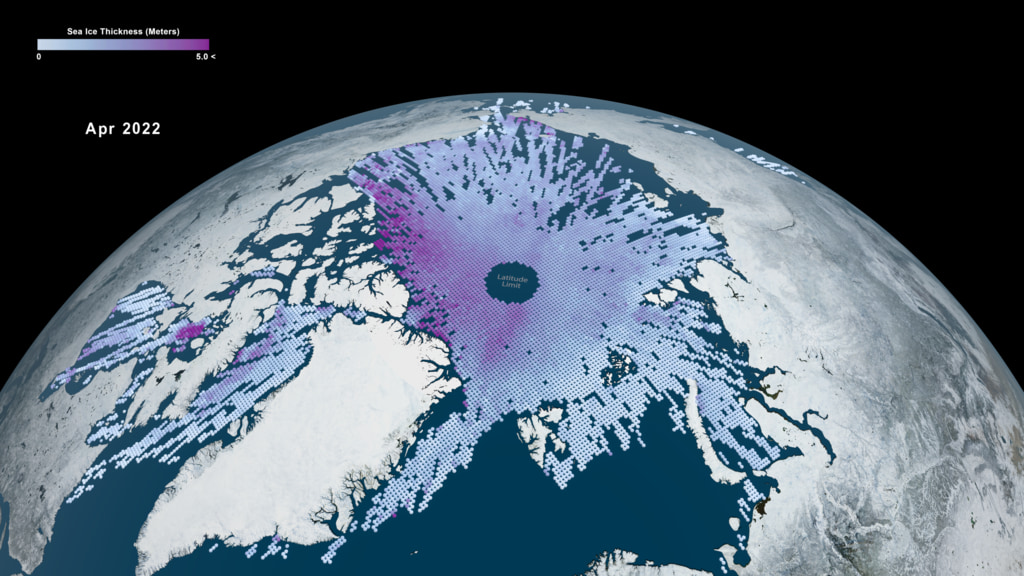
A view of the Arctic Ocean with ICESat-2 monthly average winter sea ice thickness data from November 2018 to April 2025. Low values are depicted in light blue, and higher values (5 meters) are depicted in magenta.
One of the big challenges in polar science is measuring the thickness of the floating sea ice that blankets the Arctic and Southern Oceans. Newly formed sea ice might be only a few inches thick, whereas sea ice that survives several winter seasons can grow to several feet in thickness (over ten feet in some places).
Sea ice thickness is typically estimated by first measuring sea ice freeboard - how much of the floating ice can be observed above sea level. Sea ice floats slightly above sea level because it is less dense than water.
NASA’s ICESat-2 satellite measures the Earth’s surface height by firing green laser pulses towards Earth and timing how long it takes for those laser pulses to reflect back to the satellite. Ice freeboard is calculated by differencing the heights of the ice surface and areas of open water next to the ice. Additional information including the depth and density of the snow layer on top of the ice is needed to convert this freeboard measurement to sea ice thickness. New state-of-the-art snow accumulation models have been developed to provide this extra data in preparation for the launch of ICESat-2.
The very high precision of the ICESat-2 laser has enabled us for to measure the thickness of very thin sea ice for the first time. As the Arctic warms rapidly it is becoming increasingly dominated by a younger and thinner ice cover, making these new measurements extremely invaluable for understanding our changing polar regions.
ICESat-2 L4 monthly gridded sea ice thickness data available here: https://nsidc.org/data/is2sitmogr4/versions/4

Still image showing ICESat-2 sea ice thickness data for March 2019

Still image showing ICESat-2 sea ice thickness data for March 2020

Still image showing ICESat-2 sea ice thickness data for March 2021

Still image showing ICESat-2 sea ice thickness data for March 2022

Still image showing ICESat-2 sea ice thickness data for March 2023

Still image showing ICESat-2 sea ice thickness data for March 2024

Still image showing ICESat-2 sea ice thickness data for March 2025
Credits
-
Visualizer
-
Kel Elkins
(USRA)

-
Kel Elkins
(USRA)
-
Scientists
- Alek A. Petty (University of Maryland)
- Denis Felikson (NASA/GSFC)
- Thomas A. Neumann (NASA/GSFC)
- Nathan T. Kurtz (NASA/GSFC)
-
Producer
- Ryan Fitzgibbons (eMITS)
Datasets used
-
Sea Ice Freeboard [ICESat-2: Advanced Topographic Laser Altimeter System (ATLAS)]
ID: 1056This dataset can be found at: https://nsidc.org/data/atl20/versions/5
See all pages that use this dataset -
Sea Ice Thickness (Monthly Gridded Sea Ice Thickness) [ICESat-2]
ID: 1260This dataset can be found at: https://nsidc.org/data/is2sitmogr4/versions/4
See all pages that use this dataset
Note: While we identify the data sets used on this page, we do not store any further details, nor the data sets themselves on our site.
Older Versions
- ID: 5100
 Visualization
Release date
This page was originally published on Monday, December 29, 2025.
This page was last updated on Friday, December 19, 2025 at 11:50 AM EST.