New Missions to L1
Three heliophysics missions will be launched to Lagrange Point 1 (L1) where they will get an uninterrupted view of the Sun about one million miles from Earth towards the Sun. The missions will launch no earlier than September 2025 on a SpaceX Falcon 9 rocket from Space Launch Complex 40 at Cape Canaveral Space Force Station in Florida.
IMAP
NASA's Interstellar Mapping and Acceleration Probe (IMAP) will study the heliosphere, the Sun’s magnetic bubble that shields our solar system, to better understand the protective boundary. To achieve this, IMAP will sample, analyze, and map particles streaming toward Earth from the edges of interstellar space. The mission also will help researchers learn more about the solar wind — the constant stream of particles from the Sun — energetic particles, and cosmic rays in the heliosphere. These particles can affect human explorers in space, harm technological systems, and likely play a role in the presence of life itself in the universe.
Carruthers Geocorona Observatory
NASA's Carruthers Geocorona Observatory will study Earth's geocorona, the part of the outer atmosphere that emits ultraviolet light. Studying this will allow researchers to better understand the atmosphere and improve our ability to predict how solar activity can affect Earth.
SWFO-L1
NOAA's Space Weather Follow On-Lagrange 1 (SWFO-L1) mission will keep a watchful eye on the Sun and near-Earth environment for space weather activity, using a suite of instruments to make real time measurements of the solar wind. The 24/7 data from SWFO-L1 will give operators critical lead time to take precautionary actions that protect vital infrastructure, economic interests and national security on Earth and in space.
All Three Missions
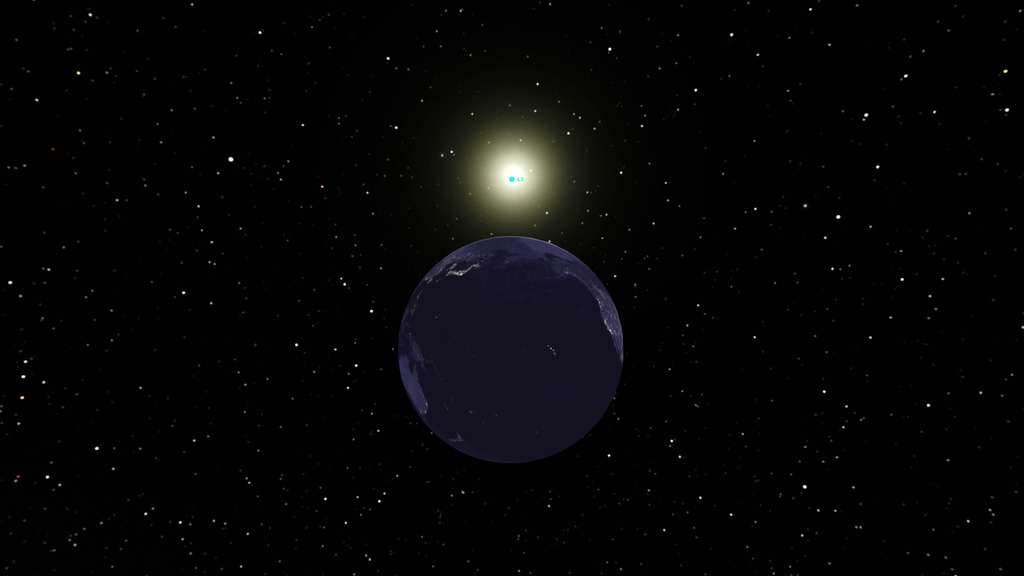
A data visualization showing all three missions launching from Earth and arriving at L1.
IMAP
A data visualization showing IMAP launching from Earth and arriving at L1. IMAP has 10 science instruments that will help researchers understand how the solar wind interacts with the interstellar medium and how energetic particles are accelerated in space.
Carruthers Geocorona Observatory
A data visualization showing the Carruthers Geocorona Observatory launching from Earth and arriving at L1. The SmallSat mission will use an advanced ultraviolet imager to monitor Earth’s exosphere — the outermost layer of the atmosphere — and the exosphere’s response to solar-driven space weather. Carruthers is poised to become the first SmallSat to operate at L1 and the first to deliver continuous exospheric observations from this vantage point.
SWFO-L1
A data visualization showing SWFO-L1 launching from Earth and arriving at L1. The mission will use a suite of instruments to make real-time measurements of the solar wind, thermal plasma, and the magnetic field. In addition, SWFO-L1 will have a Compact Coronagraph (CCOR) instrument to detect coronal mass ejections.
Credits
-
Data visualizer
- Tom Bridgman (Global Science and Technology, Inc.)
-
Producer
- Joy Ng (eMITS)
-
Technical support
- Laurence Schuler (ADNET Systems, Inc.)
- Ian Jones (ADNET Systems, Inc.)
- Ella Kaplan (Global Science and Technology, Inc.)
Missions
This page is related to the following missions:Datasets used
-
Planning Ephemerides (any format) (Planning Ephemerides)
ID: 1252
Note: While we identify the data sets used on this page, we do not store any further details, nor the data sets themselves on our site.
Related
- ID: 14957
 Produced Video
 - ID: 14887
![Produced VideoWatch this video on the NASA Goddard YouTube channel.Complete transcript available.Music Credit: "Time in Motion” by Rick Hearson [PRS], “Proud Patterns by Paul Joseph Smith [PRS] from Universal Production Music](/vis/a010000/a014800/a014887/14887_Thumbnail.jpg) Produced Video
Produced Video - ID: 14888
 Produced Video
 - ID: 20410
 Animation
Release date
This page was originally published on Monday, July 21, 2025.
This page was last updated on Friday, July 11, 2025 at 10:20 AM EDT.