Neutron Star Animations
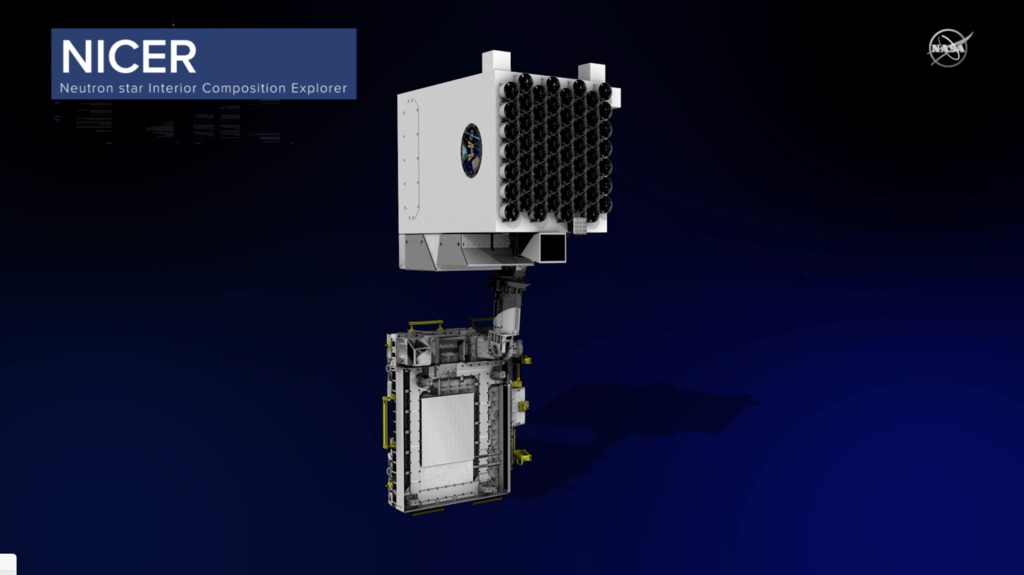
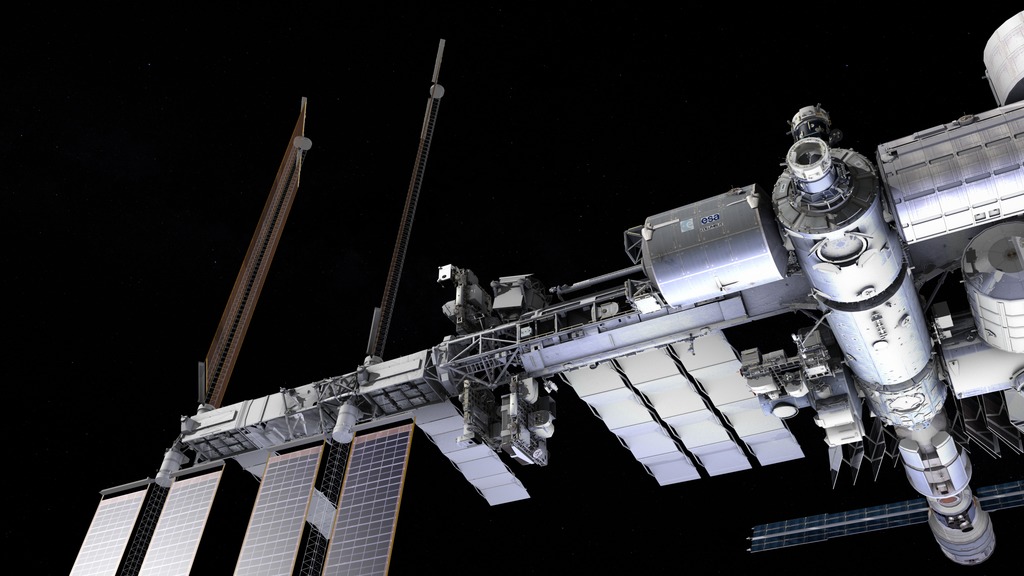
The Neutron star Interior Composition Explorer (NICER) mission will study neutron stars, the densest known objects in the cosmos. These neutron star animations and graphics highlight some of their unique characteristics.
For more information about NICER visit: nasa.gov/nicer.
A neutron star begins its life as a star between about 7 and 20 times the mass of the sun. When this type of star runs out of fuel, it collapses under its own weight, crushing its core and triggering a supernova explosion. What remains is an ultra-dense sphere only about the size of a city across, but with up to twice the mass of the sun squeezed inside.
This animation shows the size and scale of a neutron star over San Francisco.
Neutron stars squeeze up to two solar masses into a city-size volume, giving rise to the highest stable densities known anywhere. The nature of matter under these conditions is a decades-old unsolved problem.
This stylized animation shows the structure of a neutron star. The states of matter at neutron stars' inner cores remains a mystery.
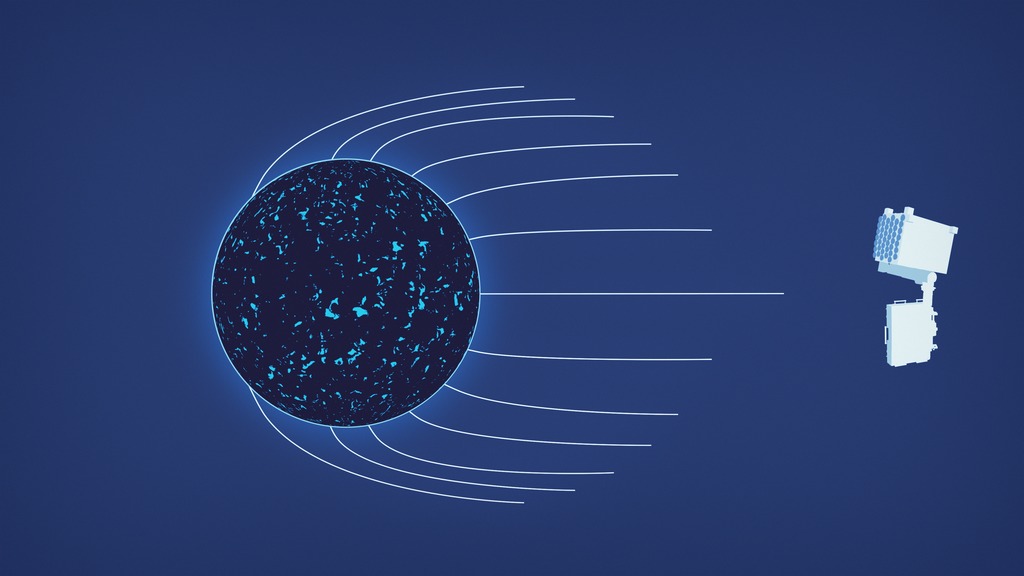
NICER will confront nuclear physics theory with unique measurements, exploring the exotic states of matter within neutron stars through rotation-resolved X-ray spectroscopy.
Animation of a spinning neutron star in space. Neutron stars are directly observable, usually as “pulsars” – the lighthouses of the cosmos.
For More Information
Credits
Please give credit for this item to:
NASA's Goddard Space Flight Center Conceptual Image Lab
-
Animators
- Walt Feimer (KBR Wyle Services, LLC)
- Lisa Poje (USRA)
-
Producers
- Clare Skelly (NASA/GSFC)
- Scott Wiessinger (USRA)
-
Art director
- Michael Lentz (USRA)
Missions
This page is related to the following missions:Related
- ID: 14884
![New supercomputer simulations explore the tangled magnetic structures around merging neutron stars. These structures, called magnetospheres, interact as the city-sized stars enter their final orbits. Magnetic field lines can connect both stars, break, and reconnect, while currents surge through surrounding plasma moving at nearly the speed of light. The simulations show that these systems may produce X-rays and gamma rays that future observatories should be able to detect. Credit: NASA’s Goddard Space Flight CenterAlt text: Narrated video introducing simulations of merging neutron star magnetospheresMusic: “A Theory Develops,” Pip Heywood [PRS], Universal Production MusicWatch this video on the NASA Goddard YouTube channel.Complete transcript available.](/vis/a010000/a014800/a014884/NS_Binary_Sim_Still_searchweb.png)
- ID: 13841
- ID: 12741
 Produced Video
 - ID: 12630
 Produced Video
 - ID: 12605
 Produced Video
 - ID: 20266
 Animation
 - ID: 20268
 Animation
Release date
This page was originally published on Wednesday, April 26, 2017.
This page was last updated on Monday, June 23, 2025 at 12:18 AM EDT.