Testing for the Katalyst-NASA Swift Boost Mission

Kieran Wilson, LINK’s principal investigator, and Hunter Robertson, a space systems engineer, both at Katalyst Space, stand next to their spacecraft inside the SES (Space Environment Simulator) at NASA’s Goddard Space Flight Center in Greenbelt, Md., on April 17, 2026, ahead of thermal vacuum testing. During testing in the SES, LINK fired its three ion thrusters, deployed one of its three arms, and experienced space-like hot and cold temperatures.
Credit: NASA/Sophia Roberts
Alt text: Two people stand next to a spacecraft inside a large black chamber.
Image description: Downward-looking view of two people in white clean suits standing next to a spacecraft at the bottom of a large black circular chamber. The spacecraft lies at center on a black circular plate crisscrossed with white lines. Around the perimeter of the chamber are ladders and various stands. Several small lamps near the chamber’s floor create pools of light. There is a door open to the outside of the chamber at about 1 o’clock.
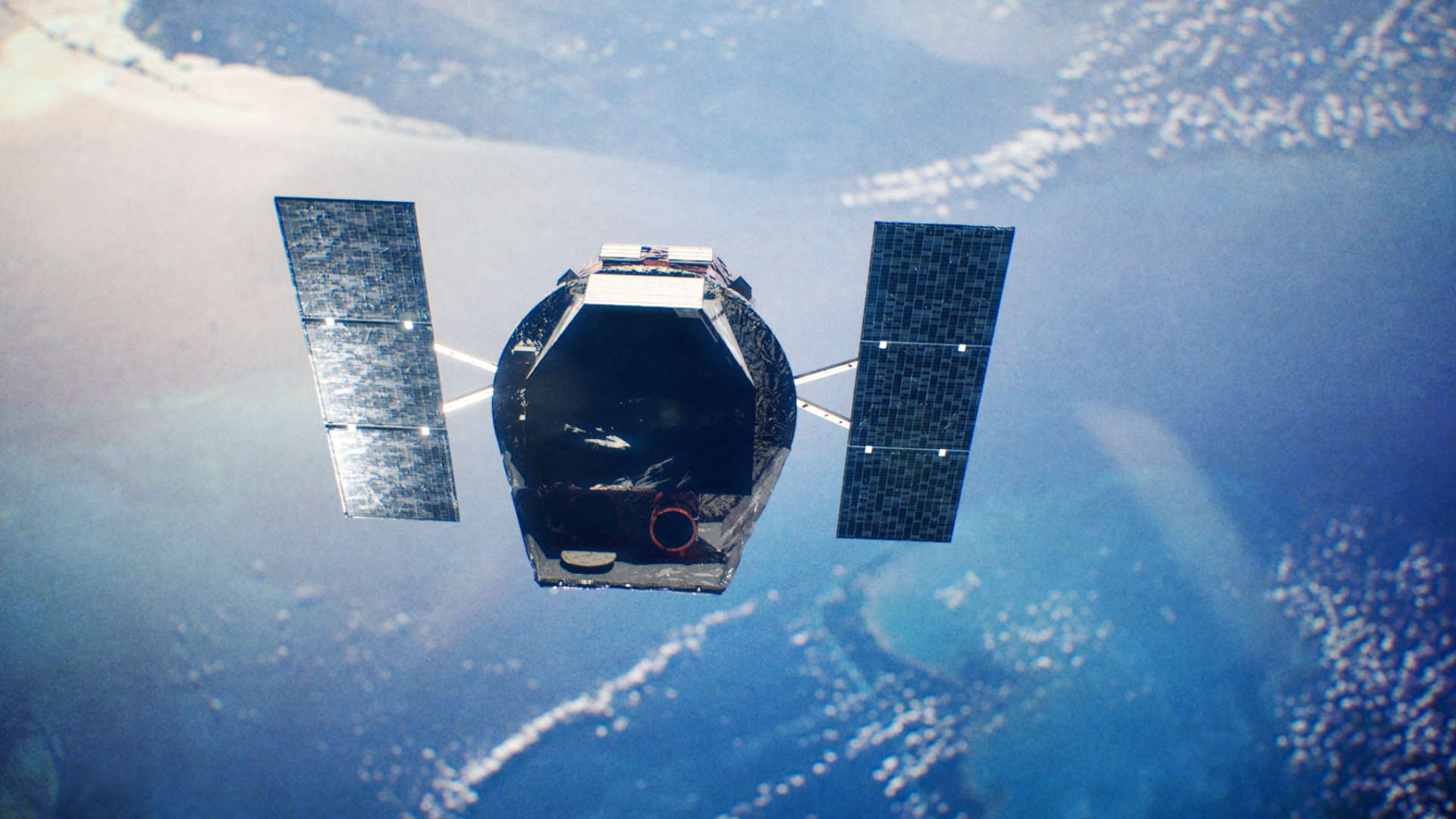
In April and May 2026, engineers from Katalyst Space tested their LINK robotic servicing spacecraft at NASA’s Goddard Space Flight Center in Greenbelt, Maryland, ahead of its mission to raise the orbit of the agency’s Neil Gehrels Swift Observatory.
All spacecraft in low Earth orbit experience drag caused by our planet’s atmosphere. If they don’t have propulsion systems to maintain their positions, the drag gradually reduces their altitudes. A recent bout of solar storms magnified this effect on Swift, which began to sink faster than anticipated.
In September 2025, NASA contracted Katalyst, based in Flagstaff, Arizona, to raise Swift. The company had less than a year to design, build, test, and launch its spacecraft and to rendezvous, grab, and lift Swift.
At Goddard, the Katalyst team completed two assessments for LINK. Vibration testing mimicked the intense shaking the spacecraft will experience during launch. Thermal vacuum testing replicated space-like temperature extremes during which the engineers practiced operating LINK’s ion thrusters and robotic arms.
Wilson removes screws from LINK’s protective container after arrival at NASA Goddard on April 14, 2026. LINK traveled from Katalyst’s integration and testing facility in Broomfield, Colo., to undergo vibration and thermal vacuum testing at Goddard ahead of launch.
Credit: NASA/Sophia Roberts
Alt text: A man stands on a ladder and unscrews a large hexagonal silver box.
Image description: A man in a green shirt and jeans stands on a silver ladder. He works on the top of a large hexagonal silver container that sits on top of a black frame. There is a red ladder on the other side of the container. The container rests in front of a pair of large brown doors in a large warehouse-like space filled with equipment.
Katalyst engineers unbox LINK at NASA Goddard on April 14, 2026. Once in space, LINK will attempt to rendezvous with NASA’s Neil Gehrels Swift Observatory and boost it into a higher orbit.
Credit: NASA/Sophia Roberts
Alt text: Engineers in clean suits unbox a satellite.
Image description: Four people in white clean suits and hair nets hold the edges of a large silver container with a spacecraft inside. It’s sitting on top of a black frame, which a fifth person lies underneath. The spacecraft is silver as well, with folded black solar panels facing the camera. There is a set of large closed brown doors behind the spacecraft, as well as various pieces of equipment like ladders and extendable barriers.
Wilson and Sebastian Alexander, Katalyst’s lead environmental test engineer, examine LINK on April 14, 2026, before testing begins at NASA Goddard. The spacecraft’s robotic arms are folded against its sides and top.
Credit: NASA/Sophia Roberts
Alt text: Two people examine a spacecraft.
Image description: Two people in white clean suits and hair nets examine a silver spacecraft resting on a black square frame. The spacecraft has folded black solar panels that are attached to the side facing the camera. Two robotic arms are also folded against its left and right sides. In the background of the warehouse-like setting are two large brown doors. The one on the right has white lettering visible that reads “Facility 409” and “Vibration Cell.” Scattered around the spacecraft are ladders and other pieces of equipment.
Katalyst engineers stabilize LINK as it moves into a vibration chamber at NASA Goddard on April 15, 2026. The vibration chamber simulates the intense shaking the spacecraft will experience during launch.
Credit: NASA/Scott Wiessinger
Alt text: People maneuver a spacecraft into a large chamber.
Image description: Two people in white clean suits and hair and beard nets stand in the center of this photograph. They each have a gloved hand on the bottom of a silver spacecraft. The spacecraft is suspended from a frame and is being moved into a large chamber by a crane that is out of view. Two more people on the right and left edges of the photo look on. Another person, also in a clean suit and wearing a black helmet, stands next to a railing and holds a crane operator box. The chamber is lit from below.

Alexander looks up at LINK as it lowers into a vibration chamber at NASA Goddard on April 15, 2026.
Credit: NASA/Scott Wiessinger
Alt text: A person looks up at a spacecraft suspended in a large chamber.
Image description: A person in a white clean suit and hair and beard nets faces away from the camera. They look up at a spacecraft being lowered into a large chamber. The bottom third of the chamber has white walls covered in pipes. The top two-thirds are yellower, and a large pair of doors opens to another area. A railing runs in front of the doors.

LINK descends into a vibration chamber at NASA Goddard on April 15, 2026. Visible on the bottom are three circular ion thrusters, which will be powered by about 132 pounds (60 kilograms) of xenon gas. The satellite’s two solar panels, each about 12 feet (6 meters) long, fold accordion-like against its sides.
Credit: NASA/Scott Wiessinger
Alt text: A spacecraft hangs in a large chamber.
Image description: A spacecraft hangs from the ceiling of a large chamber. A black robotic arm rests against the side facing the camera. Two folded solar panels create a gold, accordion-like appearance on the spacecraft’s right and left sides. Inside the circular bottom, three smaller circles and a host of other electronics are visible. The spacecraft is attached to a yellow frame and crane mechanism. Behind it, the chamber’s two large tan doors are open. A railing runs in front of the doors.

LINK descends into the SES at NASA Goddard on April 28, 2026. The SES recreates the hot and cold temperature extremes LINK will experience in space. Engineers tested Swift in the same chamber before it launched in November 2004.
Credit: NASA/Scott Wiessinger
Alt text: A spacecraft descends into a large chamber.
Image description: A small silver spacecraft hangs from the ceiling of a large warehouse-like space. It’s attached to a yellow frame and is descending into a large chamber. A white banner on the side of the chamber says “Goddard Space Flight Center” with the circular NASA logo on the left side.
Katalyst engineers attach LINK to a baseplate inside the SES at NASA Goddard on April 28, 2026. Once all the air was pumped out of the 27-foot-diameter chamber, the team practiced firing the satellite’s ion thrusters and operated one of the robotic arms.
Credit: NASA/Sophia Roberts
Alt text: People in cleans suits work on a spacecraft in a large chamber.
Image description: People in white clean suits and blue gloves attach a spacecraft to a black frame at the bottom of a large black circular chamber. Two additional people in clean suits observe them, one to the left of the spacecraft and one further away standing in a doorway. A red ladder stands against the chamber’s far wall.
This video shows the LINK spacecraft moving into a vibration chamber at NASA Goddard on April 15, 2026.
0:00 Katalyst engineers slide LINK toward the entrance of the vibration chamber. 0:16 Another view of LINK sliding toward the chamber entrance. 0:32 Engineers attach LINK to a crane. 0:48 The engineers step away from LINK before it starts to lift from its base. 0:56 The engineers hold LINK at the bottom as it starts to lift away from its base. Once it’s clear, they continue to keep it steady as it rises. 1:42 Two engineers each place a hand on LINK as it moves forward into the chamber. 2:18 LINK descends into the chamber beyond a safety railing. 2:28 Looking down into the chamber, a technician watches LINK lower onto a base at the bottom. 2:42: View of LINK lowering into the chamber from below. 2:52: Another view of LINK from below. 2:58 Another view of LINK from below, nearing the bottom of the chamber. 3:18 Close up of a hand on the remote control for the crane. 3:21 Hunter Robertson stabilizes LINK as it lowers onto the baseplate at the bottom of the vibration chamber. 3:31 Pan down to LINK at the bottom of the vibration chamber.
Credit: NASA/Sophia Roberts and Scott Wiessinger
This video shows the LINK spacecraft from below as it descends into the vibration chamber at NASA Goddard on April 15, 2026.
0:00 LINK descends from out of frame into the chamber. 0:29 Two technicians enter the frame from bottom right to observe the descent. 0:49 LINK’s descent pauses, and then it shifts to the left. 1:19 The camera’s position shifts to the left side of the chamber to watch LINK continue to descend toward the baseplate. 2:00 LINK’s descent stops again, and several engineers enter the frame from the right. 2:50 LINK begins to descend slowly again.
Credit: NASA/Sophia Roberts and Scott Wiessinger
Vibration tests replicate the intense shaking spacecraft experience during launch, as shown in this 35-second clip of LINK’s testing at NASA Goddard on May 1, 2026.
Credit: NASA/Sophia Roberts and Scott Wiessinger
This video shows LINK entering the SES at NASA Goddard on April 28, 2026.
0:00 Different views of thermal vacuum engineer Juan Novillo (KBR) rolling back the lid of the SES. 0:38 An unseen crane lifts LINK, which has its thrusters pointed toward the camera. 0:55 The camera tilts up to follow LINK’s ascent towards the ceiling. 1:20 LINK moves sideways towards the SES chamber. 1:32 Opposite view of LINK moving toward the entrance to the SES chamber. 2:13 LINK descends into the chamber. 2:48 View of LINK descending into the SES from below. 4:14 Slow pan downward as LINK is about halfway into the chamber. 4:51 View of LINK nearing the baseplate inside the SES from behind three clean-suited figures. 5:39 Katalyst engineers guide LINK onto its frame at the bottom of the chamber. 6:14 Wilson watches LINK settle onto its frame. 6:28 Pan around LINK at the bottom of the SES. 7:00 View of LINK inside the SES from outside the chamber door. 7:37 The camera moves into the chamber from the doorway.
Credit: NASA/Sophia Roberts and Scott Wiessinger
Credits
Please give credit for this item to:
NASA's Goddard Space Flight Center. However, individual items should be credited as indicated above.
-
Photographers
- Scott Wiessinger (eMITS)
- Sophia Roberts (eMITS)
-
Videographers
- Scott Wiessinger (eMITS)
- Sophia Roberts (eMITS)
-
Science writer
- Jeanette Kazmierczak (University of Maryland College Park)
Missions
This page is related to the following missions:Series
This page can be found in the following series:Related
- ID: 15062
 Produced Video
 - ID: 15061
 Produced Video
 - ID: 15060
 Produced Video
 - ID: 15051
 Produced Video
 - ID: 14786
 Animation
 - ID: 14721
![Watch to learn how NASA’s Neil Gehrels Swift Observatory got its name.
Credit: NASA’s Goddard Space Flight Center
Music: “In a Conundrum,” Pip Heywood [PRS], Universal Production Music“Spinning Particles,” Christian Telford [ASCAP] and Koichi Sanchez-Imahashi [ASCAP], Universal Production MusicWatch this video on the NASA Goddard YouTube channel.Complete transcript available.](/vis/a010000/a014700/a014721/Swift_Name_20_Thumbnail2.jpg) Produced Video
Produced Video - ID: 13926
 Animation
Release date
This page was originally published on Wednesday, May 27, 2026.
This page was last updated on Wednesday, July 29, 2026 at 2:40 PM EDT.