TESS Finds Possible New Worlds Using Stellar Eclipses

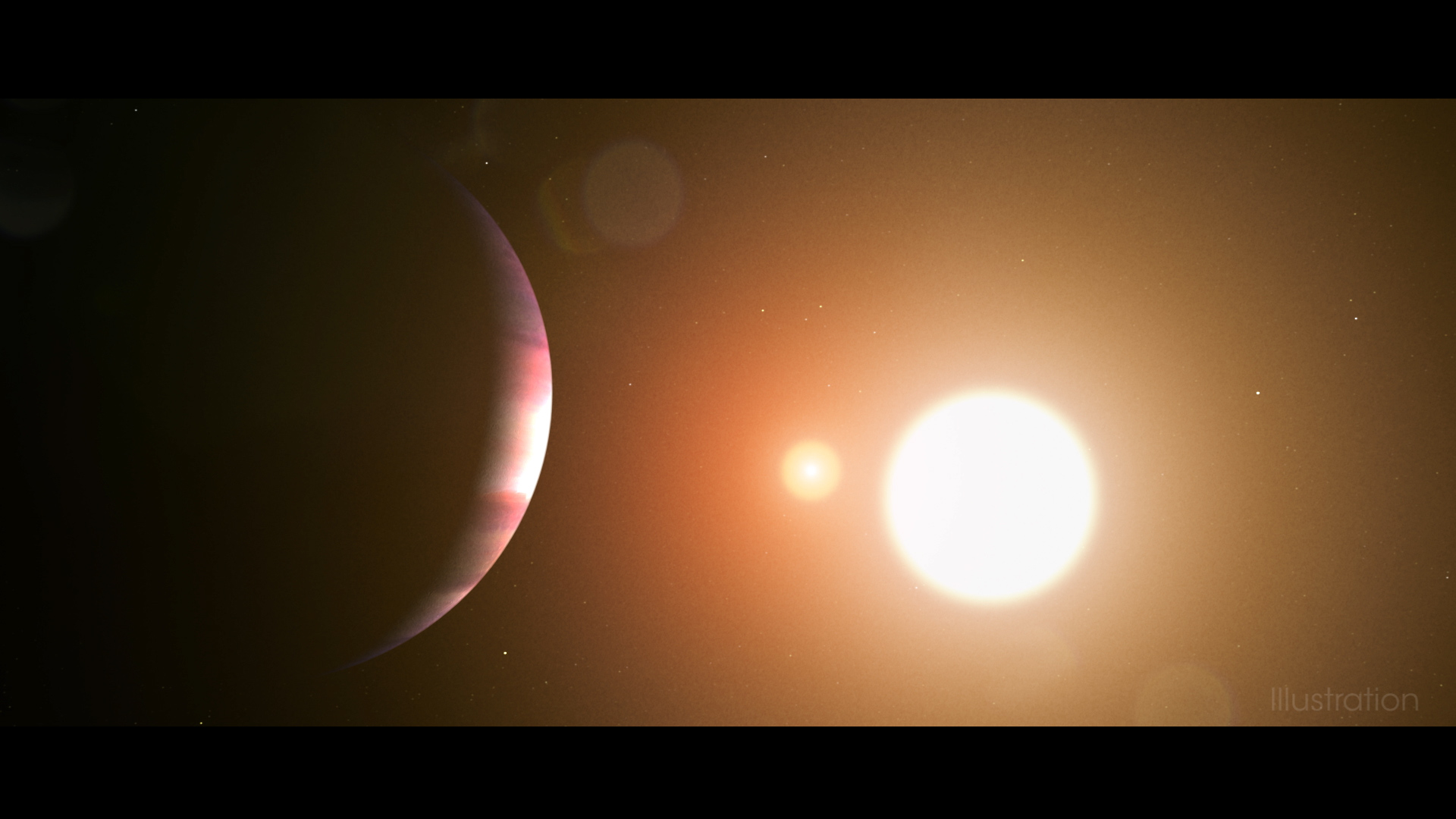
A gas giant planet looms in the foreground at right, illuminated by a pair of stars, in this artist’s concept of a world in a binary system. NASA’s TESS (Transiting Exoplanet Survey Satellite) has found planets in two binary star systems by looking for stellar dimming as the planets cross in front of one of the stars. Astronomers have now demonstrated a new method of finding planets in these systems by focusing on the timing of the stars’ mutual eclipses.
Credit: NASA's Goddard Space Flight Center/Chris Smith (USRA)
Alt text: Planet orbiting a binary system
Image description: Against a starry sky suffused with an orange glow, a gas giant planet with purple and white clouds appears in its crescent phase at right. Two bright stars illuminate the scene, one large and whitish at left, the other smaller and more orange near the center.
A study of NASA’s TESS (Transiting Exoplanet Survey Satellite) data on stellar pairs undergoing mutual eclipses has uncovered more than two dozen candidate exoplanets, or worlds beyond our solar system. This method allows the mission to locate planets it couldn’t otherwise detect.
To date, TESS has discovered 885 confirmed exoplanets and identified more than 7,900 candidates, nearly all found because the planets pass in front of their stars from our perspective. These events, called transits, produce a small, regular dip in the brightness of the planet’s host star. TESS also observes tens of thousands of eclipsing binary stars — two orbiting stars that alternately eclipse each other from our vantage point. Astronomers can detect the gravitational tug of exoplanets in these systems by carefully measuring the exact timing of many eclipses. Prior to the new study, discoveries by NASA’s retired Kepler mission and other facilities had recorded 16 transiting worlds around binary stars, while TESS had found an additional two.
Identifying transits in binary systems clearly is challenging, but astronomers would like to know more about the range of planets that can form around two gravitationally bound stars. Now, using TESS data on stellar eclipses, astronomers have developed a technique to search for planets that is not limited to the orientation of the planet’s orbit.
The timing of stellar eclipses can gradually change through tidal and rotational interactions between the stars, the effects of general relativity, and the presence of other unseen masses, such as planets, in the system. All of these forces cause the entire orbital plane of the binary to rotate, or precess, and this in turn alters the eclipse timing. After analyzing 1,590 binaries with at least two years of TESS data, one study revealed 27 systems with candidate planets that now await confirmation.
The masses of the new candidates remain uncertain, but the smallest world may hold as little 12 Earth masses, with the largest topping out around 3,200 Earths, or about 10 times Jupiter's mass. Confirming these planets will require future ground-based observations that precisely measure the velocities of the host stars, which will reveal the slight gravitational tugs of any possible planets.
A gas giant planet looms in the foreground at the bottom, illuminated by a pair of stars, in this artist’s concept of a world in a binary system. NASA’s TESS (Transiting Exoplanet Survey Satellite) has found planets in two binary star systems by looking for stellar dimming as the planets cross in front of one of the stars. Astronomers have now demonstrated a new method of finding planets in these systems by focusing on the timing of the stars’ mutual eclipses.
Credit: NASA's Goddard Space Flight Center/Chris Smith (USRA)
Alt text: Planet orbiting a binary system
Image description: Against a starry sky suffused with an orange glow, a gas giant planet with purple and white clouds appears in its crescent phase at bottom. Two bright stars illuminate the scene, one large and whitish at top center, the other smaller and more orange below it.
Explore how observations of stellar eclipses can expand the capabilities of NASA’s TESS, leading to the discovery of new candidate planets it couldn’t otherwise detect.
Credit: NASA’s Goddard Space Flight Center/Francis Reddy
Alt text: Infographic outlining the new discovery method
Image descriptiopn: Four panels of text and illustrations appear on a dark blue background. The title reads “How TESS Finds Planets Using Stellar Eclipses.”
1: The top panel contains three illustrations. At left, in shades of light blue, is a picture of the TESS satellite. In the middle, several images of a planet, attached to a blue arrow indicating motion to the right, appear silhouetted against the disk of an orange star. Labels read “Star” and “Planet’s path.” The text below reads “NASA’s TESS (Transiting Exoplanet Survey Satellite) finds alien worlds by looking for planets that cross in front of their stars. This passage is called a transit.” At right, a fuzzy, chalk-like line tracks the orange star’s light during a transit, showing a dip in the middle. Text along the line reads “Transits dim the star a little bit once each orbit.” Text along the left axis reads “Starlight,” with “More” above it and “Less” below it. The bottom axis reads “Time” next to an arrow pointing right. Text below the panel reads “But detecting transits in systems with two stars poses a greater challenge.”
2: A larger yellow star appears next to a smaller red star below and to its left. The smaller star is attached to a light blue oval, and an arrow indicates orbital motion in the counterclockwise direction. Text above the stars reads “Binary system. Two stars orbit each other.” The larger star is labeled “Primary (brightest) star,” while the smaller one is labeled “Secondary (companion) star.” At right is another brightness graph, showing a chalky yellow curve with a deep V-shaped notch on the left and a smaller dip on the right. Above the graph are two illustrations of the binary system at left seen from more oblique angles, such that the small star passes in front of (left) and behind (right) the larger star. The left drawing is labeled “Primary eclipse” and an arrow from it points to the deep notch in the graph. The one on the right is labeled “Secondary eclipse,” with an arrow pointing to the small notch in the graph. Above eclipse illustrations, text reads “Viewed from Earth, some binary stars mutually eclipse.” Below the graph, text reads “These larger light variations make it harder to find the tiny dips of transiting planets. Out of hundreds of discoveries, TESS has found only two transiting worlds in binary systems!”
3: In the third panel, a label reads “Orbits aren’t fixed in place. They can slowly rotate, or precess.” The same overhead view of the binary system from the previous panel is shown. The orbital track is now accompanied by two darker copies rotated at slightly different angles. Three magenta lines, one brighter than the others, span the orbit and crosses through the primary star. Two short, thick magenta arrows indicate counterclockwise motion of the lines. A magenta label reads “Line of apsides” and a caption below reads “This line links the companion’s closest and farthest distances (apsides) from the primary star. It precesses with the orbit.” At right is another brightness graph, similar to the one in the previous panel. It has three sets of progressively darker chalky yellow lines, suggesting changes in the eclipse positions over time. The deeper primary eclipses are arriving earlier, while the secondary eclipses are coming later. Text at the top of the graph reads “The slow orbital changes gradually alter when eclipses occur.” Below the graph lie illustrations of three multihued planets, the one on the left resembling a terrestrial world and the others resembling cloudy planets with thick atmospheres. Text below the graph reads “One way orbits precess is from the gravitational effects of additional bodies in the system, like planets!”
4: In the final panel, at left is a cartoon symbolizing many TESS observations of an eclipsing binary system. Text reads “Thousands of TESS brightness measurements have let astronomers find potential planets in eclipsing binaries. These are planet candidates that TESS could not otherwise detect.” The middle image is a larger drawing of TESS, angled so that it appears to be viewing the binary system shown in the previous panel. On the right are light blue outlines of jigsaw puzzle pieces, with six connected at left and two unconnected at right. The final text reads “When confirmed by observations from other facilities, these worlds will help astronomers build a more complete picture of planet formation in our galaxy.”
For More Information
See NASA.gov
Credits
Please give credit for this item to:
NASA's Goddard Space Flight Center. However, individual items should be credited as indicated above.
-
Science writer
- Francis Reddy (University of Maryland College Park)
-
Scientist
- Allison Youngblood (GSFC)
Related
- ID: 13510
 Produced Video
Release date
This page was originally published on Tuesday, May 12, 2026.
This page was last updated on Wednesday, July 15, 2026 at 12:13 PM EDT.