Argonne Assembles, Tests Early ComPair-2 Hardware

Tim Cundiff, an engineering specialist at Argonne National Laboratory in Lemont, Illinois, monitors the automated wire bond of a ComPair-2 detector layer in April 2025.
Image courtesy of Argonne National Laboratory
Alt text: A man in a lab uses a microscope.
Image description: A man in a white clean suit, gloves, safety glasses, and a hairnet sits in front of a piece of machinery in a laboratory and peers into a microscope. Behind him is a long bench covered in scientific equipment and computers. In front of him, inside the machinery, are what look like two black treads that loop in and out of frame.
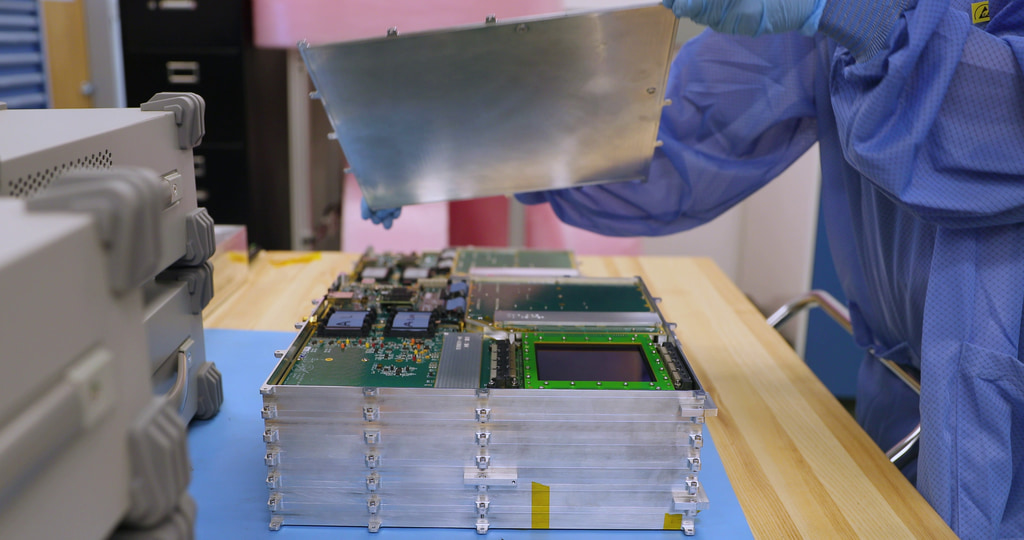
In spring 2025, scientists and engineers at the U.S. Department of Energy’s Argonne National Laboratory in Lemont, Illinois, assembled two layers of next-generation gamma-ray detectors for NASA’s upcoming ComPair-2 scientific balloon mission, which will be led by researchers at the agency’s Goddard Space Flight Center in Greenbelt, Maryland.
Gamma rays are the most energetic form of light and span a broad range of energies. Detectors on current missions have a gap in coverage where supernovae and powerful explosions called gamma-ray bursts shine the brightest. It’s also where astronomers expect to see the strongest glow from the most massive and distant active galaxies, which are powered by monster black holes.
ComPair-2 will sport 10 layers of detectors to study gamma rays between 20,000 and 100 million electron volts. For comparison, visible light’s energy falls between 2 and 3 electron volts.
The mission’s name derives from the two methods it uses to study gamma-ray interactions in its detectors: Compton scattering and pair production. In Compton scattering, a gamma ray hits a charged particle, such as an electron, and transfers some energy to it. Pair production occurs when a gamma ray grazes the nucleus of an atom and converts into a pair of particles — an electron and its antimatter counterpart, a positron. ComPair-2 accurately measures these interactions to determine the energy and direction of the arriving gamma rays.

Each ComPair-2 layer, like the one shown here, has approximately 30,000 wire bonds that connect its gamma-ray detectors to the front-end electronics board. Each bond is assembled by automation with oversight from Cundiff and his colleagues.
Image courtesy of Argonne National Laboratory
Alt text: Wire bonding a detector layer
Image description: A sturdy black block with what looks like a needle attached lowers onto a tray of green and gold electronics.

Cundiff watches the machine fasten bond wires through a microscope.
Image courtesy of Argonne National Laboratory
Alt text: A man in a lab uses a microscope.
Image description: A man in a white clean suit, gloves, safety glasses, and a hair net looks through a microscope. He’s watching machinery work on a tray of green and gold electronics. The machinery is housed inside a white metal box with open sides and moves via two black treads.

A different view of Cundiff overseeing the automated wire bonding process.
Image courtesy of Argonne National Laboratory
Alt text: A man in a lab uses a microscope.
Image description: A man in a white clean suit, gloves, safety glasses, and a hair net looks through a microscope. He’s watching machinery work on a tray of green and gold electronics. The machinery, seen from the side, is housed inside a white metal box with open sides and moves via two black treads. In the background is a brightly lit lab space.

Each ComPair-2 layer has 95 AstroPix quad chips like the one shown here. Each quad chip has four silicon pixel gamma-ray detectors. Each of these detectors incorporates 1,225 pixels. AstroPix detectors, which are developed by NASA Goddard, function similarly to the sensors in cellphone cameras except they are sensitive to gamma-ray light.
Image courtesy of Argonne National Laboratory
Alt text: A gloved hand holds a detector square.
Image description: A person in a white jacket and gloves holds a two-by-two square of what looks like copper-colored computer chips. The camera cuts off the person at the shoulders. Behind them, out of focus, is laboratory equipment.

Manoj Jadhav, technical project leader at Argonne’s Micro Assembly Facility, works on one frame that will house a ComPair-2 detector layer.
Image courtesy of Argonne National Laboratory
Alt text: A man in a lab uses equipment.
Image description: A man in a white clean suit, gloves, hair net, and safety glasses adjusts a piece of equipment in a laboratory. The equipment rests on a blue mat on top of a bench. The lab is brightly lit, but a lamp clamped to the bench provides more illumination for the man’s work.

Jadhav carefully lowers an AstroPix quad chip into the frame for the detector layer. The AstroPix chips and all the electronics for detecting gamma rays will rest on this frame.
Image courtesy of Argonne National Laboratory
Alt text: Gloved hands adjust a piece of equipment.
Image description: A pair of gloved hands adjusts a piece of equipment. The right hand moves a sliding attachment along one side. Suspended from the attachment by what looks like four tiny black suction cups is a silver block of material. The person is lowering it into hole in a silver frame where similar holes have been filled with other silver blocks. The piece of equipment has a control panel at the back with several red switches. The one closest to the camera says “POWER” at the top in white lettering.

Jessica Metcalfe, a physicist at Argonne and the lab’s principal investigator for ComPair-2, helps Cundiff with assembly.
Image courtesy of Argonne National Laboratory
Alt text: Scientists work in a lab.
Image description: A woman in a white clean suit, gloves, safety glasses, and a hair net sits at a table in a brightly lit laboratory. She’s opening a container, and the space on the table around her is cluttered with tools and other scientific equipment. Further along the table a man in similar attire reaches in front of him to adjust something.

Metcalfe and Jadhav look on as Cundiff examines a ComPair-2 layer under a microscope.
Image courtesy of Argonne National Laboratory
Alt text: Two scientists watch a third work in a lab.
Image description: A woman and a man in white clean suits, safety glasses, and hair nets stand in a brightly lit laboratory. A man in similar attire sits at a table between them. He uses a microscope to examine a tray of gold-colored electronics.

Jadhav tests a ComPair-2 layer prior to delivery to NASA Goddard. He provides power to the front-end electronics that control the detectors to confirm the wire bonding and assembly were performed correctly.
Image courtesy of Argonne National Laboratory
Alt text: A man works in a lab.
Image description: A man in white clean suit, gloves, safety glasses, and a hair net sits at a table in a brightly lit laboratory. He tests a tray of gold-colored electronics on a table in front of him. He looks a small yellow box in the lower left corner of the image, which is slightly out of focus.
Credits
Please give credit for this item to:
NASA's Goddard Space Flight Center
-
Producer
- Sophia Roberts (eMITS)
-
Technical support
- Aaron E. Lepsch (ADNET Systems, Inc.)
-
Science writer
- Jeanette Kazmierczak (University of Maryland College Park)
Series
This page can be found in the following series:Related
- ID: 14980

- ID: 14794
 Produced Video
 - ID: 14372

- ID: 14354
Release date
This page was originally published on Friday, March 20, 2026.
This page was last updated on Friday, March 20, 2026 at 12:22 PM EDT.