Prototype ComPair-2 Gamma-Ray Detectors Complete Thermal Vacuum Testing

Prototype gamma-ray detectors for the ComPair-2 mission rests in a thermal vacuum chamber after testing in June 2025 at NASA’s Goddard Space Flight Center in Greenbelt, Maryland. The ComPair-2 team tested the detectors’ performance at hot and cold temperatures over the course of a week and the overall survivability of the layer itself.
Credit: NASA/Sophia Roberts
Alt text: A piece of equipment sits inside a chamber in a lab.
Image description: A cylindrical metal chamber at the center of the image has its door swung all the way open. Inside are silver-wrapped ComPair-2 detectors attached to many copper-colored wires. The chamber is in a lab with white walls and has tubes, wires, and other pieces of equipment attached.
In June 2025, scientists and engineers tested a layer of next-generation gamma-ray detectors in a thermal vacuum chamber at NASA’s Goddard Space Flight Center in Greenbelt, Maryland. Future iterations of the hardware are slated for a mission called ComPair-2 (Compton Pair-2).
Gamma rays are the most energetic form of light and span a broad range of energies. Detectors on current missions currently have a gap in coverage where supernovae and powerful explosions called gamma-ray bursts shine the brightest. It’s also where astronomers expect to see the strongest glow from the most massive and distant active galaxies, which are powered by monster black holes.
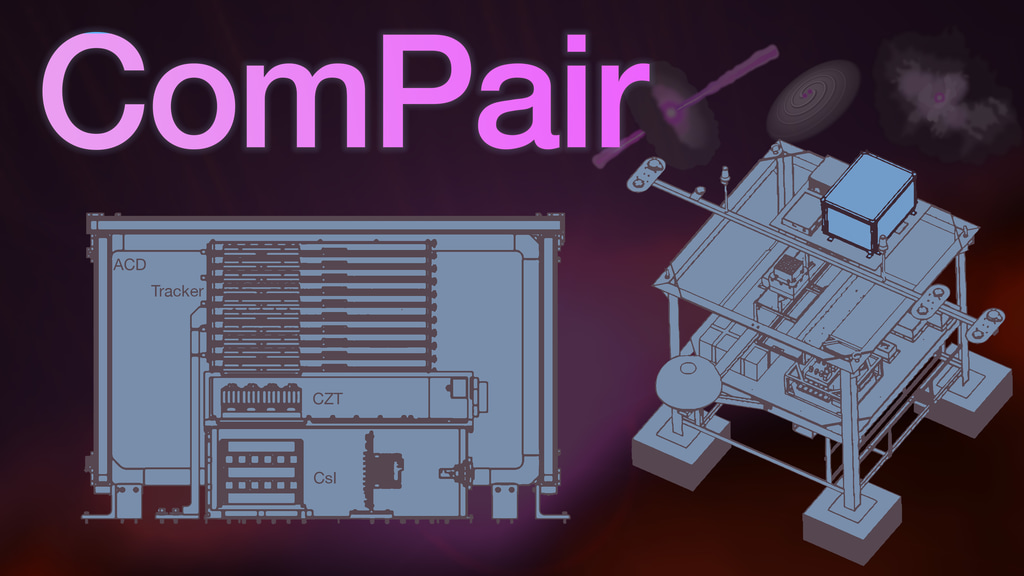
ComPair-2 will sport 10 layers of these new detectors to study midrange gamma rays between 20,000 and 100 million electron volts. For comparison, visible light’s energy falls between 2 and 3 electron volts. The mission uses complementary metal oxide semiconductors, sensors also found in digital cameras.
The mission’s name derives from the two methods it uses to study gamma-ray interactions in its detectors: Compton scattering and pair production. In Compton scattering, a gamma ray hits a particle, such as an electron, and transfers some energy to it. Pair production occurs when a gamma ray grazes the nucleus of an atom and converts into a pair of particles — an electron and its antimatter counterpart, a positron. ComPair-2 accurately measures these interactions to determine the energy and direction of the arriving gamma rays.
Iker Liceaga-Indart, a mechanical engineer at NASA Goddard, peers into the thermal vacuum chamber to evaluate the prototype after testing.
Credit: NASA/Sophia Roberts
Alt text: A man investigates a chamber in a lab.
Image description: A man in a navy-blue polo shirt kneels to look into a cylindrical metal chamber in a lab. The chamber door is fully open and inside are silver-wrapped ComPair-2 detectors attached to many copper-colored wires.
Liceaga-Indart, Lucia Tian, Zachary Metzler, and Julie Cox carefully place the detector layer on a lab bench after removing it from the chamber. The team wrapped the layer in a thermal blanket made of a mylar and aluminum material to simulate the insulating environment it might experience as one part of an instrument inside a future gamma-ray observatory.
Credit: NASA/Sophia Roberts
Alt text: Four people hold different corners of an equipment setup.
Image description: Four people are setting ComPair-2 detectors wrapped in silver foil on a table in a lab. Each holds a post at the rectangle’s four corners. The table they’re setting it on is wood with a blue mat in the middle. Behind it is a wall covered in shelves filled with boxes and equipment.
Tian and Liceaga-Indart watch as Cox carefully slices the tape holding the sheets of thermal blanket together around the layer.
Credit: NASA/Sophia Roberts
Alt text: Three people stand around a piece of equipment on a lab table.
Image description: A woman in a navy-blue shirt works on ComPair-2 detectors wrapped in silver material on a table in a lab. A woman in a red shirt and a man in a navy-blue polo shirt watch. The equipment has many copper-colored wires attached to the right side. In the background, the lab wall is covered in shelves filled with boxes and equipment.
Cox and Metzler lift the top layer of thermal blanketing, revealing the detector layer underneath.
Credit: NASA/Sophia Roberts
Alt text: Two people lift a foil sheet off a piece of equipment on a lab table.
Image description: A woman in a navy-blue shirt and a man in a white shirt lift a piece of silver foil off a sheet of ComPair-2 detectors in a lab. The electronics rest on a blue mat on a wooden tabletop. Copper-colored wires attach to the right side. In the background, the wall of the lab is covered in shelves full of boxes and equipment.

Tian does an initial check of the wirebonds that connect the detectors’ circuitry. Each layer currently has 27,000 wirebonds. The ComPair-2 team carefully inspects each one any time the layer goes through a test.
Credit: NASA/Sophia Roberts
Alt text: A woman inspects circuitry in a lab.
Image description: A woman wearing a red shirt leans over a layer of ComPair-2 detectors with rows and rows of orange circuitry on top. She holds a phone in one hand and carefully touches the corner of the rectangle with the other. The rectangle rests on a piece of silver foil with copper-colored wires attached to one side and two white strips to another. To the left of the woman is the door of a cylindrical metal chamber. Behind her is a lab space with blue cabinets.
White heat straps help manage the test layer’s temperature, and copper-colored wires connect to temperature sensors. Teams developing smaller missions at NASA Goddard often make use of spare hardware and electronics from other projects. The heat straps here were excess materials from NASA’s Nancy Grace Roman Space Telescope.
Credit: NASA/Sophia Roberts
Alt text: A piece of electronic equipment rests on a lab bench.
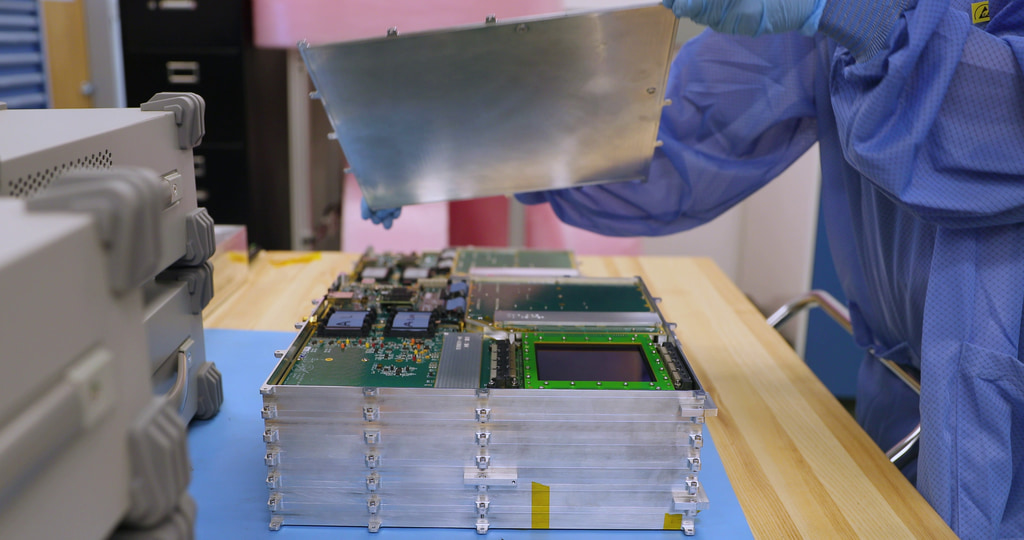
Image description: A rectangular layer of ComPair-2 detectors rests on a lab bench. The top is covered in strips of orange circuitry with a band of green along the right side. It sits on top of a piece of silver foil and has two white straps and several copper-colored wires attached to the near side. The wooden tabletop has a blue mat. Behind the table is a cylindrical metal chamber with its door swung open. Blue-and-white cabinets and shelving line the walls.
Credits
Please give credit for this item to:
NASA's Goddard Space Flight Center. However, individual items should be credited as indicated above.
-
Photographers
- Sophia Roberts (eMITS)
- Scott Wiessinger (eMITS)
-
Science writer
- Jeanette Kazmierczak (University of Maryland College Park)
Series
This page can be found in the following series:Related
- ID: 14991
 Produced Video
 - ID: 14794
 Produced Video
 - ID: 14373
 Infographic
 - ID: 14372

- ID: 14354
Release date
This page was originally published on Thursday, February 26, 2026.
This page was last updated on Thursday, February 26, 2026 at 12:02 PM EST.