Infographic: NASA’s Pandora Mission
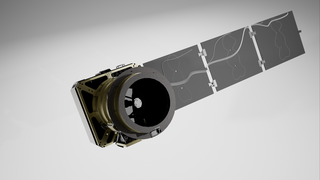
Pandora is a NASA small satellite (SmallSat) mission designed to study exoplanet atmospheres and their host stars. In its first year, it will observe about 20 exoplanets using visible and near-infrared light, revisiting each planet 10 times for 24-hour observations to separate the planet’s signal from its star and reveal the composition of the planet’s atmosphere.

This artist’s concept summarizes NASA’s Pandora mission and its science goals. Pandora will repeatedly observe multiple planets and their host stars in both visible and near-infrared light. These measurements will enable astronomers to separate chemical fingerprints detected in a planet’s atmosphere from potentially misleading signals originating from its host star.
Credit: NASA/Sophia Roberts
Alt text: Pandora mission infographic
Image description: A sketch of the Pandora spacecraft lies in the top third of the image, which has a light tan and white background. Spanning the bottom is a mottled yellow semicircle representing a Sun-like star, and on its left are reddish brown blemishes representing sunspots. Above it a series of planets in an arc are connected by a faint gray dashed line. The planets are shaded more darkly as they proceed to the right, as if they are orbiting the star and entering a transit. Two bubbles contain sketches of molecules, one by the third planet image and one beneath it pointing to the star. The title, at center and below the spacecraft, reads “Pandora helps untangle star/planet signals.” Light gray dashed lines fan out from the title to the star below. The NASA insignia is at top left. Additional text at the top reads “Pandora’s goal is to disentangle the signals of exoplanets and their stars to better understand their atmospheres.” Text around the spacecraft reads “Weight: 717 lbs. (325 kg), Approx. one male elk,” “Uses a spare detector from NASA’s James Webb Space Telescope,” and “Orbit: low Earth.” Text below the title and above the star reads “The Science” and “As starlight passes through a planet’s atmosphere, molecules such as water leave chemical fingerprints. Pandora makes long, simultaneous observations of the planet and star in visible and near-infrared light. Scientists need to know if detected molecules, especially those important to life, come from the planet or the star.” Text by the top of the star reads “Stars produce signals similar to planetary atmospheres, and stellar activity can distort measurements.” Text at the bottom reads “Year 1, 20 exoplanets to be observed, 10 observations per planet, 24 hours per observation,” and “SmallSat, Pandora is a lower-cost mission that complements other larger missions like NASA’s Webb.”
Credits
Please give credit for this item to:
NASA's Goddard Space Flight Center. However, individual items should be credited as indicated above.
-
Producer
- Sophia Roberts (eMITS)
-
Science writers
- Jeanette Kazmierczak (University of Maryland College Park)
- Francis Reddy (University of Maryland College Park)
-
Technical support
- Aaron E. Lepsch (ADNET Systems, Inc.)
Series
This page can be found in the following series:Related
- ID: 14945
 Produced Video
 - ID: 14883
![Watch to learn how a new tool uses data from exoplanets, worlds beyond our solar system, to tell us about their polka-dotted stars.Credit: NASA’s Goddard Space Flight CenterMusic: “Whimsical Whirlwinds,” Claire Leona Batchelor [PRS], Universal Production MusicWatch this video on the NASA Goddard YouTube channel.Complete transcript available.Get the vertical version of this video [here](https://svs.gsfc.nasa.gov/14797/){target=_blank}.](/vis/a010000/a014800/a014883/PolkaDotStars_Thumbnail.jpg) Produced Video
Produced Video - ID: 14747
 Produced Video
 - ID: 14754
![Watch to learn more about NASA's Pandora mission, which will revolutionize the study of exoplanet atmospheres.Credit: NASA's Goddard Space Flight CenterMusic: “Mesmeric Thoughts,” Andrew Michael Hewitt [PRS], Universal Production MusicWatch this video on the NASA Goddard YouTube channel.Complete transcript available.](/vis/a010000/a014700/a014754/YTframe_ASD_Pandora.jpg) Produced Video
Produced Video
Release date
This page was originally published on Thursday, August 20, 2026.
This page was last updated on Monday, August 31, 2026 at 9:16 AM EDT.