XRISM Clocks Hot Wind of Galaxy M82

The Resolve instrument aboard the XRISM (X-ray Imaging and Spectroscopy Mission) spacecraft captured data revealing the velocity of the hot wind at the center of starburst galaxy M82. The energy range of iron emission lines show that the gas moves around 2 million miles (about 3 million kilometers) per hour. Inset: XRISM Xtend instrument’s image of M82.
Credit: NASA’s Goddard Space Flight Center, JAXA/NASA, XRISM Collaboration et al. 2026
Alt text: Spectrum and image of galaxy M82
Image description: This image is labeled, “XRISM Resolve Measures the Hot Wind of Starburst Galaxy M82.” It shows a graph where the bottom is labeled, “X-ray energy (keV),” with a range from 2 to 9. The left side is labeled “X-ray brightness.” A squiggly white line starts near the bottom of the left side. Several peaks are labeled, including silicon, sulfur, argon, and calcium. Four peaks are identified as iron. In the upper right corner, a small inset shows an image that looks like a purple pansy with a yellow center.
For the first time, astronomers have directly measured the speed of superheated gas billowing from a cauldron of stellar activity at the heart of M82, a nearby galaxy undergoing an extraordinary burst of star formation.
The material is moving more than 2 million miles (over 3 million kilometers) per hour and appears to be the primary force driving a cooler, well-studied, galaxy-scale wind.
Researchers made the calculations using data from the Resolve instrument aboard the XRISM (X-ray Imaging and Spectroscopy Mission) spacecraft.
M82, also called the Cigar galaxy, is located 12 million light-years away in the northern constellation Ursa Major. Astronomers classify it as a starburst galaxy because it’s forming stars at a much higher rate than typical for its size — about 10 times faster than the Milky Way.
In astronomy, M82 is well known for its extended, cool wind, which stretches out to 40,000 light-years and propels huge quantities of gas and dust. Scientists have studied it with many missions, including NASA’s Chandra, Webb, Hubble, and retired Spitzer space telescopes, trying to connect the dots between the stellar activity and the large-scale outflow.
Researchers particularly want to understand the role of cosmic rays. These high-speed charged particles are found throughout the cosmos and are accelerated by some of the same events scientists think produce winds like in M82. There’s a possibility they are a main source of outward pressure on the gas.
Resolve’s high resolution and sensitivity allowed scientists to accurately measure the speed of the hot wind by looking at an X-ray signal from superheated iron in the galactic center.
The amount of X-ray light from iron and other elements told them the temperature — right within predictions at 45 million degrees Fahrenheit (25 million degrees Celsius). The heat exerts pressure on the gas and pushes it outward. This rushing from high pressure to low pressure forms the wind — the same reason winds blow through Earth’s atmosphere.
The broadness of the iron spectral lines conveyed the hot wind’s speed. This works through Doppler shifting, the same phenomenon that causes the pitch of a sound, like a siren, to rise or fall due to the source’s motion toward or away from you. In the case of M82, the hot material near the center flies quickly in both directions, stretching out the iron spectral line. The amount of stretching reveals the iron’s velocity. The researchers found that the wind is a little faster than expected. Combined with the high temperature, it’s powerful enough to produce the cool wind without cosmic rays, although they may still be contributing.
The researchers calculate that the center of M82 expels enough gas every year to form seven stars with the mass of our Sun.
The Xtend instrument aboard XRISM captured this image of M82.
Credit: NASA’s Goddard Space Flight Center, JAXA/NASA, XRISM Collaboration et al. 2026
Alt text: Image of galaxy M82
Image description: In this X-ray image, the M82 galaxy looks like a purple pansy with a yellow center. Two black lines run through the top and bottom of the pansy.
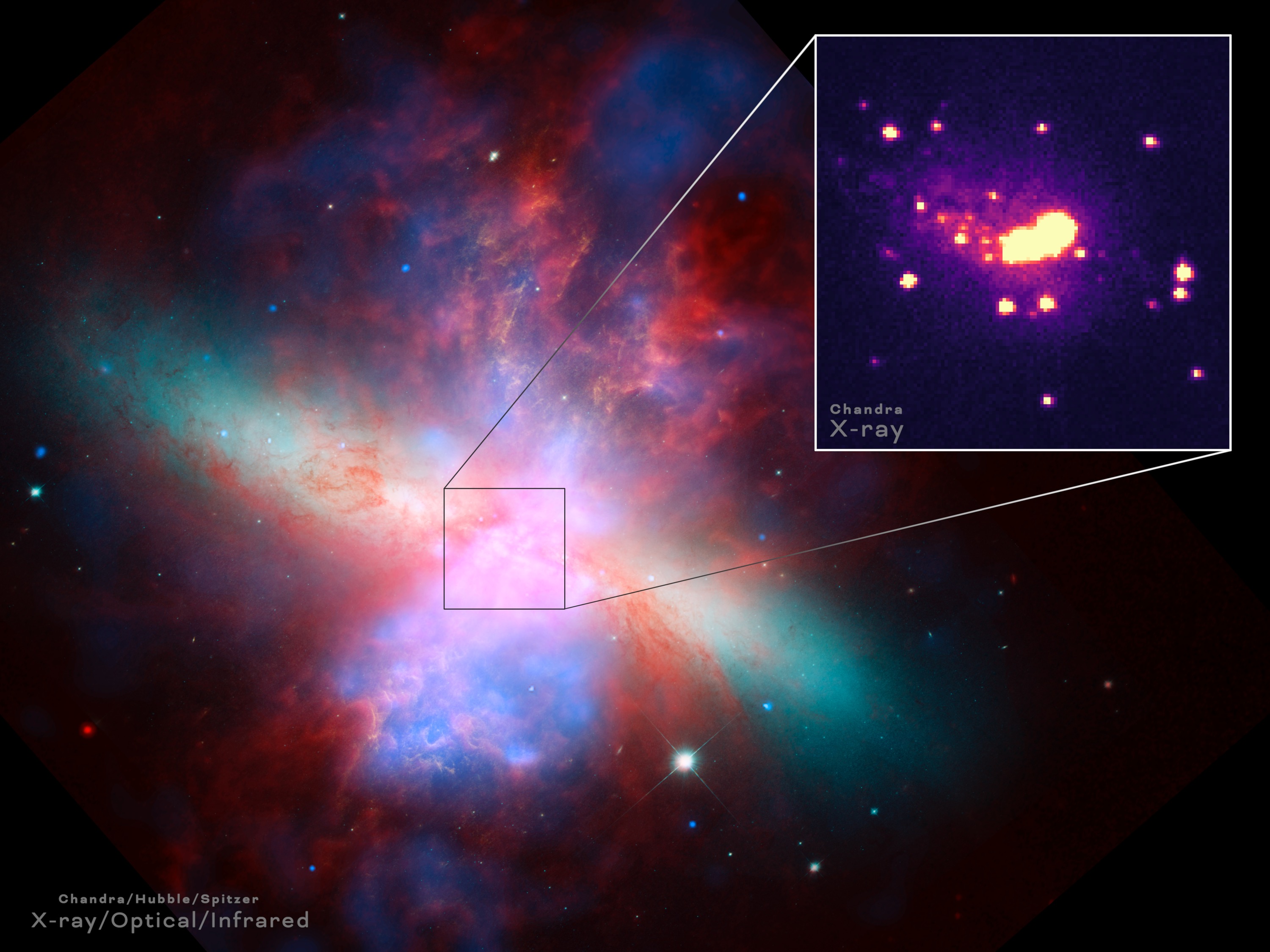
The cool wind of galaxy M82 drives gas and dust up to 40,000 light-years from its core, as shown here using data from NASA’s Chandra X-ray Observatory and Hubble and Spitzer space telescopes. The inset shows a Chandra view of the galaxy’s central region, where a cauldron of stellar activity kick-starts the larger-scale outflow.
Credit: NASA’s Goddard Space Flight Center; X-ray: NASA/CXC/JHU/D.Strickland; Optical: NASA/ESA/STScI/AURA/The Hubble Heritage Team; Infrared: NASA/JPL-Caltech/Univ. of AZ/C. Engelbracht; XRISM Collaboration et al. 2026
Alt text: Chandra, Hubble, and Spitzer image of M82 with Chandra inset
Image description: This image shows observations from NASA’s Chandra, Hubble, and Spitzer missions of the starburst galaxy M82. An angled disk, green at the edges and yellowish white toward the center, shows the plane of the galaxy. Extending above and below are clouds of purple and red. An inset, pointing towards the galactic center, shows a yellow-orange blob surrounding by swirling purple. It’s labeled, “Chandra X-ray.” The larger image is labeled, “Chandra/Hubble/Spitzer X-ray/Optical/Infrared.”

Unlabeled version of the above
Credit: NASA’s Goddard Space Flight Center; X-ray: NASA/CXC/JHU/D.Strickland; Optical: NASA/ESA/STScI/AURA/The Hubble Heritage Team; Infrared: NASA/JPL-Caltech/Univ. of AZ/C. Engelbracht; XRISM Collaboration et al. 2026
Alt text: Chandra, Hubble, and Spitzer image of M82 with Chandra inset
Image description: This image shows observations from NASA’s Chandra, Hubble, and Spitzer missions of the starburst galaxy M82. An angled disk, green at the edges and yellowish white toward the center, shows the plane of the galaxy. Extending above and below are clouds of purple and red. And inset, pointing towards the galactic center, shows a yellow-orange blob surrounding by swirling purple.

Unlabeled version of the above, without inset. Find more versions and information about M82 at science.nasa.gov
Credit: NASA’s Goddard Space Flight Center; X-ray: NASA/CXC/JHU/D.Strickland; Optical: NASA/ESA/STScI/AURA/The Hubble Heritage Team
Alt text: Chandra, Hubble, and Spitzer image of M82
Image description: This image shows observations from NASA’s Chandra, Hubble, and Spitzer missions of the starburst galaxy M82. An angled disk, green at the edges and yellowish white toward the center, shows the plane of the galaxy. Extending above and below are clouds of purple and red.
This Chandra image shows M82’s central region, where a cauldron of stellar activity kick-starts the larger-scale outflow.
Credit: NASA/CXC/JHU/XRISM Collaboration et al. 2026
Alt text: Chandra image of M82
Image description: This X-ray image has a bright yellow blob with an orange outline at the center. Several other yellow-orange dots are scattered across the image. Bright purple surrounds the central blob, gradually getting darker toward the edge of the image.
This animation shows the difference between iron-25’s spectral line in a laboratory setting compared to XRISM’s observations from the center of M82. The M82 line is broader than the lab version due to Doppler shifting, which is the same phenomenon that causes the pitch of a sound to rise or fall due to the source’s motion toward or away from you. In the case of M82, the hot material near the center flies quickly in both directions, stretching out the iron’s spectral line. The amount of stretch tells scientists the iron’s velocity.
Credit: NASA’s Goddard Space Flight Center, JAXA/NASA, XRISM Collaboration et al. 2026
Alt text: Animation of iron spectral broadening
Image description: This animation begins on a graph of a white line against a background of swirling purple, green, and yellow — an image of the central part of M82. The white line has several jagged peaks in the middle and is labeled, “Iron-25 line/Lab reference.” The horizontal and vertical axes are labeled “X-ray energy” and “X-ray brightness,” respectively. After a moment, the graph blurs and shifts, broadening so that the jagged peaks turn into one larger curve with a small dip at the top. The line label changes to “Iron-25 line/M82 observed.” The graph shifts back and forth one more time before ending.
On Earth, M82’s hot winds would sweep across the entire United States in just 5 seconds, as shown in this animation.
Credit: NASA’s Goddard Space Flight Center
Alt text: GIF of M82’s wind speed
Image description: Yellow arrows move west to east over a purple map of the United States in this looping GIF. In the bottom-left corner is a stopwatch, also in shades of purple, showing that it takes an arrow 5 seconds to move across the map. The top of the animation has blue text that says, “If M82’s winds were on Earth …”
This image of M82, captured by the Near-Infrared Camera aboard NASA’s James Webb Space Telescope, shows the center of the galaxy in such detail that astronomers can distinguish small bright sources that are either individual stars or star clusters.
Credit: NASA, ESA, CSA, STScI, Alberto Bolatto (UMD)
Alt text: Webb image of M82
Image description: This infrared image shows a section of the M82 as imaged by NASA's Webb telescope. The galaxy is seen edge-on, tilted at a 45-degree angle. It has a bright line of yellowish white glowing at its core and dark brown tendrils of dust stretch along its length. Many white dots of various sizes — stars or star clusters — are scattered throughout the image but are most heavily concentrated toward the center. The whole galaxy is set against the black backdrop of space.
For More Information
Credits
Please give credit for this item to:
NASA's Goddard Space Flight Center. However, individual items should be credited as indicated above.
-
Producer
- Scott Wiessinger (eMITS)
-
Science writers
- Jeanette Kazmierczak (University of Maryland College Park)
- Francis Reddy (University of Maryland College Park)
-
Graphics
- Francis Reddy (University of Maryland College Park)
Missions
This page is related to the following missions:Series
This page can be found in the following series:Related papers
Related
- ID: 14933
 Produced Video
 - ID: 14868
 Produced Video
 - ID: 14707
 Produced Video
 - ID: 14584
 Produced Video
Release date
This page was originally published on Wednesday, March 25, 2026.
This page was last updated on Wednesday, March 25, 2026 at 12:01 PM EDT.