NASA’s Pandora Satellite to Explore Exoplanets and Stars

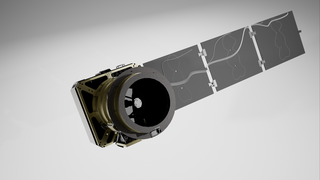
Artist’s concept of NASA’s Pandora mission, which will help scientists untangle the signals from exoplanets’ atmospheres — worlds beyond our solar system — and their stars.
Credit: NASA's Goddard Space Flight Center
Alt text: The Pandora spacecraft with an exoplanet and two stars in the background
Image description: A metallic spacecraft takes up most of this image. Its body is made of a cylindrical telescope attached to a square base. Inside the telescope is the reflection of an orange star. A line of three solar panels extends from the right side of the spacecraft at a 45-degree angle. On the right side of the background is a large planet streaked with purple, pink, and white. To the left of the planet are two stars. One is small, yellow, and very close to the planet. The other is white and is almost totally eclipsed by the spacecraft.
The NASA Pandora spacecraft will observe planets as they pass in front of their stars as seen from our perspective, events called transits.
As starlight passes through a planet’s atmosphere, it interacts with substances like water and oxygen that absorb characteristic wavelengths, adding their chemical fingerprints to the signal.
But while only a small fraction of the star’s light grazes the planet, telescopes also collect the rest of the light emitted by the star’s facing side. Stellar surfaces can sport brighter and darker regions that grow, shrink, and change position over time, suppressing or magnifying signals from planetary atmospheres. Adding a further complication, some of these areas may contain the same chemicals that astronomers hope to find in the planet’s atmosphere, such as water vapor.
All these factors make it difficult to be certain that important detected molecules come from the planet alone.
Pandora will help address this problem by providing in-depth study of at least 20 exoplanets and their host stars during its initial year. The satellite will look at each planet and its star 10 times, with each observation lasting a total of 24 hours. Many of these worlds are among the over 6,000 discovered by missions like NASA’s TESS (Transiting Exoplanet Survey Satellite).
Pandora will collect visible and near-infrared light using a novel, all-aluminum 17-inch-wide (45-centimeter) telescope jointly developed by Lawrence Livermore National Laboratory in California and Corning Specialty Materials in Keene, New Hampshire. Pandora’s near-infrared detector is a spare developed for NASA’s James Webb Space Telescope.
Each long observation period will capture a star’s light both before and during a transit and help determine how stellar surface features impact measurements.
Pandora is the first satellite to launch in the agency’s Astrophysics Pioneers program, which seeks to do compelling astrophysics at a lower cost while training the next generation of leaders in space science.

This view of the fully integrated Pandora spacecraft was taken May 19, 2025, following the mission’s successful environmental test campaign at Blue Canyon Technologies in Lafayette, Colorado. The next step is to ready the vehicle for shipping to the launch site. Visible are star trackers (center), multilayer insulation blankets (white), the end of the telescope (top), and the solar panel (right) in its launch configuration.
Credit: NASA/BCT
Alt text: Pandora, fully integrated, with blue-lit background
Image description: Against a background filled with blue light is a gray rectangular stand. Atop it is a structure with what appear to be short red feet at each of the visible corners of a bluish box. A white conical structure extends upward form the box, containing a bluish rectangular panel about midway up. At the top extends a short circular structure nearly as wide as the cone’s top surface; it is bluish and topped by a metallic red ring. On the right side is a large rectangle containing 92 dark blue rounded rectangles separated by brown; white cables run from the bottom into the spacecraft. At the base of the white area at left are two small, roughly pyramidal features; the one at far left is colored gold and seen from the side, while the one to the right of it, seen end on, appears as a red square. Numerous gold-wrapped cables extend down along the sides and continue to the right underneath the box. Along the cable path, at the bottom of the nearest corner of the box, is a small red rectangle with text reading “REMOVE BEFORE FLIGHT.”

This view of the fully integrated Pandora spacecraft was taken May 19, 2025, following the mission’s successful environmental test campaign at Blue Canyon Technologies in Lafayette, Colorado. The next step is to ready the vehicle for shipping to the launch site. Visible are star trackers (center), multilayer insulation blankets (white), the end of the telescope (top), and the solar panel (right) in its launch configuration.
Credit: NASA/BCT
Alt text: Pandora, fully integrated, with U.S. flag in the background
Image description: Against a white background wall decorated with a large U.S. flag is a gray rectangular stand. Atop it is a structure with what appear to be short red feet at each of the visible corners of a shiny metallic box that reflects equipment not seen in the image. A white conical structure extends upward form the box, containing a bluish rectangular panel about midway up. At the top extends a short circular structure nearly as wide as the cone’s top surface; it is shiny, metallic, and topped by a metallic red ring. On the right side is a large rectangle containing 92 dark blue rounded rectangles separated by brown; white cables run from the bottom into the spacecraft. At the base of the white area at left are two small, roughly pyramidal features; the one at far left is colored gold and seen from the side, while the one to the right of it, seen end on, appears as a red square. Numerous gold-wrapped cables extend down along the sides and continue to the right underneath the box. Along the cable path, at the bottom of the nearest corner of the box, is a small red rectangle with text reading “REMOVE BEFORE FLIGHT.”

This view looks down the barrel of Pandora’s 17-inch-wide (45 centimeters) telescope and was captured April 12, 2025, at Lawrence Livermore National Laboratory in California. The concentric black circles are optical baffles designed to prevent stray light bouncing around the telescope tube from reaching the detectors. At center, part of the ceiling appears in Pandora’s main mirror. Above it, attached to the tube by four supports, is the secondary mirror, which bounces light through the main mirror and into the telescope’s detectors.
Credit: NASA/Jordan Karburn, LLNL
Alt text: Looking down the barrel of Pandora’s telescope
Image description: The camera is looking down into the open end of Pandora’s telescope tube. The mirror, a bright shiny circle reflecting part of the ceiling, is visible at the center. Above it is a gold-colored circle with a silver rectangle at its center. Four support legs extend from it to the side of the telescope tube. The tube interior is lined with a series of concentric black rings.

Pandora’s 17-inch-wide (45 centimeters) telescope and its associated systems are seen April 12, 2025, at Lawrence Livermore National Laboratory in California as the instrument package nears completion.
Credit: NASA/Jordan Karburn, LLNL
Alt text: View of Pandora’s nearly completed telescope in lab
Image description: In the foreground stands a vertical tube constructed from various metal elements ranging in shade from grayish white at the base, greenish in the middle, to reddish near the top. It is topped by a short tube of shiny metal capped with a red ring. At the base of the tube is a shiny, roughly rectangular panel that stands apart from the tube, with black cables looped behind it. Tables with various pieces of lab equipment are visible and out of focus in the background.

The spacecraft bus for the Pandora mission was developed at Blue Canyon Technologies in Lafayette, Colorado, and completed on March 31, 2025. The bus provides Pandora’s structural, power, and support systems. Two star trackers (top left) enable the spacecraft’s precise and stable pointing for science observations. The large bracket extending above the main box supports Pandora’s single articulating solar array.
Credit: NASA/BCT
Alt text: Pandora bus with blue-lit background
Image description: Against a background filled with blue light is a gray rectangular stand. Atop it is a shiny aluminum box with conical protrusions on the right side, with a rectangular bracket rising from the top. On the left top side of the box are two small, roughly pyramidal features; the one at far left is colored gold and seen from the side, while the one to the right of it, seen end on, appears as a red square. Numerous gold-wrapped cables extend down along the sides and continue to the right underneath the box. Along the cable path, at the bottom of the nearest corner of the box, is a small red rectangle with text reading “REMOVE BEFORE FLIGHT.” At the three visible corners of the box’s bottom are what look like short, red, rectangular feet.

The spacecraft bus for the Pandora mission was developed at Blue Canyon Technologies in Lafayette, Colorado, and completed on March 31, 2025. The bus provides Pandora’s structural, power, and support systems. Two star trackers (top left) enable the spacecraft’s precise and stable pointing for science observations. The large bracket extending above the main box supports Pandora’s single articulating solar array.
Credit: NASA/BCT
Alt text: Pandora bus with U.S. flag in the background
Image description: Against a white background wall decorated with a large U.S. flag is a gray rectangular stand. Atop it is a shiny aluminum box with conical protrusions on the right side, with a rectangular bracket rising from the top. On the left top side of the box are two small, roughly pyramidal features; the one at far left is colored gold and seen from the side, while the one to the right of it, seen end on, appears as a red square. Numerous gold-wrapped cables extend down along the sides and continue to the right underneath the box. Along the cable path, at the bottom of the nearest corner of the box, is a small red rectangle with text reading “REMOVE BEFORE FLIGHT.” At the three visible corners of the box’s bottom are what look like short, red, rectangular feet.
Labeled version of the artist’s concept of Pandora.
Credit: NASA's Goddard Space Flight Center
Alt text: The Pandora spacecraft with an exoplanet and two stars in the background
Image description: A metallic spacecraft takes up most of this image. Its body is made of a cylindrical telescope attached to a square base. Inside the telescope is the reflection of an orange star. A line of three solar panels extends from the right side of the spacecraft at a 45-degree angle. On the right side of the background is a large planet streaked with purple, pink, and white. To the left of the planet are two stars. One is small, yellow, and very close to the planet. The other is white and is almost totally eclipsed by the spacecraft. It is labeled “Pandora” in the upper left corner.
Labeled version of the artist’s concept of Pandora, alternative font.
Credit: NASA's Goddard Space Flight Center
Alt text: The Pandora spacecraft with an exoplanet and two stars in the background
Image description: A metallic spacecraft takes up most of this image. Its body is made of a cylindrical telescope attached to a square base. Inside the telescope is the reflection of an orange star. A line of three solar panels extends from the right side of the spacecraft at a 45-degree angle. On the right side of the background is a large planet streaked with purple, pink, and white. To the left of the planet are two stars. One is small, yellow, and very close to the planet. The other is white and is almost totally eclipsed by the spacecraft. It is labeled “Pandora” in the upper left corner.
Two artist’s concepts of the Pandora mission form this banner-style image.
Credit: NASA's Goddard Space Flight Center
Alt text: Two versions of the Pandora mission in space
Image description: On the left, a spacecraft observes a mottled yellow and orange star with a planet silhouetted in front of it. Extending from the spacecraft toward the lower left is a rectangle containing panels of blue and purple that represents Pandora's solar array. On the right, a different illustration of the same spacecraft is in front of a large pink, purple, and white planet as well as two stars. It’s solar panels seen from this angle are silver. The image is labeled in the center, “Pandora” and “Launching early 2026.”
For More Information
Credits
Please give credit for this item to:
NASA's Goddard Space Flight Center. However, individual items should be credited as indicated above.
-
Producers
- Scott Wiessinger (eMITS)
- Claire Andreoli (NASA/GSFC)
-
Animators
- Jonathan North (eMITS)
- Chris Smith (eMITS)
-
Graphic designer
- Scott Wiessinger (eMITS)
-
Science writer
- Jeanette Kazmierczak (University of Maryland College Park)
Series
This page can be found in the following series:Related
- ID: 14883
![Watch to learn how a new tool uses data from exoplanets, worlds beyond our solar system, to tell us about their polka-dotted stars.Credit: NASA’s Goddard Space Flight CenterMusic: “Whimsical Whirlwinds,” Claire Leona Batchelor [PRS], Universal Production MusicWatch this video on the NASA Goddard YouTube channel.Complete transcript available.Get the vertical version of this video [here](https://svs.gsfc.nasa.gov/14797/){target=_blank}.](/vis/a010000/a014800/a014883/PolkaDotStars_Thumbnail.jpg) Produced Video
Produced Video - ID: 14747
 Produced Video
 - ID: 14754
![Watch to learn more about NASA's Pandora mission, which will revolutionize the study of exoplanet atmospheres.Credit: NASA's Goddard Space Flight CenterMusic: “Mesmeric Thoughts,” Andrew Michael Hewitt [PRS], Universal Production MusicWatch this video on the NASA Goddard YouTube channel.Complete transcript available.](/vis/a010000/a014700/a014754/YTframe_ASD_Pandora.jpg) Produced Video
Produced Video
Release date
This page was originally published on Friday, January 9, 2026.
This page was last updated on Wednesday, January 14, 2026 at 9:49 AM EST.