ESCAPADE Launch
NASA’s ESCAPADE (Escape and Plasma Acceleration and Dynamics Explorers) spacecraft launched at 3:55 p.m. EST on Thursday, Nov. 13, 2025, aboard a Blue Origin New Glenn rocket from Launch Complex 36 at Cape Canaveral Space Force Station in Florida. Ground controllers for the ESCAPADE mission established communications with both spacecraft by 10:35 p.m. EST the same day.
The twin spacecraft, built by Rocket Lab, will investigate how a never-ending, million-mile-per-hour stream of particles from the Sun, known as the solar wind, has gradually stripped away much of the Martian atmosphere, causing the planet to cool and its surface water to evaporate. The mission is led by the University of California, Berkeley.
Learn more on NASA.gov.
Video – Launch Clean Feed
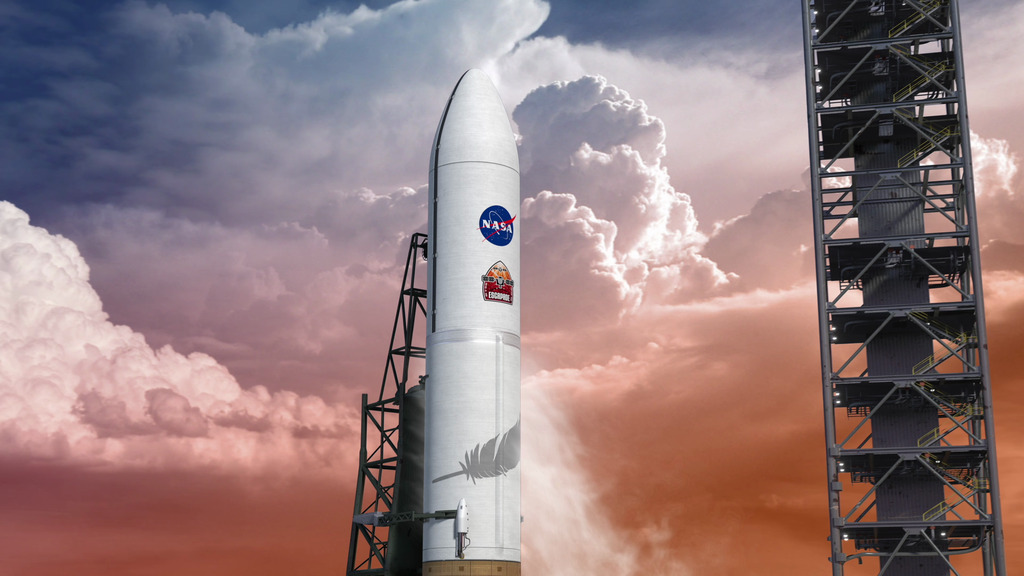
NASA's ESCAPADE mission launched at 3:55 p.m. EST on Nov. 13, 2025, aboard a Blue Origin New Glenn rocket from Launch Complex 36 at Cape Canaveral Space Force Station in Florida.
Credit: Blue Origin
Video – Launch Broadcast
Blue Origin's webcast of the ESCAPADE launch on Nov. 13, 2025.
Credit: Blue Origin

Photo
Blue Origin’s New Glenn rocket carrying NASA’s twin ESCAPADE (Escape and Plasma Acceleration and Dynamics Explorers) spacecraft launches at 3:55 p.m. EST, Thursday, Nov. 13, 2025, from Launch Complex 36 at Cape Canaveral Space Force Station in Florida. The ESCAPADE mission, built by Rocket Lab, will study how solar wind and plasma interact with Mars’ magnetosphere and how this interaction drives the planet’s atmospheric escape to prepare for future human missions on Mars.
Credit: Blue Origin
Photo
Blue Origin’s New Glenn rocket carrying NASA’s twin ESCAPADE (Escape and Plasma Acceleration and Dynamics Explorers) spacecraft launches at 3:55 p.m. EST, Thursday, Nov. 13, 2025, from Launch Complex 36 at Cape Canaveral Space Force Station in Florida. The ESCAPADE mission, built by Rocket Lab, will study how solar wind and plasma interact with Mars’ magnetosphere and how this interaction drives the planet’s atmospheric escape to prepare for future human missions on Mars.
Credit: Blue Origin
Photo
Blue Origin’s New Glenn rocket carrying NASA’s twin ESCAPADE (Escape and Plasma Acceleration and Dynamics Explorers) spacecraft launches at 3:55 p.m. EST, Thursday, Nov. 13, 2025, from Launch Complex 36 at Cape Canaveral Space Force Station in Florida. The ESCAPADE mission, built by Rocket Lab, will study how solar wind and plasma interact with Mars’ magnetosphere and how this interaction drives the planet’s atmospheric escape to prepare for future human missions on Mars.
Credit: Blue Origin
Photo
Blue Origin’s New Glenn rocket carrying NASA’s twin ESCAPADE (Escape and Plasma Acceleration and Dynamics Explorers) spacecraft launches at 3:55 p.m. EST, Thursday, Nov. 13, 2025, from Launch Complex 36 at Cape Canaveral Space Force Station in Florida. The ESCAPADE mission, built by Rocket Lab, will study how solar wind and plasma interact with Mars’ magnetosphere and how this interaction drives the planet’s atmospheric escape to prepare for future human missions on Mars.
Credit: Blue Origin
Photo
Blue Origin’s New Glenn rocket carrying NASA’s twin ESCAPADE (Escape and Plasma Acceleration and Dynamics Explorers) spacecraft launches at 3:55 p.m. EST, Thursday, Nov. 13, 2025, from Launch Complex 36 at Cape Canaveral Space Force Station in Florida. The ESCAPADE mission, built by Rocket Lab, will study how solar wind and plasma interact with Mars’ magnetosphere and how this interaction drives the planet’s atmospheric escape to prepare for future human missions on Mars.
Credit: Blue Origin
Photo
Blue Origin’s New Glenn rocket carrying NASA’s twin ESCAPADE (Escape and Plasma Acceleration and Dynamics Explorers) spacecraft launches at 3:55 p.m. EST, Thursday, Nov. 13, 2025, from Launch Complex 36 at Cape Canaveral Space Force Station in Florida. The ESCAPADE mission, built by Rocket Lab, will study how solar wind and plasma interact with Mars’ magnetosphere and how this interaction drives the planet’s atmospheric escape to prepare for future human missions on Mars.
Credit: Blue Origin
Photo
Blue Origin’s New Glenn rocket carrying NASA’s twin ESCAPADE (Escape and Plasma Acceleration and Dynamics Explorers) spacecraft launches at 3:55 p.m. EST, Thursday, Nov. 13, 2025, from Launch Complex 36 at Cape Canaveral Space Force Station in Florida. The ESCAPADE mission, built by Rocket Lab, will study how solar wind and plasma interact with Mars’ magnetosphere and how this interaction drives the planet’s atmospheric escape to prepare for future human missions on Mars.
Credit: Blue Origin
For More Information
Credits
Please give credit for this item to:
NASA's Goddard Space Flight Center
-
Support
- Joy Ng (eMITS)
Related
- ID: 14925
![Produced VideoWatch this video on the NASA Goddard YouTube channel.Complete transcript available.Music credit: "Machine Learning” by Ben Niblett and Jon Cotton [PRS] from Universal Production MusicAdditional Video and Animations: Blue Origin, Rocket Lab, StoryblocksSound Effects: Pixabay](/vis/a010000/a014900/a014925/14925_Thumbnail.jpg) Produced Video
Produced Video - ID: 14666
 Produced Video
 - ID: 14918
 Produced Video
Release date
This page was originally published on Friday, November 14, 2025.
This page was last updated on Monday, November 24, 2025 at 2:45 PM EST.