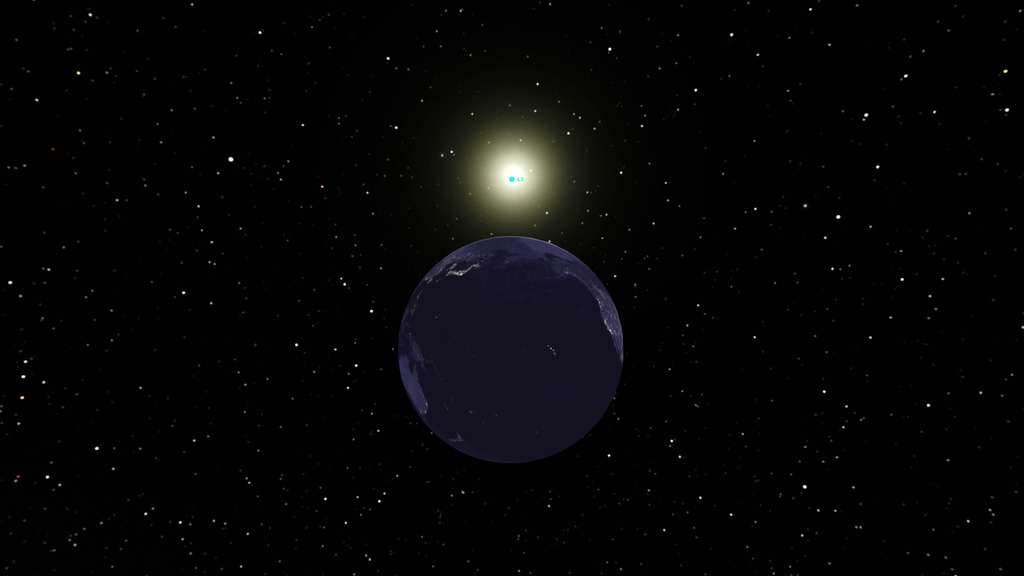
Lagrange Point 1 Animation
Lagrange points are positions in space where objects sent there tend to stay put. At Lagrange points, the gravitational pull of two large masses precisely equals the centripetal force required for a small object to move with them. These points in space can be used by spacecraft to reduce fuel consumption needed to remain in position.
Of the five Lagrange points, three are unstable and two are stable. The unstable Lagrange points - labeled L1, L2 and L3 - lie along the line connecting the two large masses. The stable Lagrange points - labeled L4 and L5 - form the apex of two equilateral triangles that have the large masses at their vertices. L4 leads the orbit of earth and L5 follows.
The L1 point of the Earth-Sun system affords an uninterrupted view of the Sun and will be home to three new heliophysics missions in 2025 - NASA's Interstellar Mapping and Acceleration Probe (IMAP), NASA's Carruthers Geocorona Observatory, and NOAA's Space Weather Follow On-Lagrange 1 (SWFO-L1).
Credit: NASA's Conceptual Image Lab/Krystofer Kim
Credits
Please give credit for this item to:
NASA's Goddard Space Flight Center
-
Animator
- Kim Dongjae (eMITS)
-
Support
- Joy Ng (eMITS)
-
Technical support
- Aaron E. Lepsch (ADNET Systems, Inc.)
Related
- ID: 14957
 Produced Video
 - ID: 14887
![Produced VideoWatch this video on the NASA Goddard YouTube channel.Complete transcript available.Music Credit: "Time in Motion” by Rick Hearson [PRS], “Proud Patterns by Paul Joseph Smith [PRS] from Universal Production Music](/vis/a010000/a014800/a014887/14887_Thumbnail.jpg) Produced Video
Produced Video - ID: 14888
 Produced Video
Used as a Source In
- ID: 14895
![Produced VideoWatch this video on the NASA Goddard YouTube channel.Complete transcript available.Music credit: "Soaring Dreams” by Klas Johan Wahl and Anders Paul Niska [STIM], “Electric Works” by Philippe Lhommet [SACEM], and “Mercurial Temperment” by Christian Telfold [ASCAP] from Universal Production Music](/vis/a010000/a014800/a014895/14895_Thumbnail.jpg)
Release date
This page was originally published on Tuesday, July 22, 2025.
This page was last updated on Tuesday, July 22, 2025 at 5:09 PM EDT.