Cosmic Desktop & Phone Wallpapers
We can’t clean up your messy desktop, but we can provide a bit of beauty from the universe to act as a backdrop to it. Here you’ll find a collection of images from across the universe.
Download these phone and desktop wallpapers for your screens.

A multigenerational stellar portrait
The Cepheus B and C regions contain multiple star clusters of different ages that were all born from the same dense clumps of material, as seen in this celestial mosaic from NASA's retired Spitzer Space Telescope. The green and orange triangular shape filling the left side of the image is a cloud of gas and dust that has been carved away by radiation from stars. The bright region at the tip of the triangle is dust that has been heated by the stars, which creates the surrounding red glow. Near the middle of the left edge is a grouping of newborn stars known as Cepheus C. In the upper right corner is a star cluster, known as Cepheus B, whose members are slightly older than the stars in Cepheus C. The image is made of four colors (blue, green, orange, and red), each representing a different wavelength of infrared light.
Credit: NASA/JPL-Caltech
For more information: NASA’s Spitzer Captures Stellar Family Portrait Download the desktop version here. Download the smartphone version here. Alt text: Infrared mosaic from Spitzer of the Cepheus B and Cepheus C region, with multiple generations of stars formed from the same cloud of gas and dust. Image description (desktop wallpaper): A roughly triangular region takes up the left side of this image of the Cepheus B and C regions of the sky. One corner of the triangle sits at the top, just right of center, and it features a bright dot with a red halo. The rest of the triangle spills off the bottom and left edges and is filled with green and orange wisps. A second region of green and orange wisps takes up the lower right side of the image, anchored by two bright white dots near the bottom edge, directly below the triangle’s tip. In the background is the darkness of space punctured by countless stars that appear as small red and blue dots.


A flower from WISE
Known formally as NGC 2237, the Rosette Nebula is a flower-shaped star-forming cloud of dust and gas in our Milky Way galaxy. It is located within the constellation Monoceros, or the Unicorn. At the center of the flower is a cluster of young stars called NGC 2244. The massive stars in the cluster have eroded away the cloud, carving out a hole with their strong stellar winds. This image was captured by NASA’s retired WISE (Wide-Field Infrared Explorer) satellite in 2010, and each color represents a different wavelength of infrared light. The streak seen at upper left is the trail of a satellite, captured as WISE snapped the multiple frames that make up this view.
Credit: NASA/JPL-Caltech/UCLA
For more information: WISE Captures the Unicorn’s Rose
Download the desktop version here.

Download the smartphone version here.

Alt text: Infrared image from WISE showing the Rosette Nebula.
Image description (desktop wallpaper):
The Rosette nebula fills this infrared image. The nebula resembles a red flower with a halo of green leaves. The center of the flower lies just below the middle of the image. It is a rough circle filled with the blackness of space and dotted with blue stars. A streak of bright red runs partway across it. Surrounding this is a thick, irregular ring of red clouds that spills off the bottom edge. Encircling the red is a wide ring of green cloudy structures that give the red “flower” a scalloped edge. The green extends past the top and right edges. The top left corner reveals black space, and the entire image is speckled with blue stars.
Stars blowing bubbles within bubbles
The star-forming region known as W39, located within the constellation Scutum, features several bubbles, as shown in this infrared image from NASA’s WISE (Wide-Field Infrared Explorer) satellite and Spitzer Space Telescope. In the center is a giant bubble that has been carved out of cosmic dust by massive stars. As bubbles like this push outward, they can trigger further star formation, including massive stars that subsequently create their own bubbles. Two such smaller bubbles can be seen here in yellow on the rim of the larger bubble.
Credit: NASA/JPL-Caltech/University of Wisconsin
For more information: Bubbles Within Bubbles
Download the desktop version here.

Download the smartphone version here.

Alt text: Infrared image from WISE and Spitzer of W39, a star-forming region with bubbles created by winds from massive stars.
Image description (desktop wallpaper):
The W39 star-forming region appears in shades of green, red, and yellow on a black starry background. A rough egg shape dominates the center of the image, outlined by red clouds that are thick on the top and sides but barely visible along the bottom. Surrounding this are two lines of clouds, first yellow then green, that just hug the red oval on the left but then widen out to fill the image on the right. Several bright white and red spots dot the image, with two prominent ones lying on the oval’s edge.
CW Leonis Plows Ahead
A runaway star plows through the depths of space piling up interstellar material before it, in this ultraviolet image from NASA's GALEX (Galaxy Evolution Explorer). The star, called CW Leonis, is hurtling through space at about 204,000 mph (328,000 kilometers per hour), or roughly 265 times the speed of sound on Earth. It is moving from right to left in this image.
For more information: Plowing Through the Depths of Space
Download the desktop version here.

Download the smartphone version here.

Credit: NASA/JPL-Caltech
Alt text: Ultraviolet image of runaway star CW Leonis imaged by GALEX.
Image description (desktop wallpaper):
Runaway star CW Leonis lies in the center of a dark sky filled with hundreds of teal and orange dots in various sizes. The star is embedded in a pale blue knot that is surrounded by a translucent blue bubble. Faint, wispy tendrils appear to connect this bubble to clouds clustered in the lower right. Another bright blue spot on the left is surrounded by a small blue bubble, while several other wispy clouds cross the image.
A Window to the Milky Way
The glow of the Milky Way — our galaxy seen edgewise — cuts across a sea of stars in this image from our exoplanet hunter, TESS (Transiting Exoplanet Survey Satellite). Those puffy cloud-like structures are how we see our home galaxy from our place inside its starry disk. This snapshot was captured by TESS during a 30-minute period on June 12, 2019. Black lines in the images are gaps between TESS’s camera detectors. Some stars are so bright they saturate an entire column of pixels on the detectors, creating long spikes of light.
For more information: NASA’s TESS Presents Panorama of Southern Sky
Download the desktop version here.

Download the smartphone version here.

Credit: NASA's Goddard Space Flight Center
Alt text: A star-filled image captured in just 30 minutes from one of TESS’s cameras in June 2019.
Image description (desktop wallpaper):
This image resembles part of a window with 10 panes that looks out onto a starry sky. One stark black bar cuts the image in half horizontally while four more slice it vertically. These lines are the gaps between detectors in the TESS camera system. Inside each pane are countless white dots of varying sizes against a blue-black backdrop. The stars are so dense in parts of the image it appears as though there are clouds running across the panes from the lower left toward the upper right. This is the plane of our Milky Way galaxy. A few stars have long streaks running horizontally on either side of them.
Star cluster’s superbubble
Hot, speedy material carves a bubble out of star cluster NGC 1929. New stars form in the cluster, and some are very massive. Those massive stars produce intense radiation, expel matter at high speed, and race through their evolution to explode as supernovae. The outflows and shock waves sculpt huge cavities called superbubbles in the surrounding gas. X-rays from NASA's Chandra X-ray Observatory (blue) show hot regions created by these processes, while infrared data from NASA's Spitzer Space Telescope (red) outline where the dust and cooler gas are found. The optical light from the 2.2-meter Max-Planck-ESO telescope (yellow) in Chile shows where ultraviolet radiation from hot, young stars is causing gas in the nebula to glow.
For more information: A Surprisingly Bright Superbubble
Download the desktop version here.

Download the smartphone version here.

Credit: X-ray: NASA/CXC/U.Mich./S.Oey, IR: NASA/JPL, Optical: ESO/WFI/2.2-meter
Alt text: Composite image from Chandra, Spitzer, and the 2.2-meter Max-Planck-ESO telescope of NGC 1929, a star cluster in the Large Magellanic Cloud.
Image description (desktop wallpaper):
The blackness of space is speckled with hundreds of dots in yellow, red, blue, and white. Puffy red and yellow cloudy features dominate the central region, spilling off the top and bottom edges. Near the center, a blue and white haze breaks up the clouds, resembling a cartoon shark swimming upward. Its imagined eye has a white dot surrounded by a small blue halo, and its dorsal fin points off to the left.
Messier 81 and Messier 82 in an intergalactic dance
This image from NASA's WISE (Wide-Field Infrared Explorer) features Messier 81 and Messier 82, which swung past each other a few hundred million years ago.
For more information: WISE Beholds a Pair of Dancing Galaxies
Download the desktop version here.

Download the smartphone version here.

Credit: NASA/JPL-Caltech/UCLA
Alt text: Infrared image of galaxies Messier 81 and Messier 82, which are eventually going to merge.
Image description (desktop wallpaper):
Against a black backdrop speckled with blue dots are two bright galaxies. In the lower left, M81 is a grand spiral galaxy. Its arms appear as green vines twisting inward toward a blue central bright spot. Embedded in those arms are spots of yellow and orange light. In the upper right, M82 appears as an elongated white oval with a bright yellow halo.
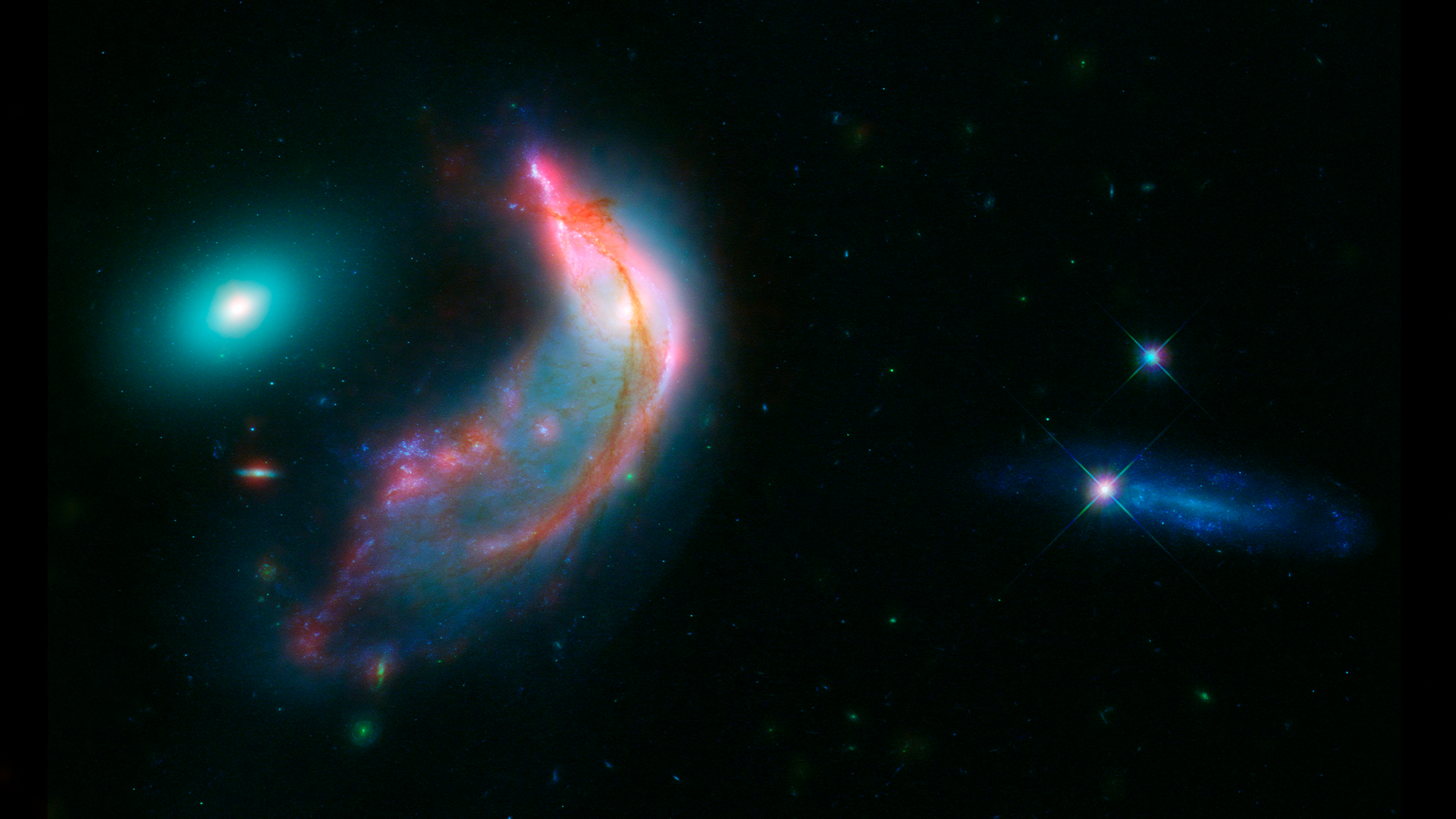
The Penguin and the Egg
Collectively known as Arp 142, this cosmic penguin is actually a galaxy called NGC 2936 that has been twisted by the gravitational pull of another galaxy, called NGC 2937. Over time, gravity is slowly pulling the pair together and they will eventually merge. Data from NASA's Spitzer and Hubble space telescopes have been combined to show these dramatic galaxies in light that spans the visible and infrared parts of the spectrum.
For more information: Arp 142: The Penguin and the Egg
Download the desktop version here.
Download the smartphone version here.

Credit: NASA-ESA/STScI/AURA/JPL-Caltech
Alt text: Two glowing, colorful galaxies look like a penguin and its egg and are shown here in infrared from the retired Spitzer Space Telescope and visible light from the Hubble Space Telescope.
Image description (desktop wallpaper):
A penguin-shaped arc of bright dust and gas that includes bright streaks and spots of pink, orange, and purple sits on the left side of a black backdrop speckled by small, bright, green, and blue stars. Just above this is a bright white oval resembling an egg and surrounded by glowing turquoise. Two bright stars marked by X-shaped spikes of light lay across a bright blue swath at the right of the image.
Whirlpool Galaxy Tangoing with M51b
Bright green sources of high-energy X-ray light captured by NASA's NuSTAR satellite are overlaid on an optical-light image of the Whirlpool galaxy (center) and its companion galaxy, M51b (the large greenish-white spot to the right of the Whirlpool), taken by the Sloan Digital Sky Survey. The bright green spots at the center of the Whirlpool and M51b are created by material surrounding supermassive black holes, and additional X-ray sources in the vicinity contribute to the emission. Shining just as brightly is a neutron star, located at the top of the Whirlpool in this image.
For more information: In Colliding Galaxies, a Pipsqueak Shines Bright
Download the desktop version here.

Download the smartphone version here.

Credit: NASA/JPL-Caltech, IPAC
Alt text: Image of Messier 51, also known as the Whirlpool galaxy, captured by the Sloan Digital Sky Survey and NASA's NuSTAR mission.
Image description (desktop wallpaper):
Living up to its nickname, the galaxy resembles a swirling whirlpool, with two large purple arms twisting around the galaxy’s bright center. The arms are veiny and spotted with white, indicating areas of high density. One of the spiraling arms curves down toward the bottom left, where it appears to dissipate in a pool of pale purple light. The other arm stretches up and to the right where it appears to end in a large white and green knob. This is the Whirlpool’s companion galaxy, Messier 51b. Splotches of bright green light seen across the galaxy indicate the presence of high-energy X-rays detected by NuSTAR, likely produced by objects such as supermassive black holes and at least one ultraluminous neutron star.
Credits
Please give credit for this item to:
NASA's Goddard Space Flight Center
-
Project support
- Scott Wiessinger (eMITS)
-
Producer
- Barb Mattson (University of Maryland College Park)
-
Writer
- Barb Mattson (University of Maryland College Park)
Series
This page can be found in the following series:Related
- ID: 14146
 Produced Video
Release date
This page was originally published on Tuesday, July 15, 2025.
This page was last updated on Friday, February 6, 2026 at 1:23 PM EST.