What Happened During the Biggest Geomagnetic Storm in Over 20 Years
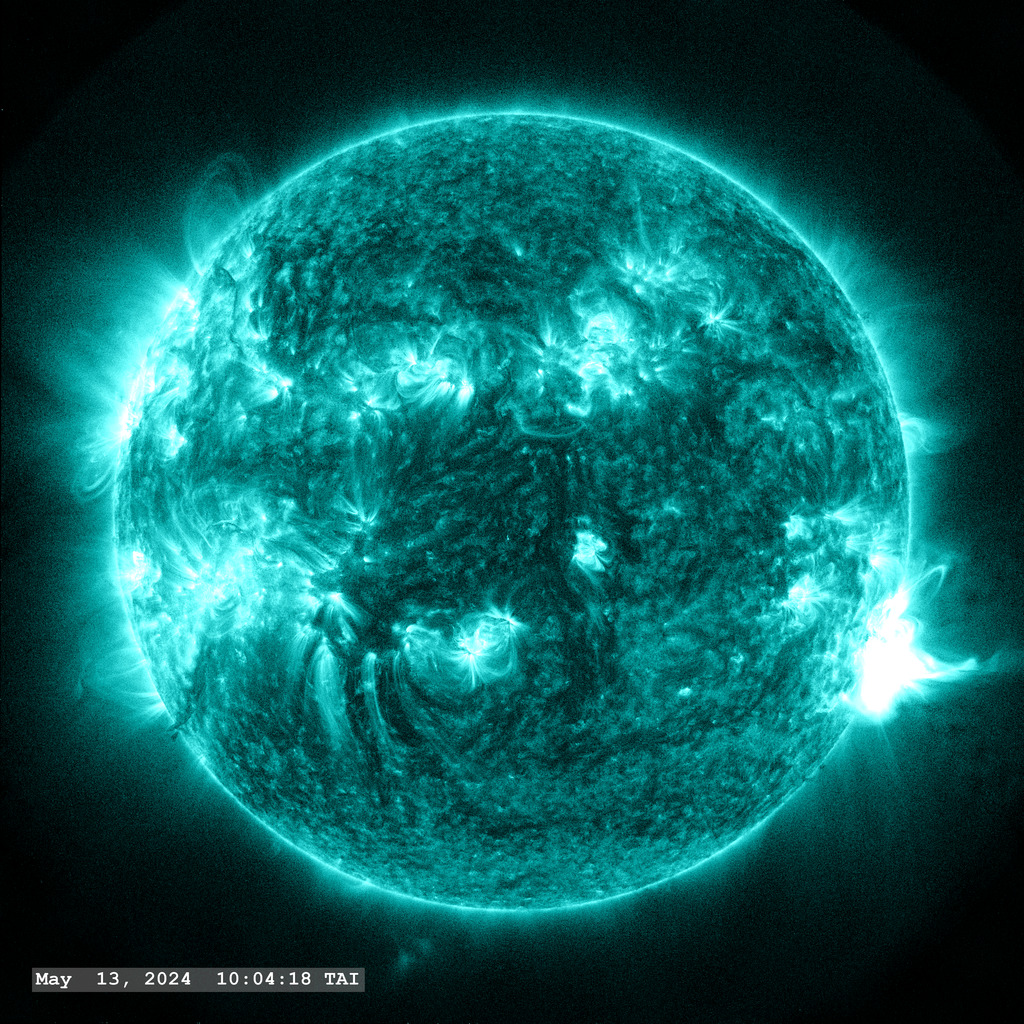
On May 10, 2024, the first G5 or “severe” geomagnetic storm in over two decades hit Earth. The event did not cause any catastrophic damages, but it did produce surprising effects on Earth. The storm, which has been called the best-documented geomagnetic storm in history, spread auroras to unusually low latitudes and produced effects spanning from the ground to near-Earth space. Data captured during this historic event will be analyzed for years to come, revealing new lessons about the nature of geomagnetic storms and how best to weather them.
Learn more:
• What NASA Is Learning from the Biggest Geomagnetic Storm in 20 Years
• How NASA Tracked the Most Intense Solar Storm in Decades
Watch this video on the NASA Goddard YouTube channel.
Music credits: “Set in the Sky” by Nicholas Smith [PRS]; “Constant Motion”, “Future Now”, and “Currents” by Ben Niblett [PRS] and Jon Cotton [PRS]; “Bow Down To Me” by Max Cameron Concors [ASCAP] and Victoria Faith Beaumont [PRS]; “Moto Perpetuo” by Laurent Dury [SACEM].
Aurora imagery is used with permission. Aurora credits in order of appearance: Neil Zeller, Randell Sean Inoc, Xicao Liu, Bill Dunford, Shelley Tonkin, Alistair Luckman, Shane Turgeon, Kimberly Sibbald, Kylie Reid, Adam Block, Darius Yeoh, William Hudson, Quinn Keon.
Data Visualization
This is a TIEGCM model simulation of Earth's thermosphere from May 10-11, 2024, as a G5 geomagnetic storm hit Earth.
Data visualization credit: NASA/AJ Christensen
Data model: NASA DRIVE Science Center for Geospace Storms

Graphic
The May 2024 geomagnetic storm created two extra radiation belts, sandwiched between the two permanent Van Allen Belts. One of the new belts, shown in purple, included a population of protons, giving it a unique composition that hadn’t been seen before. The discovery of the new belts is particularly important for protecting spacecraft launching into geostationary orbits, since they travel through the Van Allen Belts several times before reaching their final orbit.
Credit: NASA/Goddard Space Flight Center/Kristen Perrin
Leare more here.
Video
The aurora borealis in Bear Lake, Utah, on May 10, 2024.
Credit: NASA/Bill Dunford
Video
The aurora borealis in Bear Lake, Utah, on May 10, 2024.
Credit: NASA/Bill Dunford

Photo
The aurora borealis near Malad City, Idaho, on May 11, 2024. A tree (bottom right) and its branches are silhouetted against the dramatic night sky, which is red, purple and green due to the aurora. Streaks of light shimmer, making the aurora look like the folds in a curtain (middle left). A road winds toward the mountainous horizon (bottom middle), and the back of a car appears (bottom right)—the International Space Station streaks in white (middle top) across the sky, which is dotted with white stars.
Credit: NASA/Bill Dunford
Photo
The aurora borealis in Bear Lake, Utah, on May 10, 2024.
Credit: NASA/Bill Dunford
Photo
The aurora borealis in Bear Lake, Utah, on May 10, 2024.
Credit: NASA/Bill Dunford

Photo
The aurora borealis in Southwestern British Columbia on May 10, 2024.
Credit: NASA/Mara Johnson-Groh

Photo
The aurora borealis in Southwestern British Columbia on May 10, 2024.
Credit: NASA/Mara Johnson-Groh

Photo
The aurora borealis in Southwestern British Columbia on May 10, 2024.
Credit: NASA/Mara Johnson-Groh
Credits
Please give credit for this item to:
NASA's Goddard Space Flight Center
-
Producer
- Joy Ng (eMITS)
-
Scientist
- Kelly Korreck (NASA)
-
Cinematographer
- Rob Andreoli (eMITS)
-
Data visualizer
-
AJ Christensen
(SSAI)

-
AJ Christensen
(SSAI)
Related
- ID: 5284
 Visualization
 - ID: 5285
 Visualization
Alternate Versions
- ID: 20192
 Animation
Sources
- ID: 5435
- ID: 5292
 Visualization
 - ID: 5281
 Visualization
 - ID: 5282
 Visualization
 - ID: 5283
- ID: 20275
 Animation
 - ID: 20237
Release date
This page was originally published on Friday, May 9, 2025.
This page was last updated on Friday, July 18, 2025 at 12:09 PM EDT.