Small Missions
Overview
Not every NASA mission is the size and cost of Hubble or Webb. Many important instruments and missions are quite small and use less expensive methods to reach space or even simply get above most of the atmosphere.
Sounding Rockets
Sounding rockets carry scientific instruments into space along a parabolic trajectory. Their overall time in space is brief, typically 5-20 minutes, and at lower vehicle speeds for a well-placed scientific experiment.
- ID: 14628 Produced Video
![Discovering Earth's Third Global Energy FieldWatch this video on the NASA Goddard YouTube channel.Complete transcript available.Music credit: "Atoms in Motion" by Phillip John Gregory [PRS], “Curious By Nature” by Eddie Saffron [PRS], “Perfect Vibes” by Thomas Gallicani [SACEM], “Natural Response” by Jonathan Elisa [ASCAP] and Sarah Trevino [ASCAP] from Universal Production MusicSound effects: Pixabay](/vis/a010000/a014600/a014628/Thumbnail02.jpg)
Discovering Earth’s Third Global Energy Field
Go to this pageHigh above the Earth’s North and South Poles, a steady stream of particles escapes from our atmosphere into space. Scientists call this mysterious outflow the “polar wind,” and for almost 60 years, spacecraft have been flying through it as scientists have theorized about its cause. The leading theory was that a planet-wide electric field was drawing those particles up into space. But this so-called ambipolar electric field, if it exists, is so weak that all attempts to measure it have failed – until now.In 2022, scientists traveled to Svalbard, a small archipelago in Norway, to launch a rocket in an attempt to measure Earth’s ambipolar electric field for the first time. This was NASA’s Endurance rocketship mission, and this is its story.To learn more, visit: https://science.nasa.gov/science-research/heliophysics/nasa-discovers-long-sought-global-electric-field-on-earth/ ||
- ID: 14362 Produced Video
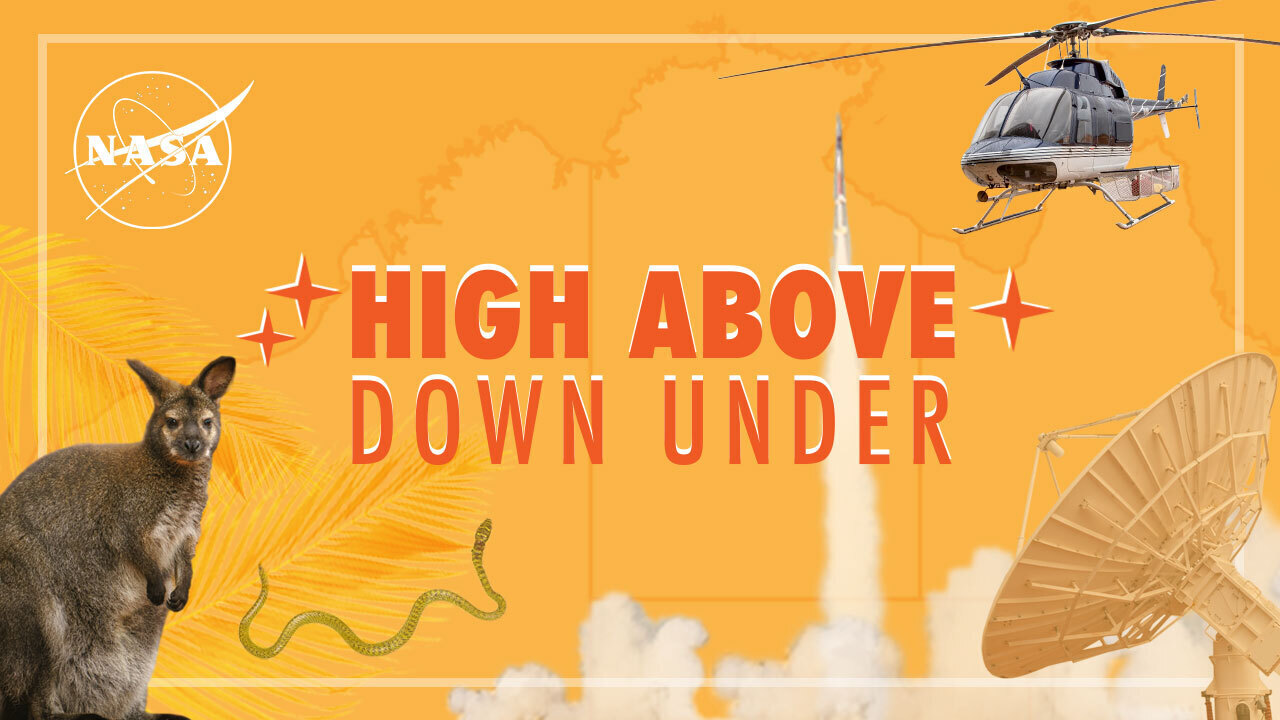
High Above Down Under Series
Go to this pageAround a different star, Earth may never have developed life at all. So what makes a star friendly to life? We joined two rocket teams as they traveled to the remote Northern Territory of Australia to capture light from our closest stellar neighbors to help reveal the answer. Follow their journey in the 6-part video series High Above Down Under. Episodes released weekly starting June 27, 2023. ||
- ID: 13932 Produced Video
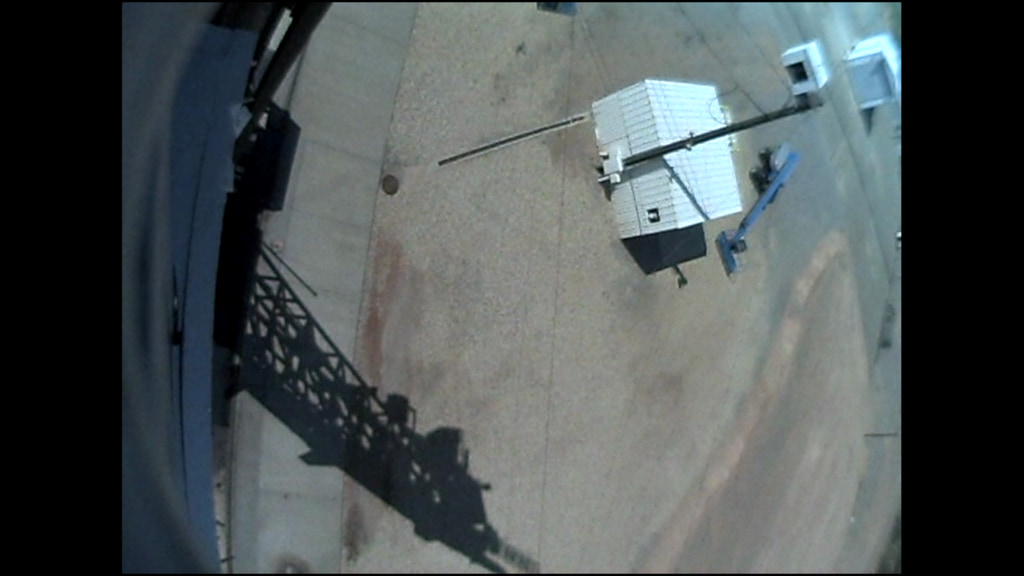
Riding Along With a NASA Sounding Rocket (2021)
Go to this pageOn Sept. 9, 2021, a sounding rocket launched from the White Sands Missile Range in New Mexico, carrying a copy of the Extreme Ultraviolet Variability Experiment, or EVE. This flight was used to calibrate the identical version of EVE that has flown in space since 2010 aboard NASA’s Solar Dynamics Observatory (SDO). Over the years, the space-based EVE has become degraded by intense sunlight, so scientists fly periodic calibration missions to keep EVE’s measurements sharp. ||
- ID: 13171 Produced Video
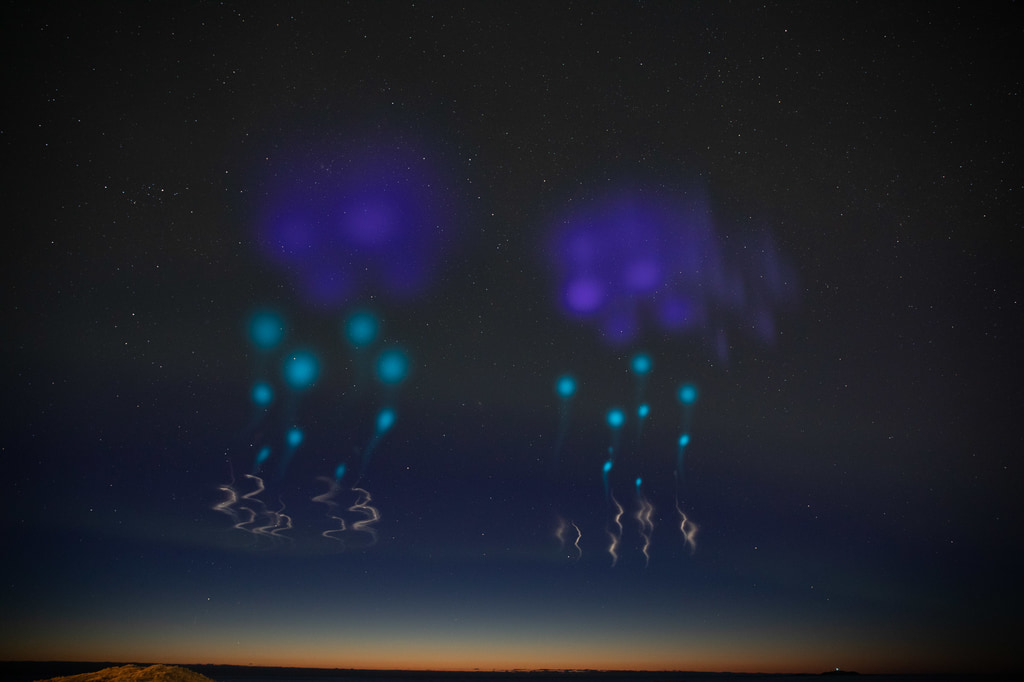
Grand Challenge Initiative - Cusp: Launch Photos & Videos
Go to this pageAZURE MissionColorful clouds formed by the release of vapors from the two AZURE rockets allow scientist to measure auroral winds.Credit: NASA/Lee Wingfield || Azure_ampule_release_print.jpg (1024x682) [97.8 KB] || Azure_ampule_release.jpg (2400x1600) [346.6 KB] || Azure_ampule_release_searchweb.png (320x180) [54.6 KB] || Azure_ampule_release_web.png (320x213) [67.1 KB] || Azure_ampule_release_thm.png (80x40) [4.6 KB] ||
- ID: 12598 Produced Video
![NASA Launches Sounding Rockets to Study AuroraMusic credit: Trial by Gresby Race Nash [PRS] from Killer Tracks.](/vis/a010000/a012500/a012598/LARGE_MP4-12598_SoundingRockets_MASTER_large.00745_print.jpg)
Sounding Rockets Highlights
Go to this pageNASA Launches Sounding Rockets to Study AuroraMusic credit: Trial by Gresby Race Nash [PRS] from Killer Tracks. || LARGE_MP4-12598_SoundingRockets_MASTER_large.00745_print.jpg (1024x682) [134.2 KB] || LARGE_MP4-12598_SoundingRockets_MASTER_large.00745_searchweb.png (320x180) [74.7 KB] || LARGE_MP4-12598_SoundingRockets_MASTER_large.00745_web.png (320x213) [92.8 KB] || LARGE_MP4-12598_SoundingRockets_MASTER_large.00745_thm.png (80x40) [5.3 KB] || 12598_SoundingRockets_MASTER.mov (1152x768) [579.8 MB] || PRORES_B-ROLL-12598_SoundingRockets_MASTER_prores.mov (1280x720) [590.8 MB] || APPLE_TV-12598_SoundingRockets_MASTER_appletv.m4v (1280x720) [41.0 MB] || NASA_TV-12598_SoundingRockets_MASTER.mpeg (1280x720) [280.2 MB] || LARGE_MP4-12598_SoundingRockets_MASTER_large.mp4 (1152x768) [85.0 MB] || YOUTUBE_HQ-12598_SoundingRockets_MASTER_youtube_hq.mov (1152x768) [105.8 MB] || LARGE_MP4-12598_SoundingRockets_MASTER_large.webm (1152x768) [8.9 MB] || APPLE_TV-12598_SoundingRockets_MASTER_appletv_subtitles.m4v (1280x720) [41.1 MB] || soundingrockets-v14.en_US.srt [1.1 KB] || soundingrockets-v14.en_US.vtt [1.1 KB] || NASA_PODCAST-12598_SoundingRockets_MASTER_ipod_sm.mp4 (320x240) [14.1 MB] ||
- ID: 40363 Gallery

Sounding Rockets
Go to this pageFor over 40 years, NASA's Sounding Rocket Program has provided critical scientific, technical, and educational contributions to the nation's space program and is one of the most robust, versatile, and cost-effective flight programs at NASA. Sounding rockets carry scientific instruments into space along a parabolic trajectory. Their overall time in space is brief, typically 5-20 minutes, and at lower vehicle speeds for a well-placed scientific experiment. The short time and low vehicle speeds are more than adequate (in some cases they are ideal) to carry out a successful scientific experiments. Furthermore, there are some important regions of space that are too low for satellites and thus sounding rockets provide the only platforms that can carry out measurements in these regions. Go to NASA.gov for the latest sounding rocket news.
- ID: 14944 Produced Video

Black Aurora Rocket Instrument Testing at NASA Goddard
Go to this pageNASA’s Black and Diffuse Aurora Science Surveyor sounding rocket mission has completed its testing campaign at NASA’s Goddard Space Flight Center in Greenbelt, Maryland, ahead of its launch. Sounding rocket missions like this one are suborbital rockets that fly scientific instruments into near-Earth space for short, approximately 15-minute flights. The mission will study so-called “black auroras,” dark patches and stripes that appear within an aurora. Previous research has hinted that they may be formed by electrons going upward escaping back out into space (rather than the absence of any electrons). The visible aurora is formed by an incoming downward stream of electrons. Scientists want to solve the puzzle as to why these patches and stripes form within the visible aurora. From Goddard, the instruments were delivered to Wallops Flight Facility, where they – along with the entire rocket payload – will be shipped to the Poker Flat Research Range in Fairbanks, Alaska, where the team aims to fly their rocket through black aurora. Onboard instruments will survey the electron populations as they fly through them to understand how and why these black patches and stripes form within the visible aurora. The mission is scheduled for launch no earlier than February 2026. ||
Balloons
Balloons have been used for decades to conduct scientific studies. They can be launched from locations across the globe and are a low-cost method to carry payloads with instruments that conduct scientific observations.
- ID: 14429 Produced Video
![NASA's Scientific Balloon Program OverviewComplete transcript available.Music Credit: “Enviro Tense” by Max Van Thun [GEMA] via Universal Production Music](/vis/a010000/a014400/a014429/14429_Balloon_Program_thumbnail.jpg)
NASA's Scientific Balloon Program
Go to this pageSince its establishment more than 30 years ago, NASA’s Balloon Program has provided high-altitude scientific balloon platforms for scientific and technological investigations, including fundamental scientific discoveries that contribute to our understanding of the Earth, the solar system, and the universe. This short video highlights several key discoveries made with NASA's scientific balloons.Visit nasa.gov/scientificballoons to learn more! ||
- ID: 14373 Infographic
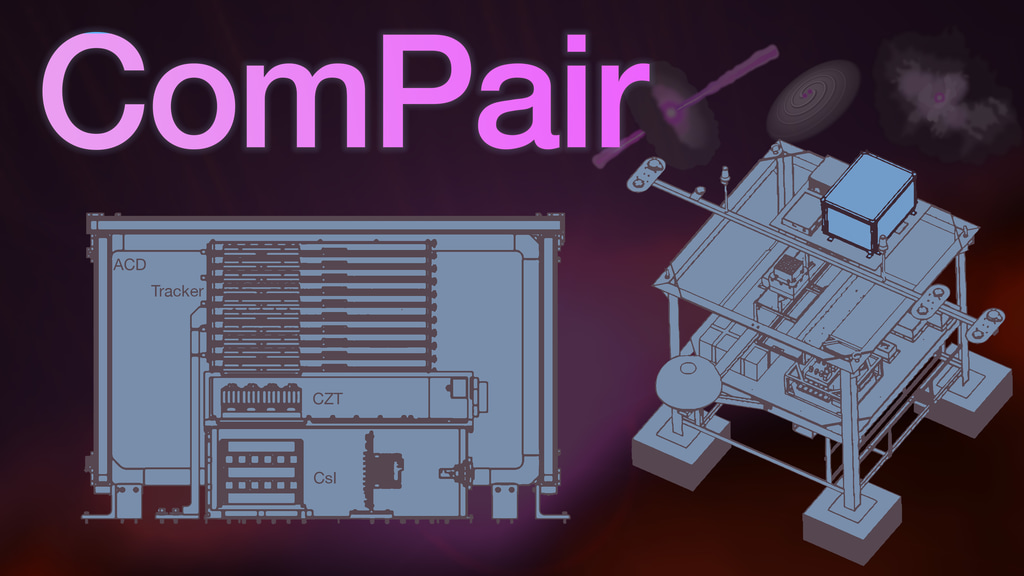
ComPair Infographic
Go to this pageExplore this infographic to learn more about ComPair and scientific ballooning.Credit: NASA’s Goddard Space Flight CenterMachine-readable PDF copy || ComPair_Infographic_Final.jpg (5100x6600) [3.3 MB] || ComPair_Infographic_Final.png (5100x6600) [11.7 MB] || ComPair_Infographic_Final-half.jpg (2550x3300) [1.3 MB] || ComPair_Infographic_Final-half.png (2550x3300) [3.8 MB] ||
- ID: 14197 Produced Video
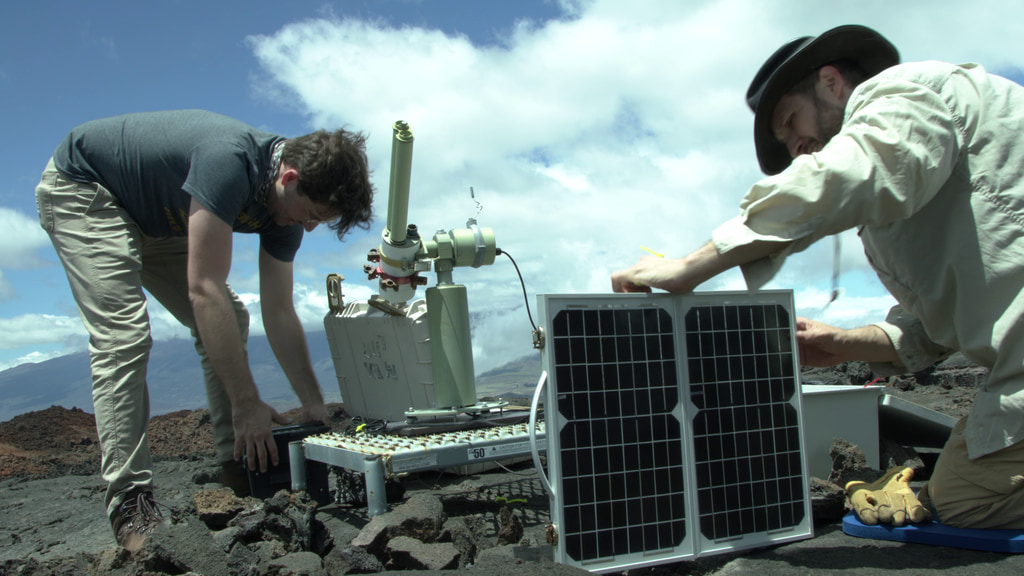
Scientists in the Field
Go to this pageVideo compiliations of NASA scientists and partners working in the field. Available to download. || Researchers in volcanic regions. Footage from GIFT in Hawaii. || Compilation2-MaunaLoa.00015_print.jpg (1024x576) [166.4 KB] || Compilation2-MaunaLoa.00015_searchweb.png (320x180) [102.7 KB] || Compilation2-MaunaLoa.00015_thm.png (80x40) [7.6 KB] || Compilation2-MaunaLoa.webm (3840x2160) [57.4 MB] || Compilation2-MaunaLoa.mp4 (3840x2160) [1.1 GB] ||
- ID: 13291 Produced Video
![Music credit: "Gear Wheels" by Fabrice Ravel Chapuis [SACEM] from Killer Tracks Complete transcript available.Watch this video on the NASA Goddard YouTube channel.](/vis/a010000/a013200/a013291/BITSE_ReadyForFlight_YouTube.00283_print.jpg)
NASA’s New Solar Scope Is Ready For Balloon Flight
Go to this pageNASA and the Korea Astronomy and Space Science Institute, or KASI, are getting ready to test a new way to see the Sun, high over the New Mexico desert. A pearlescent balloon — large enough to hug a football field — is scheduled to take flight no earlier than Aug. 26, 2019, carrying beneath it a solar scope called BITSE. BITSE is a coronagraph, a kind of telescope that blocks the Sun’s bright face in order to reveal its dimmer atmosphere, called the corona. Short for Balloon-borne Investigation of Temperature and Speed of Electrons in the corona, BITSE seeks to explain how the Sun spits out the solar wind. ||
- ID: 12968 Infographic
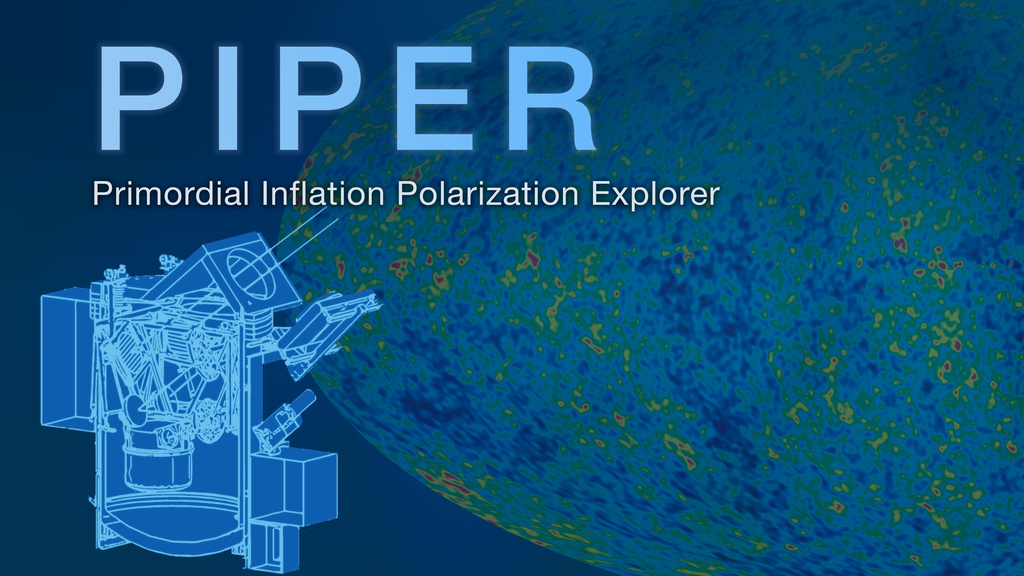
PIPER Infographic
Go to this pageThe Primordial Inflation Polarization Explorer (PIPER) is a NASA scientific balloon mission that will fly to the edge of Earth’s atmosphere to study twisty patterns of light in the universe’s “baby picture.” This infographic highlights some facts about PIPER’s instruments, capabilities and goals.Credit: NASA's Goddard Space Flight CenterMachine-readable PDF copy || PIPER_Infographic_FINAL_Medium.jpg (1500x1941) [902.2 KB] || PIPER_Infographic_FINAL_Small.jpg (1000x1294) [469.6 KB] || PIPER_Infographic_FINAL.jpg (5100x6600) [6.6 MB] || PIPER_Infographic_FINAL.png (5100x6600) [15.3 MB] || PIPER_Infographic_FINAL_Half.jpg (2550x3300) [1.7 MB] || PIPER_Infographic_FINAL_Half.png (2550x3300) [6.9 MB] ||
- ID: 12262 Produced Video
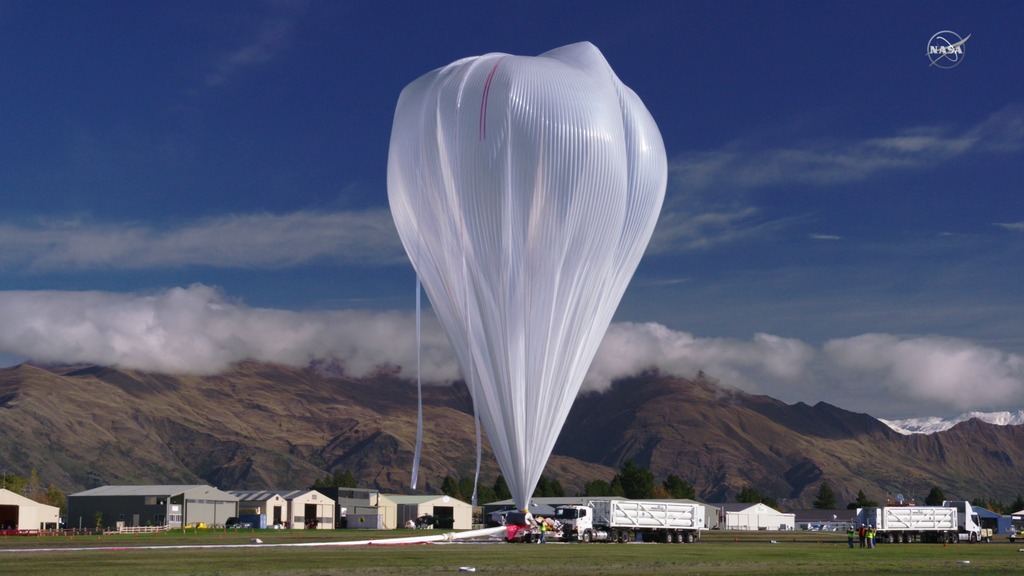
NASA Launches Super-Pressure Balloon
Go to this pageNASA successfully launched a super pressure balloon (SPB) from Wanaka Airport, New Zealand, at 11:35 a.m. Tuesday, May 17, (7:35 p.m. EDT Monday, May 16) on a potentially record-breaking, around-the-world test flight.The balloon flies at an altitude of about 110,000 feet, in a layer of Earth's atmosphere known as the stratosphere.The purpose of the flight is to test and validate the SPB technology with the goal of long-duration flight (100+ days) at mid-latitudes. In addition, the gondola is carrying the Compton Spectrometer and Imager (COSI) gamma-ray telescope as a mission of opportunity.Another mission of opportunity is the Carolina Infrasound instrument, a small, 3-kilogram payload with infrasound microphones designed to record acoustic wave field activity in the stratosphere. Developed by the University of North Carolina at Chapel Hill, previous balloon flights of the instrument have recorded low-frequency sounds in the stratosphere, some of which are believed to be new to science.As the balloon travels around the Earth, it may be visible from the ground, particularly at sunrise and sunset, to those who live in the southern hemisphere’s mid-latitudes, such as Argentina and South Africa.NASA’s scientific balloons offer low-cost, near-space access for conducting scientific investigations in fields such as astrophysics, heliophysics and atmospheric research.NASA’s Wallops Flight Facility in Virginia manages the agency’s scientific balloon flight program with 10 to 15 flights each year from launch sites worldwide. Orbital ATK, which operates NASA’s Columbia Scientific Balloon Facility in Palestine, Texas, provides mission planning, engineering services and field operations for NASA’s scientific balloon program. The CSBF team has launched more than 1,700 scientific balloons in the over 35 years of operation.Track the flight's progress in real-time here. ||
- ID: 40491 Gallery
Balloons
Go to this pageSince its establishment more than 30 years ago, the NASA Balloon Program has provided high-altitude scientific balloon platforms for scientific and technological investigations, including fundamental scientific discoveries that contribute to our understanding of the Earth, the solar system, and the universe. Balloons have been used for decades to conduct scientific studies. They can be launched from locations across the globe and are a low-cost method to carry payloads with instruments that conduct scientific observations. The primary objective of the NASA Balloon Program is to provide high altitude scientific balloon platforms for scientific and technological investigations. These investigations include fundamental scientific discoveries that contribute to our understanding of the Earth, the solar system, and the universe. Scientific balloons also provide a platform for the demonstration of promising new instrument and spacecraft technologies that enable or enhance the objectives for the Science Mission Directorate Strategic Plan.
CubeSats
CubeSats are a class of nanosatellites that use a standard size and form factor. CubeSats now provide a cost effective platform for science investigations, new technology demonstrations and advanced mission concepts using constellations, swarms disaggregated systems.
- ID: 20371 Animation
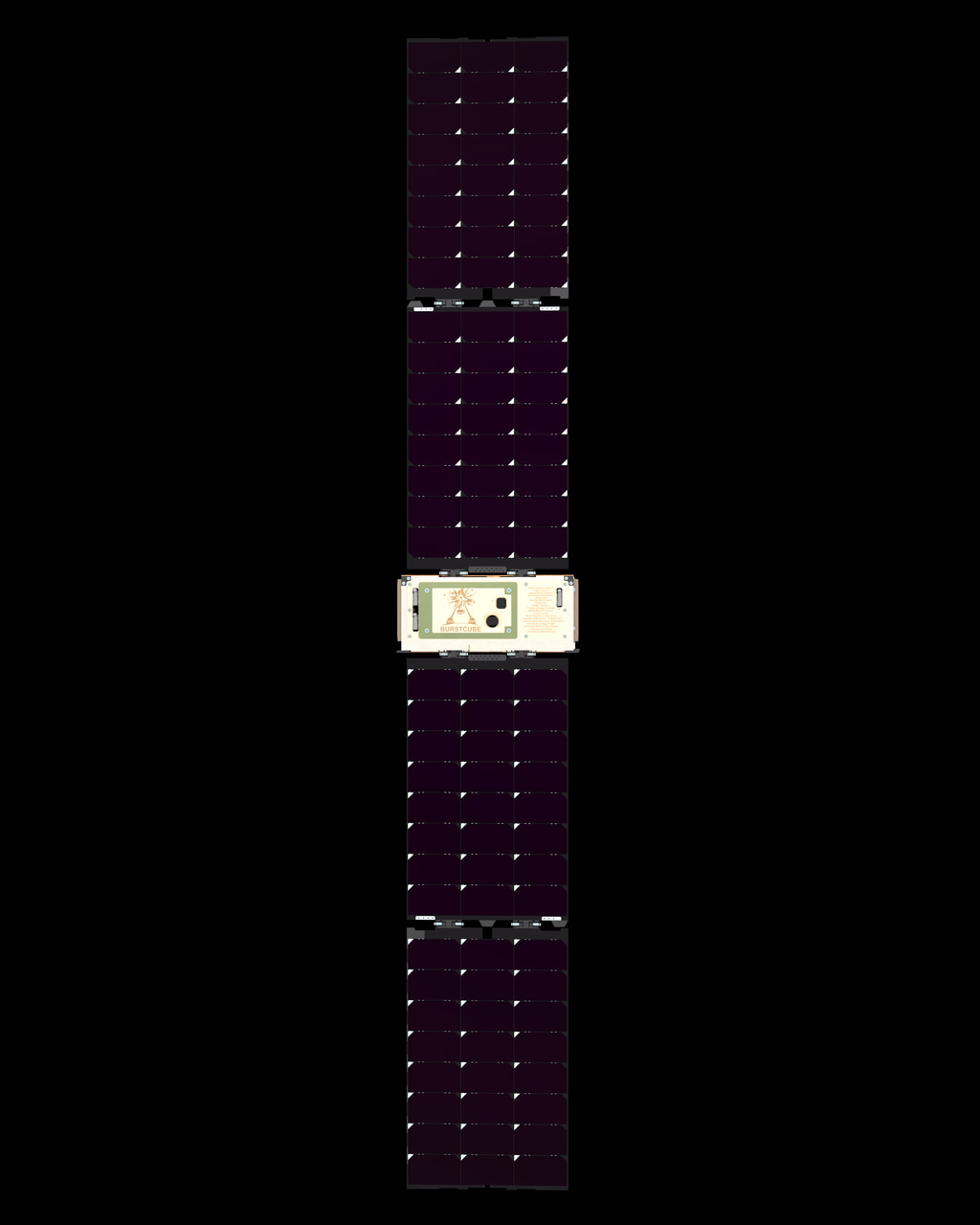
BurstCube Animations
Go to this pageBurstCube is a mission under development at NASA’s Goddard Space Flight Center in Greenbelt, Maryland. This CubeSat will detect short gamma-ray bursts, which are important sources for gravitational wave discoveries and multimessenger astronomy. The satellite is expected to launch in 2023. ||
- ID: 14195 Produced Video
Artemis I
Go to this pageNASA’s Artemis missions are returning humanity to the Moon and beginning a new era of lunar exploration. This year, the agency plans to launch the Artemis I mission, an uncrewed test flight that will take a human-rated spacecraft farther than any before. ||
- ID: 20338 Animation

SunRISE Beauty Pass
Go to this pageA coronal mass ejection (CME) erupts from the Sun and sends Type II radio bursts ahead of it. SunRISE measures the radio bursts and transmits the data to NASA’s Deep Space Network. Type II radio bursts are the earliest indicators of shocks from a solar eruption and can provide information on solar energetic particle (SEP) events. || SUNRISE-shot1_v06_4k_30fps_ProRes422.00240_print.jpg (1024x576) [172.5 KB] || SUNRISE-shot1_v06_4k_30fps_ProRes422.00240_searchweb.png (320x180) [87.2 KB] || SUNRISE-shot1_v06_4k_30fps_ProRes422.00240_thm.png (80x40) [5.9 KB] || SUNRISE-shot1_v06_4k_30fps_ProRes422.mov (3840x2160) [695.8 MB] || SUNRISE-shot1_v06_4k_30fps_h264.mp4 (3840x2160) [13.7 MB] || SUNRISE-shot1_v06_4k (3840x2160) [32.0 KB] || SUNRISE-shot1_v06_4k_30fps_ProRes422.webm (3840x2160) [5.3 MB] ||
- ID: 12957 Produced Video
![Music: Charming Noise by Adrien Sahuc [SACEM], Benjamin Sahuc [SACEM]Complete transcript available.](/vis/a010000/a012900/a012957/Screen_Shot_2018-05-14_at_5.20.10_PM.png)
During a Year in Orbit, IceCube Created a New Map of Earth's Clouds
Go to this pageMusic: Charming Noise by Adrien Sahuc [SACEM], Benjamin Sahuc [SACEM]Complete transcript available. || Screen_Shot_2018-05-14_at_5.20.10_PM.png (1536x858) [868.8 KB] || Screen_Shot_2018-05-14_at_5.20.10_PM_print.jpg (1024x572) [51.8 KB] || Screen_Shot_2018-05-14_at_5.20.10_PM_searchweb.png (320x180) [39.5 KB] || Screen_Shot_2018-05-14_at_5.20.10_PM_thm.png (80x40) [3.9 KB] || 12957_IceCube.webm (960x540) [31.6 MB] || 12957_IceCube_large.mp4 (1920x1080) [80.1 MB] || 12957_IceCube.en_US.srt [1.2 KB] || 12957_IceCube.en_US.vtt [1.2 KB] || YOUTUBE_1080_12957_IceCube_youtube_1080.mp4 (1920x1080) [127.0 MB] || a012957_IceCubeviz_textfree.mov (1920x1080) [2.1 GB] || during-a-year-in-orbit-icecube-created-a-new-map-of-earths-clouds.hwshow [365 bytes] ||
- ID: 40457 Gallery
CubeSats
Go to this pageCubeSats are a class of nanosatellites that use a standard size and form factor. The standard CubeSat size uses a "one unit" or "1U" measuring 10x10x10 cms and is extendable to larger sizes; 1.5, 2, 3, 6, and even 12U. Originally developed in 1999 by California Polytechnic State University at San Luis Obispo (Cal Poly) and Stanford University to provide a platform for education and space exploration. The development of CubeSats has advanced into it's own industry with government, industry and academia collaborating for ever increasing capabilities. CubeSats now provide a cost effective platform for science investigations, new technology demonstrations and advanced mission concepts using constellations, swarms disaggregated systems.