2004 Earth Feature Story
Special: The Benefits of Hydrologic Predictability
Each year, millions of gallons of water that flow through our rivers and tributaries offer a massive source of renewable energy—hydropower. It’s clean and efficient, currently supplying about 10 percent of the electricity in the United States and up to 70 percent of electricity demand in the Pacific Northwest. Unlike some other energy sources, hydropower does not produce greenhouse gases or air pollution. With so much at stake for U.S. citizens and those who manage water systems, improving long-lead forecasts of river streamflow can allow operators of large reservoirs to plan for expected inflows and produce hydropower more efficiently. Anticipated seasonal inflows are also of importance to large users of water, such as irrigators and farmers and hydropower reservoirs also contribute to local economies. A study of one medium-sized hydropower project in Wisconsin showed that the recreational value to residents and visitors exceeded $6.5 million annually.
HOW HYDROPOWER WORKS
Item 1
Credit: U.S. Dept. of Energy
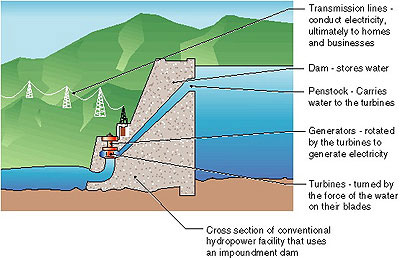
The most common type of hydroelectric power plant is an impoundment facility. This is typically a large system, and uses a dam to store river water in a reservoir. Water released from the reservoir flows through a turbine, spinning it, which in turn activates a generator to produce electricity. The water may be released either to meet changing electricity needs or to maintain a constant reservoir level.
Advances in long-lead climate forecasting have made it possible to produce useful streamflow forecasts further in advance, but many are based on only one or two variables, such as snowpack estimates. Additionally, few studies have explored the economic value of hydrologic predictability. To examine the economic benefit of incorporating additional data into long-lead forecasts, scientists Edwin Maurer of Santa Clara University and Dennis Lettenmaier at the University of Washington, linked remote conditions, such as tropical sea surface temperatures, land surface moisture levels and regional climate to streamflow in the Missouri River basin. “Many studies have suggested that combining better land moisture data with forecasts of distinct, long-term weather patterns created by atmospheric phenomena like El Niño/Southern Oscillation (ENSO) would be of value to the water management community. We attempted to quantify this, gaining insight into the relative effects of each new source of information,” said Maurer.
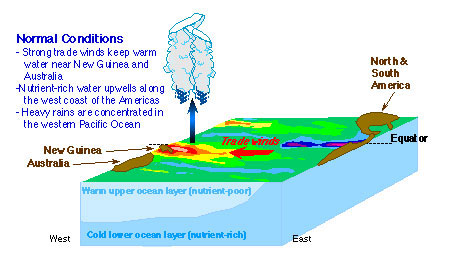
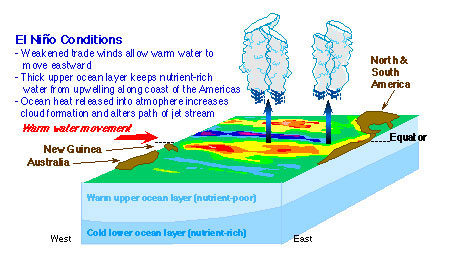
El Niño / Southern Oscillation (ENSO) marks a see-saw shift in surface air pressure between Darwin, Australia and the South Pacific Island of Tahiti. When the pressure is high at Darwin it is low at Tahiti and vice versa. El Niño, and its sister event La Niña, are the extreme phases of this southern oscillation, with El Niño referring to a warming of the eastern tropical Pacific, and La Niña a cooling. Lettenmaier said “the ENSO condition is one of the most valued tools in any long-term forecast because it has major consequences on weather patterns and is generally well understood.”
Items 2 and 3
Credit: NASA JPL
These sea surface temperature (SST) anomalies--departures from the mean state--change atmospheric wind patterns in the mid-latitudes in winter and spring, shifting the way moist air gets transported in the atmosphere, directly affecting U.S. precipitation, snow accumulation and soil moisture, which in turn impacts water runoff into river basins.
The researchers used data from the NOAA/NASA North American Land Data Assimilation project (NLDAS) to produce model simulations that considered several atmospheric variables, including soil moisture. “Errors in long-lead forecasts are often traced back in part to inaccuracies in the observed initial conditions used to make the forecast, said Lettenmaier. NLDAS is working to refine this information.” Snow and soil moisture data are currently produced using images from NASA’s Moderate Resolution Imaging Spectroradiometer (MODIS) and the Advanced Microwave Scanning Radiometer (AMSR). NASA’s Hydrosphere State Mission (HYDROS), scheduled for launch in 2010, will provide the first global views of Earth's changing soil moisture and land surface freeze/thaw conditions, leading to breakthroughs in water, energy and carbon management.
Item 3
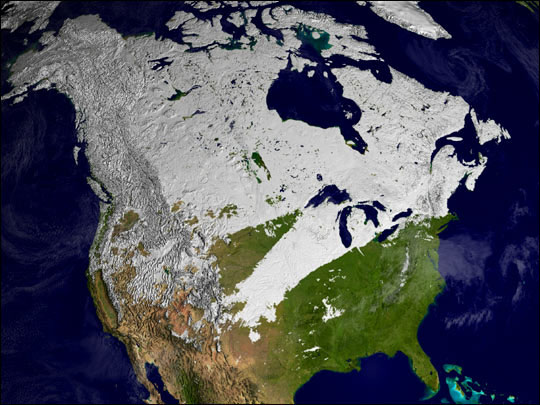
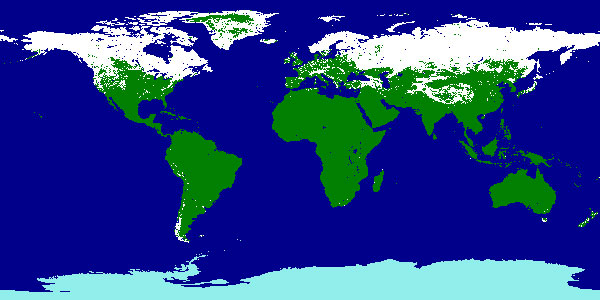
The Moderate Resolution Imaging Spectroradiometer (MODIS), flying aboard NASA’s Terra and Aqua satellites, measures snow cover over the entire globe every day, cloud cover permitting. At spatial resolutions of up to 500 meters per pixel, MODIS allows scientists to distinguish between snow and clouds, both of which appear bright white when seen from above at true-color wavelengths.
The image above shows snow cover (white pixels) across North America from February 2-9, 2002. Click the links above to access time series animations showing changes in snow cover during the winter of 2001-02. As you play the movies, notice how snow cover begins to build up in the early fall and melts by late spring in the Northern Hemisphere.
Item 4
This image was derived from the "8-Day CMG Snow Cover" field of the MODIS/Terra Snow Cover 8-Day L3 Global 0.05Deg CMG data set, available from NSIDC. The product consists of a global map of snow cover extent, expressed as a fraction of snow in each CMG cell, for an eight-day period.
The study’s findings, published in the January 2004 issue of Journal of Climate show that use of climate forecast information combined with better snow water content and soil moisture data can improve runoff predictions in ways that might yield some economic value. A typical goal of water management is to keep reservoirs as full as possible, while minimizing spill, to maintain maximum hydropower production. Hydropower's operational flexibility and its unique ability to change output allows water managers to respond effectively to forecast data. For example, if water system managers were warned of an upcoming dry season, they would likely retain higher than normal water levels, usually by reducing the amount of water typically evacuated from the system. Clearly, “improved and additional predictability, and thus a reduced uncertainty in flow volumes, translates into greater hydropower benefits,” said Maurer.
Some river basins, including the Missouri, have such large storage capacities that variations in annual inflow have little impact on hydropower generation. In the study, hydropower benefits increased by only 1.8 percent, from $530 million to $540 million.
Item 5
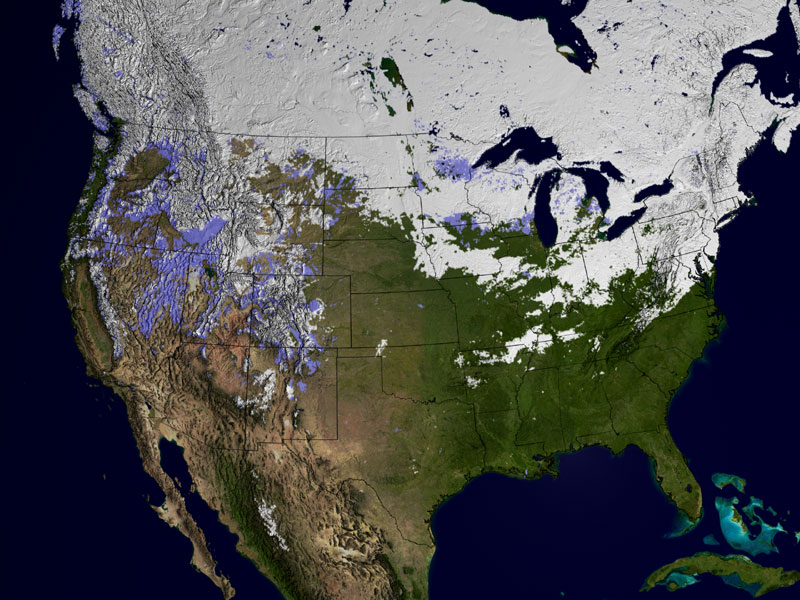
This image displays the snow cover from February 21, 2003 in white. Areas with snow cover on February 21, 2002 but not on February 21, 2003 are shown in blue.
Credit: NASA
Item 6
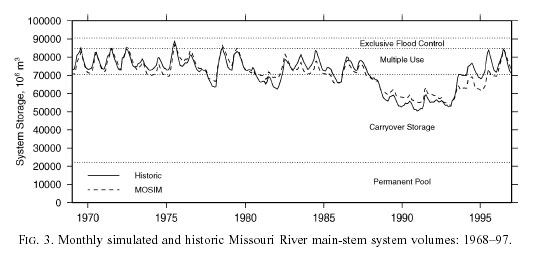
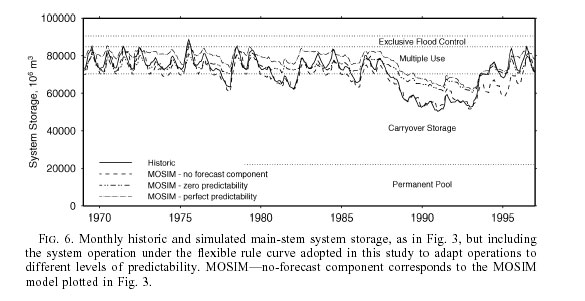
Monthly simulated and historic Missouri River main stem system volumes, 1968-1997.
Credit: Edwin P. Maurer, Santa Clara University
Item 7
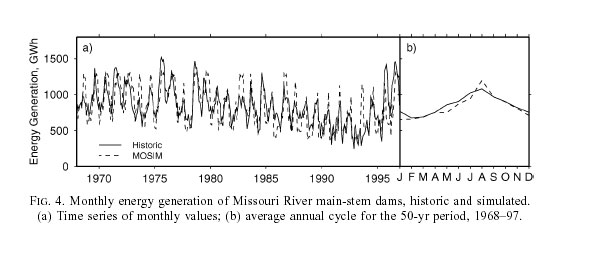
Monthly energy generation of Missouri River main stem dams, historic and simulated.
Credit: Edwin P. Maurer, Santa Clara University
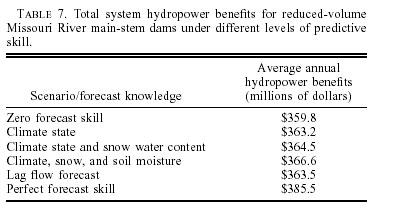
But, smaller water systems are more influenced by changing environmental conditions and thus carry greater potential benefits from improved long-lead forecasts. To simulate the effects of predictability on a smaller system, a hypothetical, reduced storage system was developed. A 7.1 percent increase in hydropower benefits was observed, representing about $25.7 million annually. Of this total, incorporating currently available climate forecasts, such as the development of El Niño or La Niña conditions, was shown to be the most important factor in predicting future streamflow. Accurate information on soil moisture provided the bulk of the remaining benefits, while snow water content data carried less hydropower benefit. It should also be noted that actions taken by water resource managers in light of forecasts are at least partially driven by the operating rules governing their reservoir system.
Item 8
Ratio of system volume to annual system inflow versus the percent difference between perfect and no forecast skill for past studies and the current study.
Credit: Edwin P. Maurer, Santa Clara University
Item 9
Total system hydropower benefits for reduced-volume Missouri River main stem dams under different levels of predictive skill.
Credit: Edwin P. Maurer, Santa Clara University
A seasonal analysis conducted by Maurer and Lettenmaier pointed to a general decrease in predictability with increasing lead time, high levels of predictability for winter runoff at short lead times, and the importance soil moisture and snow water content for improved runoff predictability. Furthermore, the economic payoffs for improved predictions were found to be most significant in the winter and spring, when climate and land surface conditions can provide information about the large inflows in the spring and summer.
Item 10
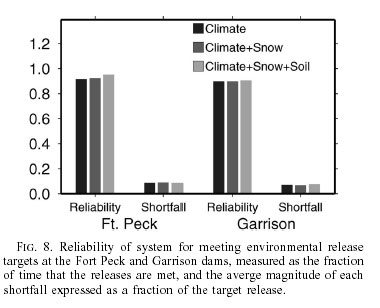
Average annual Hydropower benefits above a no forecast skill scenario with the specified level of predictability in the current month, and no skill in other months.
Credit: Edwin P. Maurer, Santa Clara University
While the study found that forecasts considering additional variables carry some economic benefits for water managers in hydropower generation, Maurer says correlating their findings to “smaller systems could definitely provide insight on other issues that are of great importance to emergency planners and communities, such as flood control.”
While the study only considered hydropower impacts of added hydrologic predictability, since they are the dominant benefits for the Missouri River reservoirs, improved long-lead forecasts of anticipated river inflows can also impact downstream navigation, habitat protection and recreation. The reservoirs formed by hydroelectric dams also often provide many water-based recreational opportunities including fishing, water sports, and boating. Many hydro operators own a significant amount of land around many reservoirs that is open to the public for uses including hiking, hunting and skiing. These may be larger factors in other basins, and would bring new dimensions to the value of predictability and the importance of better defining the land surface moisture and SST conditions.
For more information contact:
Mike Bettwy
NASA Goddard Space Flight Center
Greenbelt, MD 20771
Phone: 301-286-3026
To read about what El Niño is, click here.