|
|
A Virtual Eros -- Take a 3-D Spin Around 433 Eros
Read the Official Press Release
Introduction
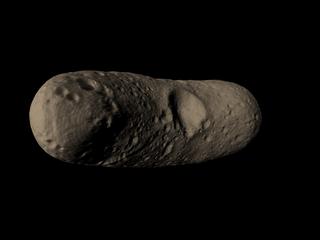
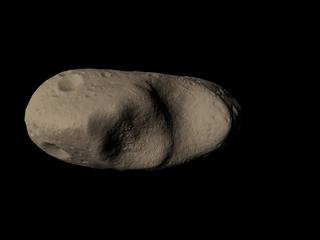
Scientists are releasing new highly detailed 3-D
views of the near-Earth asteroid 433 Eros. The images were not
captured by a camera, but are the product of over 8 million
observations from the NEAR Laser Rangefinder (NLR). Scientists use
the data from the NLR to build detailed models of Eros's shape. NEAR
team members use this information to help them understand the
asteroid's evolution and internal structure. The model can then be
used to generate a virtual tour of the asteroid 433 Eros.
Take asteroid 433 Eros Tour
433 EROS - IN 3-D
View Images and Animations
Scientists are releasing highly detailed 3-D views of the near-Earth
asteroid 433 Eros. The images were not captured by a camera, but are
the product of over 8 million observations from the NEAR Laser
Rangefinder (NLR). The NLR measures heights on Eros' surface by
determining the time short pulses of laser light take to travel from
the spacecraft to the asteroid and back. NEAR team members use this
information to build detailed models of Eros' shape, which in turn
help them understand the asteroid's collisional evolution and
internal structure. The shape of Eros also provides a context for
interpreting images and compositional information.
A VIRTUAL EROS
View Images and Animations
This sequence combines the topographic model of Eros generated by the
NEAR Laser Rangefinder (NLR) with colors sampled from other Eros
images. Scientists can examine the asteroid from any angle to help
them understand the asteroid's collisional evolution and internal
structure. The shape of Eros also provides a context for interpreting
images and compositional information.
BEST SKI SLOPES ON EROS
The asteroid's shape, density and spin combine to create a bizarre
pattern of what is "uphill" and "downhill". In this view, a map of
"gravity slope" has been painted onto the topographic model generated
by the NEAR Laser Rangefinder (NLR). A ball would tend to roll
fastest in the red regions and would tend to stay put in the blue
regions.
NEAR LASER RANGEFINDER ANIMATION
Animation of the NEAR Laser Rangefinder (NLR). The NLR measures
heights on Eros' surface by determining the time short pulses of
laser light take to travel from the spacecraft to the asteroid and
back. The elevations of points on the surface of Eros are determined
by subtracting the laser-derived distance between the spacecraft and
the surface from the distance between the spacecraft and Eros' center
of mass, as determined from radio tracking.
This multimedia project is the work of a dedicated team of researchers,
animators, and media specialists. A companion video to this web site is
available from NASA-TV. Below are a list of agencies, departments, and
researchers who provided expertise and data for this production:
Please give credit for these images to:
NASA - Goddard Space Flight Center
Johns Hopkins University Applied Physics Laboratory (JHUAPL)
NEAR Laser Rangefinder (NLR)
Last Revised: June 23, 2006 at 05:06 PM EDT
|
|