Space Weather
Overview
The term "space weather" was coined not long ago to describe the dynamic conditions in the Earth's outer space environment, in the same way that "weather" and "climate" refer to conditions in Earth's lower atmosphere. Space weather includes any and all conditions and events on the sun, in the solar wind, in near-Earth space and in our upper atmosphere that can affect space-borne and ground-based technological systems and through these, human life and endeavor. Heliophysics is the science of space weather.
This gallery organizes satellite footage, animations, visualizations, and edited videos produced at the Goddard Space Flight Center. Visualizations are different from pure animations because they are data-driven. They present a way of "seeing" the data. In the case of orbit visualizations, they are based on actual orbit information. Most of the animations and visualizations are available as frames and all the recent ones are HD quality. All videos are available in several formats and qualities including Apple ProRes for broadcast quality. Unless specifically marked otherwise, all these materials are public domain and free to use. For more infomation about NASA's media use guidelines see this page.
The content is organized in two ways. Under "Facets of Space Weather" you will find our visuals grouped by the subject they address. Under "NASA Spacecraft" you will find our visuals grouped by the satellite they were collected by, or that they refer to. This group also contains animations of the spacecraft themselves.
For breaking news solar events, go to this gallery.
For frequently-asked-question interviews with NASA scientists, go here.
Facets of Space Weather
 Link
LinkSolar Wind
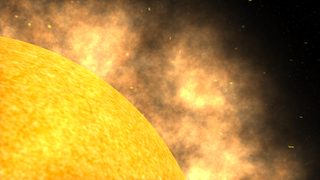
Solar wind is the plasma of charged particles (protons, electrons, and heavier ionized atoms) coming out of the Sun in all directions at very high speeds -- an average of about 400 km/sec, almost a million mph! It is responsible for the anti-sunward tails of comets and the shape of the magnetic fields around the planets. Solar wind can also have a measurable effects on the flight paths of spacecraft.
Go to this link
The solar wind varies routinely through the 27-day rotation of the Sun, as well as sporadically, in response to violent eruptions in the corona. These eruptions can result in geomagnetic storms on Earth.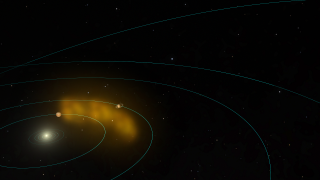 Link
LinkCoronal Mass Ejections (CMEs)
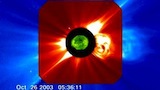
The outer solar atmosphere, the corona, is structured by strong magnetic fields. Where these fields are closed, often above sunspot groups, the confined solar atmosphere can suddenly and violently release bubbles of gas and magnetic fields called coronal mass ejections. A large CME can contain a billion tons of matter that can be accelerated to several million miles per hour in a spectacular explosion. Solar material streams out through the interplanetary medium, impacting any planet or spacecraft in its path. CMEs are sometimes associated with flares but can occur independently.
Go to this link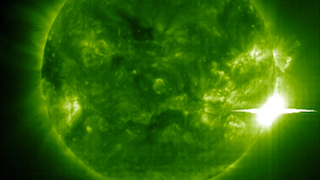 Link
LinkSolar Flares
A solar flare is an intense burst of radiation coming from the release of magnetic energy associated with sunspots. Flares are our solar system's largest explosive events. They are seen as bright areas on the sun and they can last from minutes to hours. We typically see a solar flare by the photons (or light) it releases, at most every wavelength of the spectrum. The primary ways we monitor flares are in x-rays and optical light. Flares are also sites where particles (electrons, protons, and heavier particles) are accelerated.
Go to this link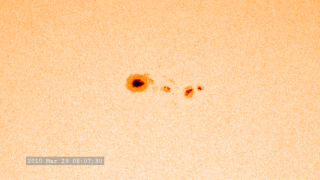 Link
LinkSunspots
Sunspots, dark areas on the solar surface, contain strong magnetic fields that are constantly shifting. A moderate-sized sunspot is about as large as the Earth. Sunspots form and dissipate over periods of days or weeks. They occur when strong magnetic fields emerge through the solar surface and allow the area to cool slightly; this area appears as a dark spot in contrast with the very bright photosphere of the sun. The rotation of these sunspots can be seen on the solar surface. Groups of sunspots, especially those with complex magnetic field configurations, are often the sites of solar flares. The average number of sunspots regularly waxes and wanes in an 11-year (on average) solar or sunspot cycle.
Go to this link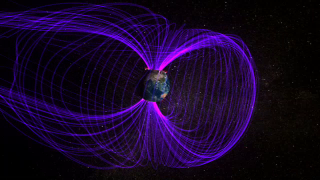 Link
LinkMagnetosphere
A magnetosphere is the region surrounding a planet where the planet's magnetic field dominates. Because the ions in the solar plasma are charged, they interact with these magnetic fields, and solar wind particles are swept around planetary magnetospheres. The shape of the Earth's magnetosphere is the direct result of being blasted by solar wind. Solar wind compresses its sunward side to a distance of only 6 to 10 times the radius of the Earth. A supersonic shock wave called the bow shock is created sunward of Earth. Most of the solar wind particles are heated and slowed at the bow shock and detour around the Earth. Solar wind drags out the night-side magnetosphere, called the magnetotail. Many other planets in our solar system have magnetospheres of similar, solar wind-influenced shapes.
Go to this link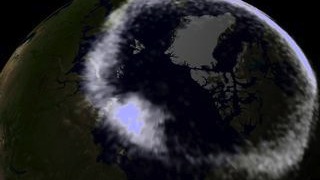 Link
LinkAurorae
An aurora is a natural display of light in the sky that can be seen with the unaided eye at night. An auroral display in the Northern Hemisphere is called the aurora borealis, or the northern lights. A similar phenomenon in the Southern Hemisphere is called the aurora australis. Auroras are the most visible effect of the sun's activity on the Earth's atmosphere.
Go to this link
Auroral displays are associated with the solar wind, the continuous flow of electrically charged particles from the sun. When these particles reach the earth's magnetic field, some get trapped. Many of these particles travel toward the Earth's magnetic poles. When the charged particles strike atoms and molecules in the atmosphere, energy is released. Some of this energy appears in the form of auroras.